Gravton Motors
Electric Two Wheeler Charging in India: Do You Really Need Public Chargers?
Charging infrastructure is the most common worry about going electric. For two-wheelers it is also the most overstated one. Here is how electric two wheeler charging really works, and when range and a normal wall socket make public chargers optional.
By Gravton Motors|26 October 2026|10 min read
Ask anyone thinking about an electric two-wheeler what worries them most and the answer is usually the same: where will I charge it? It is a fair question, and for most riders an outdated one. Electric two wheeler charging works very differently from filling a petrol tank, and once you see how, the infrastructure debate looks much smaller than the headlines suggest.
The Short Answer
For most riders, electric two wheeler charging happens at home or at work from an ordinary 3 pin socket, not at public stations. Two-wheelers sit parked for most of the day and cover short distances, so an overnight charge handles daily needs.
Range decides how often you charge. The Gravton Quanta S+ has a claimed range of 165 KM and charges from a standard 3 pin socket with its portable charger, in approximately 5.4 hours for a full charge. At a planning range of about 125 KM, that is roughly three days of a 40 km daily commute between charges.
Public charging and battery swapping still matter for long trips, riders with no home or workplace power, and delivery fleets.
How Electric Two Wheeler Charging Works in India
There are five ways to handle electric two wheeler charging in India. They differ in speed, cost and, above all, in how much new infrastructure they need.
| Method | Where | Strength | Limitation |
|---|---|---|---|
| Home 3 pin socket | Garage, parking area, home | Cheapest and needs no new infrastructure. Charges while you sleep | Needs a socket near where you park |
| Workplace or campus | Office, college, factory | Tops up while the vehicle is parked anyway | Depends on employer permission and power access |
| Public slow (AC) charging | Malls, parking lots, petrol stations | Useful for top-ups while you shop or eat | Patchy coverage and varied apps, payment methods and connectors |
| Public fast (DC) charging | Highways and charging hubs | Quick top-ups on longer journeys | Built largely for cars. Few two-wheeler compatible points, and heavy fast-charging use can affect battery life depending on the pack |
| Battery swapping | Swap stations run by network operators | A fresh battery in minutes, no waiting | Needs a swappable battery model and a nearby network |
Public networks for electric two wheeler charging in India are growing, helped by government schemes such as PM E-DRIVE that fund charging infrastructure, but coverage is uneven and concentrated in larger cities. The point of this guide is that a two-wheeler rider does not have to wait for that network to mature.
Where Most Electric Two Wheeler Charging Really Happens
Think about how a two-wheeler is actually used. It spends most of its life parked. It covers a modest distance each day. And the energy it needs to refill that distance is small, small enough to come from the same kind of socket that runs a table fan.
A petrol rider makes a trip to the pump every week or so, and the pump has to exist. An electric rider with a socket near the parking spot refuels while asleep, and the "station" is already in the house. For this group, electric two wheeler charging is closer to charging a phone than to filling a tank. It happens in the background of the day.
This is why the loudest worry about charging infrastructure often comes from people who have not yet looked at their own daily distance. For a rider covering 30 to 60 km a day with parking access to a socket, electric two wheeler charging at public stations is a backup, not a daily need.
The Real Pain Points of Electric Two Wheeler Charging
Electric two wheeler charging worries are real, but they are not all about the public network. Separating them shows which ones a better vehicle can solve.
- No socket where you park. Apartment dwellers with shared or distant parking face the hardest version of this. It is a parking and permission problem, not a network problem.
- Range that barely covers the day. If a vehicle's usable range is close to your daily distance, one missed charge leaves you stranded and you start planning your life around the battery. This is the most common source of range anxiety.
- A patchy public network. Finding a working public charger that fits your vehicle, with an app you have installed, is still inconsistent in many cities.
- Charging time versus expectation. Riders used to a two-minute pump stop expect speed. Overnight charging removes the wait, but only if you switch your thinking.
- Poor home wiring. Loose sockets, missing earthing and overloaded extension boards are a safety issue and a reason some riders hesitate.
- Trips beyond range. Intercity rides need planning. This is where public charging has genuine value.
Notice that only two of these six depend on public infrastructure. The others depend on range, parking and wiring, and a vehicle with more range softens most of them.
Range Is the Charging Infrastructure You Carry With You
Every kilometre of range you carry is a kilometre you do not need a charger for. A vehicle with a small battery has to be plugged in almost every night and leaves no margin when plans change. A vehicle with a large margin turns charging from a daily chore into an occasional routine.
Range is a substitute for infrastructure. The more you carry, the less you depend on anyone else's charger.
This is the core of the argument for a motorcycle such as the Quanta S+, because easier electric two wheeler charging comes from carrying more range. Its claimed range of 165 KM is roughly double that of many entry-level electric scooters, which means a rider covering a typical daily distance goes days between charges rather than hours.
How More Range Eases Electric Two Wheeler Charging
The table below shows how many days a full charge lasts at different daily distances. It uses a 25 percent buffer on claimed range to allow for real-world conditions, so the planning range is 75 percent of the claim.
| Vehicle (claimed range) | Planning range | 30 km a day | 40 km a day | 60 km a day | 80 km a day |
|---|---|---|---|---|---|
| An 80 KM class two-wheeler | About 60 km | 2.0 days | 1.5 days | 1.0 day | 0.75 day |
| Gravton Quanta S (125 KM) | About 94 km | 3.1 days | 2.3 days | 1.6 days | 1.2 days |
| Gravton Quanta S+ (165 KM) | About 124 km | 4.1 days | 3.1 days | 2.1 days | 1.5 days |
Method: planning range is 75 percent of claimed range; days between charges is planning range divided by daily distance. Actual range varies with load, speed, terrain, temperature and riding pattern.
Look at the 40 km row. The 80 KM class vehicle needs charging about every day and a half, roughly 20 times a month. The Quanta S+ needs it about every three days, roughly 10 times a month. Twice the range means about half the electric two wheeler charging events, and a far bigger cushion when you forget to plug in, take a longer route or give someone a lift.
At 80 km a day the 80 KM class vehicle cannot complete a day on one charge, which is where public charging becomes necessary. The S+ still gets through a full day with margin. That is the practical difference between "charging infrastructure is my problem" and "charging infrastructure is a convenience".
Quanta S+ and the 3 Pin Socket
Range reduces how often you charge. The charger decides where electric two wheeler charging can happen. The Gravton Quanta comes with a portable charger that plugs into a standard 3 pin socket, the same type found in homes, offices, shops and hostels across India.
- No special installation. There is no wall box to buy and no installer to book. If you have a socket near your parking spot, you have a charging point.
- It travels with you. Because the charger is portable, any 3 pin socket becomes a charging point, at the office, at a relative's home or on a trip. India has far more sockets than public stations will ever have.
- Overnight is enough. Approximately 5.4 hours for a full charge fits an evening plug-in or a night's sleep, so the vehicle is ready each morning.
- Know when it is done. The GOTAC app shows battery status and sends charging notifications, so you do not have to check the vehicle.
- Safe chemistry. The Quanta uses LMFP battery chemistry, known for strong thermal stability, backed by a 3 year or 30,000 KM warranty.
The combined effect. A large range margin means you rarely need a charger in a hurry. A portable charger and a standard socket mean you rarely need a public one. Together they remove most of the reasons riders cite for worrying about electric two wheeler charging infrastructure.
How to Set Up Electric Two Wheeler Charging at Home Safely
Electric two wheeler charging from a household socket is simple, but it deserves the same care as any appliance that runs for hours. These steps cover the basics.
- Use the manufacturer's charger only. Chargers are matched to the battery and its management system. Substitutes can damage the pack or void the warranty.
- Choose a dedicated, properly earthed socket. Check the charger's rating label and make sure the socket is rated for the load. If you are unsure, ask an electrician to inspect it.
- Avoid extension boards and multi-plugs. They add resistance and heat. Plug the charger straight into the wall socket and keep the cable short and untangled.
- Charge in a dry, shaded, ventilated spot. Keep the charger and battery away from rain, wet floors and direct sun.
- Have protection on the circuit. A working MCB or ELCB on the circuit adds a layer of safety against faults.
- Unplug when done and inspect now and then. Look for loose pins, frayed cables and warm sockets. Replace anything damaged.
If you live in an apartment, speak to your housing society before you start. Ask about a socket in the parking area, how the electricity will be metered, and whether approval is needed. Many societies now accommodate this, but practice varies.
When Public Charging and Swapping Still Matter
Honest advice includes the cases where home-based electric two wheeler charging is not enough.
- Long trips. A journey beyond your planning range needs charging planned along the way. The Quanta completed Kanyakumari to Khardung La, 4,011.9 KM across 11 states in 6.5 days, on roughly 400 rupees of electricity. Rides like that need preparation, which is where public points and carrying the portable charger both help.
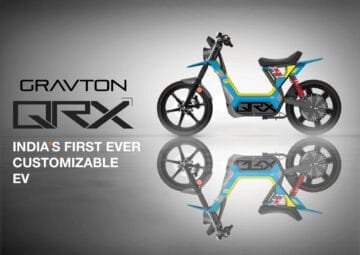
- No home or workplace power. If you cannot charge where you park or work, a swappable-battery model is a better fit. The Gravton QRX ScooByk uses a swappable or rental 2.4 kWh battery with a 100 km IDC range, so a rider can exchange a pack instead of plugging in.
- High daily distance. Riders consistently above 100 km a day, such as some delivery riders, benefit from swapping or a mid-shift top-up. See our guide for electric delivery fleet vehicles in India.
What to Check Before You Buy
If electric two wheeler charging is your main hesitation, test every vehicle you consider against these points.
- Range versus your real daily distance, with a 20 to 25 percent buffer on the claimed figure.
- Charging from a standard 3 pin socket, using a portable charger that is included with the vehicle.
- Full-charge time, so you know if it fits your overnight window.
- Battery chemistry, certifications and the battery's own warranty, not just the vehicle warranty.
- App notifications and charging history, so you can see what is happening without being there.
- A swappable option, if you have no reliable place to plug in.
- Service support for the charger and battery in your city.
For a wider view of the choices, see our guide to the different types of electric two-wheelers.
What Charging Actually Costs
Electric two wheeler charging at home costs a fraction of petrol. Gravton states a running cost of about 0.10 rupees per kilometre for the Quanta. Here is what that means at a 40 km daily ride.
| Item | Petrol motorcycle | Gravton Quanta |
|---|---|---|
| Energy cost per km | About 2.56 rupees | About 0.10 rupees |
| Cost per day at 40 km | About 102 rupees | About 4 rupees |
| Cost per month (30 days) | About 3,070 rupees | About 120 rupees |
Assumptions: petrol at 115 rupees per litre and 45 km per litre; Gravton's stated running cost of 0.10 rupees per km; 40 km a day. Actual cost depends on your electricity tariff, load and riding pattern.
See How Easy Charging Can Be
Book a test ride on the Quanta and ask us to show you the portable charger and the GOTAC app.
Book a Test Ride Call 7995252220Frequently Asked Questions
Can I charge an electric two-wheeler from a normal 3 pin socket?
Yes. Most electric two-wheelers sold in India come with a portable charger that plugs into a standard household 3 pin socket. The Gravton Quanta charges this way, with no wall box or special installation. Use a properly earthed socket, avoid extension boards, and check the charger's rating label against the socket.
How long does it take to charge the Gravton Quanta?
Gravton quotes approximately 5.4 hours for a full 0 to 100 percent charge using the portable charger. That fits an overnight charge or an evening plug-in. Partial top-ups take less time.
Do I need public charging stations to own an electric two-wheeler?
Most riders do not. Two-wheelers are parked for most of the day and used for short distances, so charging at home or work covers daily needs. Public charging and battery swapping matter mainly for long trips, riders without access to home power, and delivery fleets.
How often will I need to charge the Quanta S+?
The Quanta S+ has a claimed range of 165 KM. Allowing a 25 percent buffer for real-world conditions gives a planning range of about 125 KM, which is roughly 3 days of a 40 km daily commute between charges. Actual range varies with load, speed, terrain and riding pattern.
How much does it cost to charge an electric two-wheeler in India?
Cost depends on your electricity tariff and the vehicle's efficiency. Gravton states a running cost of about 0.10 rupees per kilometre for the Quanta. At 40 km a day that is about 4 rupees a day, or roughly 120 rupees a month, compared with about 3,000 rupees a month for a petrol motorcycle at 115 rupees per litre and 45 km per litre.
Is it safe to charge an electric two-wheeler overnight?
It is generally safe when done correctly: use the charger supplied by the manufacturer, a dedicated and properly earthed socket, no extension boards, a dry and ventilated place, and a battery with stable chemistry. Gravton uses LMFP battery chemistry, which is known for strong thermal stability.
What if I live in an apartment with no charging point?
Check whether your parking area has a socket you can use, and speak to your housing society about approval and metering. A portable charger helps, since any standard 3 pin socket works, including at the office. If home or work charging is not possible, a swappable-battery model such as the Gravton QRX ScooByk can remove the need to charge at home.
About this guide. Published by Gravton Motors, Hyderabad, an electric two-wheeler manufacturer, so Gravton details are manufacturer-provided. Range figures are claimed figures, and real-world range varies. Charging methods and public network coverage change over time, so check current availability in your city.
Website: www.gravton.com | Email: connect@gravtonmotors.com | Phone: 7995252220