Gravton Motors
Different Types of Electric Two Wheelers — A Definitive Guide to Buying in 2026
Electric scooters, mopeds, motorcycles and step-through bikes — what is the difference, who is each one for, and which should you actually buy?
The Indian electric two-wheeler market has never had more options — and never been more confusing. Walk into any EV showroom or browse any comparison site in 2026 and you will find electric scooters, mopeds, motorcycles, step-through bikes and everything in between, all competing for the same buyer. This guide cuts through the noise and tells you exactly what each type is, who it is built for, and what you should be asking before you sign anything.
Quick Answer — At a Glance
- 1 Electric scooters — best for short urban commutes, easy to ride, limited on range and rough roads
- 2 Electric mopeds — lightest and cheapest, but limited performance and not suitable beyond city limits
- 3 Electric motorcycles — best overall range, road capability and performance, straddle seating only
- 4 Step-through electric motorcycles — motorcycle capability with scooter accessibility, best for families and diverse riders
Type 01
Electric Scooters
An electric scooter is a two-wheeled vehicle with a step-through frame, small wheels typically between 10 and 14 inches, a flat floorboard for feet, underseat storage and an electric motor usually integrated into the rear wheel hub. The rider sits upright with both feet flat on the platform. In India, electric scooters currently dominate the market — brands like Ola, TVS, Ather and Bajaj all play primarily in this segment.
Electric scooters were designed with urban convenience in mind. They are easy to mount, easy to park and easy to ride for first-time two-wheeler users. The low seat height and step-through frame make them accessible regardless of height or experience. Most electric scooters in India offer a claimed range between 80 KM and 150 KM on a single charge, with real-world figures typically 15 to 20 percent lower.
Where electric scooters begin to show their limitations is on anything beyond a smooth urban road. The small wheel diameter means every pothole and speed breaker is felt acutely. Ground clearance is typically between 130 mm and 160 mm — workable in ideal conditions but genuinely limiting on rough roads, flyover approach ramps and waterlogged streets. Gradability on most electric scooters tops out around 10 to 15 percent, which means a loaded scooter will slow significantly on steep inclines.
Advantages
- Easiest to ride and most accessible for new riders
- Good underseat storage for everyday items
- Widest range of models and price points in India
- Comfortable upright seating for short trips
- Generally lower purchase price at entry level
- Easy to park in tight urban spaces
Limitations
- Small wheels struggle on potholes and rough roads
- Low gradability — struggles on steep inclines when loaded
- Lower ground clearance limits off-road and wet-road performance
- Real-world range often significantly below claimed range
- Not suited for highway or long-distance riding
- Limited payload capacity for pillion and cargo
Solo urban commuters covering 30 to 50 km daily on relatively smooth roads, first-time two-wheeler buyers and those who prioritise ease of use over road performance.
Type 02
Electric Mopeds
An electric moped sits below the scooter in terms of performance and price. Mopeds are typically low-speed vehicles with smaller motors, limited to speeds between 25 and 45 km/h in most configurations. They often feature pedals in older designs, though modern electric mopeds in India have largely dropped pedals in favour of a purely electric drivetrain. They are lightweight, compact and designed primarily for the last-mile urban commute.
In India, electric mopeds are common in delivery applications and as budget options for very short daily commutes. They require low-speed vehicle registration in many configurations, which simplifies the paperwork but also restricts where and how fast they can be used. The battery capacity is generally small, with most mopeds offering a real-world range of 50 to 80 km per charge.
The moped’s primary appeal is its price. Entry-level electric mopeds in India can be purchased for well under one lakh rupees, making them the most accessible electric option from a pure cost perspective. However, that low cost comes with genuine compromises in build quality, safety features, weather resistance and performance that buyers should weigh carefully before choosing this category.
Advantages
- Lowest purchase price in the electric two-wheeler category
- Extremely lightweight and easy to handle
- Ideal for very short last-mile commutes
- Simple mechanically — low maintenance requirement
- Easy to charge with small battery packs
Limitations
- Speed limited — not suitable for arterial roads or highways
- Very short range — typically 50 to 80 km real world
- Minimal safety features and structural integrity
- Not designed for pillion riding or cargo loads
- Poor performance on any gradient or rough surface
- Limited after-sales support and network
Very short last-mile commutes in flat urban areas, delivery applications covering minimal distances, and buyers whose primary requirement is the lowest possible purchase price.
Type 03
Electric Motorcycles
An electric motorcycle follows the traditional motorcycle architecture — a straddle seating position where the rider sits with legs on either side of the fuel tank or battery housing, large wheels typically 17 inches or more, full suspension front and rear and a higher performance motor. Electric motorcycles are the closest electric equivalent to the ICE motorcycles that have dominated Indian roads for decades.
The electric motorcycle category in India is growing rapidly. Players like Ultraviolette, Revolt, Matter, Oben and Gravton are all competing in this space, each taking different approaches to performance, range and pricing. Electric motorcycles deliver the range, road confidence and performance that electric scooters simply cannot match. A 17-inch alloy wheel covers potholes significantly better than a 12-inch scooter wheel. A proper motorcycle suspension system absorbs rough road impacts across sustained distances. And motorcycle motors in the 3 to 10 kW range deliver the gradability and load capacity that urban Indian roads genuinely demand.
The traditional motorcycle architecture does have one significant limitation for a wide cross-section of Indian riders: the straddle seating position. For riders in sarees, lungis, formal trousers or any clothing not suited to straddling a frame, mounting and dismounting a conventional motorcycle requires an awkward step-over motion that is not always practical or comfortable. This is where the step-through design becomes critical.
Advantages
- Best real-world range in the electric two-wheeler category
- Large wheels handle rough Indian roads significantly better
- Higher gradability — handles inclines under full load
- Higher payload capacity for pillion and cargo
- Better suspension for long-distance comfort
- Highway and arterial road capable
- Stronger build quality and structural integrity
Limitations
- Straddle seating restricts access for diverse riders and clothing types
- Higher purchase price than scooters at comparable range
- Fewer models available compared to scooter segment
- Perceived as more intimidating for first-time riders
- No underseat storage in most designs
Riders covering longer daily distances, those using their two-wheeler on rough or semi-urban roads, pillion riders and families who need real payload capacity, and anyone prioritising range and road confidence over urban convenience features.
Type 04
Step-Through Electric Motorcycles
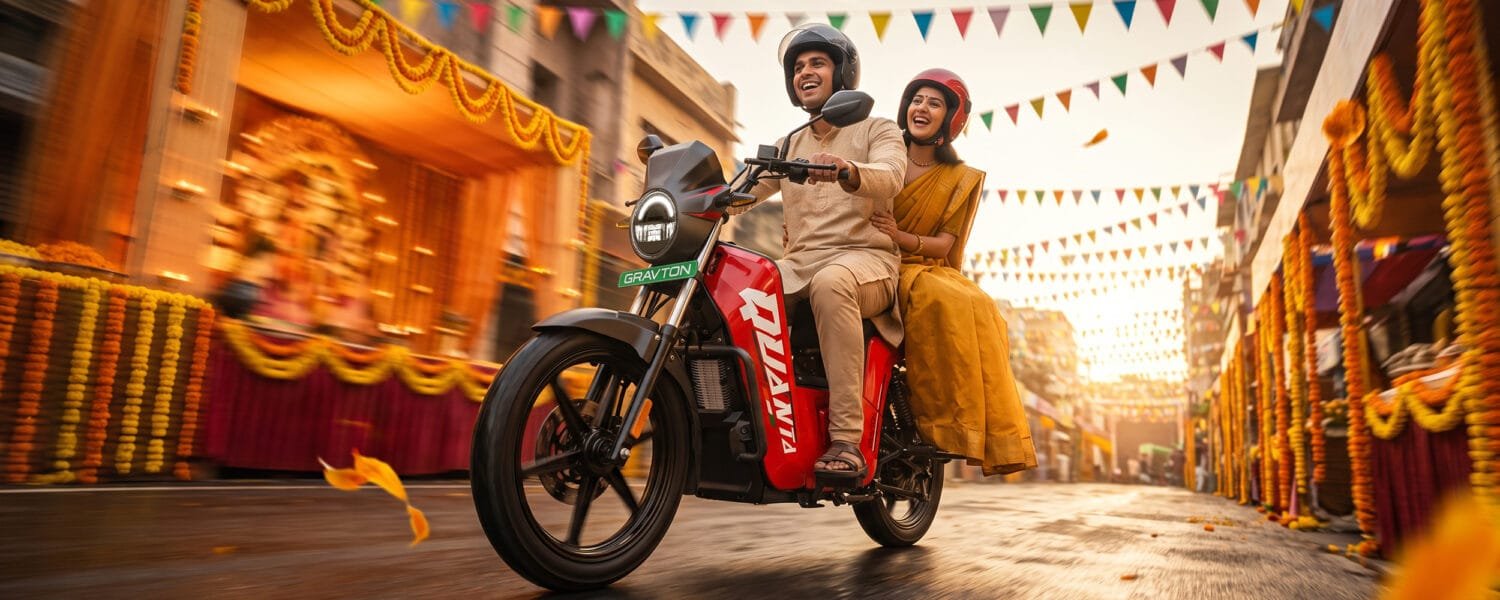
A step-through electric motorcycle is the newest and most significant category in the Indian electric two-wheeler market — and the most misunderstood. It combines a motorcycle’s large wheels, high ground clearance, powerful motor and structural integrity with a step-through frame architecture that makes mounting and dismounting as easy as a scooter, regardless of clothing, height or physical ability.
This is not a scooter with bigger wheels. And it is not a motorcycle with a cut-out in the frame. It is a purpose-built architecture that answers a question the rest of the market has not asked seriously: why should riders have to choose between motorcycle capability and scooter convenience?
In practice, a step-through motorcycle design means the low frame sill runs between the rider’s feet rather than rising up as a tank or battery housing to straddle. The rider still sits on a proper motorcycle seat, with proper motorcycle ergonomics, but steps through rather than over to mount. For a woman in a saree, a man in formal office attire, an older rider or a shorter rider — this makes a real difference to daily usability.
Advantages
- All motorcycle advantages — range, wheels, gradability, payload
- Accessible to every rider regardless of clothing or height
- Family-friendly — multiple family members can ride comfortably
- Step-through ease without sacrificing motorcycle performance
- Better positioned for Indian road conditions than scooters
- Unique architecture that no conventional category can replicate
Limitations
- Very few models currently available in India
- Higher price point than entry-level scooters
- Can be misunderstood as a scooter by buyers not familiar with the category
Families who share a vehicle, working professionals who ride in formal clothing, women riders who want motorcycle performance without the straddle compromise, gig workers and delivery riders who need payload capacity, and anyone who wants the best of both worlds without paying a premium to get it.
Head-to-Head: All Four Types Compared
Here is how the four categories stack up on the metrics that matter most for Indian buyers:
| Feature | Electric Moped | Electric Scooter | Electric Motorcycle | Step-Through Motorcycle (Quanta) |
|---|---|---|---|---|
| Wheel Size | 10 to 12 inch | 10 to 14 inch | 17 inch+ | 17 inch (6-spoke alloy) |
| Real-World Range | 50 to 80 KM | 70 to 130 KM | 100 to 200 KM | 125 to 165 KM |
| Gradability | 8 to 12% | 10 to 15% | 20 to 35% | 33% |
| Ground Clearance | 130 to 150 mm | 130 to 165 mm | 170 to 210 mm | 190 mm |
| Payload Capacity | 60 to 90 KG | 80 to 120 KG | 100 to 160 KG | 150 KG |
| Step-Through Frame | Yes | Yes | No | Yes — with motorcycle specs |
| Family Friendly | Limited | Moderate | Limited by frame | Highest in category |
| Running Cost | ₹0.10 to 0.15/km | ₹0.10 to 0.15/km | ₹0.08 to 0.12/km | ₹0.10/km |
| Highway Capable | No | Limited | Yes | Yes — up to 75 km/h |
| Rough Road Performance | Poor | Moderate | Good to Excellent | Excellent |
“The best electric two-wheeler for India is not the one with the highest claimed range or the most features on a spec sheet. It is the one that handles real Indian roads, real Indian loads and real Indian riders — and does it every day without compromise.”
The Verdict
Why the Gravton Quanta is the Best of All Four
The Gravton Quanta is India’s only urban electric utility motorcycle — and it was designed specifically to answer the limitations of every other category in this guide. It is not a scooter. It is not a conventional motorcycle. It is the only electric two-wheeler in India that delivers motorcycle-grade capability with step-through accessibility, purpose-built for the way India actually rides.
- 17-inch 6-spoke alloy wheels — India’s first on an electric two-wheeler — handle potholes, gravel and rough roads with genuine motorcycle confidence
- 33% gradability means it does not slow on flyovers, hill roads or steep inclines even under full load with a pillion
- Step-through frame makes it accessible to every member of the family — in a saree, formal wear, kurta or jeans
- 150 KG payload and 263 KG GVW built for real Indian carrying requirements — not just a solo commuter
- LMFP battery chemistry — fire-resistant by design, with 3-year / 30,000 KM warranty
- GOTAC Edge AI telemetrics built in — live tracking, anti-theft, remote immobilisation, cell-level battery monitoring
- World record — the first and only electric two-wheeler to complete Kanyakumari to Khardung La, 4,011.9 KM across 11 states in 6.5 days
- Available in Quanta S (125 KM) and Quanta S+ (165 KM) — two variants for different daily range requirements
Final Verdict
Which Type Should You Buy in 2026?
If you cover less than 40 km daily on smooth urban roads and ride alone, an electric scooter is a practical choice. If budget is the only consideration and your commute is very short, a moped gets the job done.
But if you ride with a pillion regularly, carry loads, navigate rough roads, need more than 100 km of real-world range, live in a city with flyovers and gradients, or want a vehicle that every member of your household can use comfortably — there is only one answer.
The step-through electric motorcycle. And right now, in India, that means the Gravton Quanta.
Experience It Before You Decide
Book a test ride and see what motorcycle capability with step-through ease actually feels like on real Indian roads.
Book a Test RideFrequently Asked Questions
What are the different types of electric two wheelers available in India?
The main types are electric mopeds, electric scooters, electric motorcycles and step-through electric motorcycles. Each differs in frame design, wheel size, performance, range and intended use. Electric scooters dominate the Indian market currently but electric motorcycles and step-through motorcycles offer significantly better road performance for Indian conditions.
What is the difference between an electric scooter and an electric motorcycle?
Electric scooters have smaller wheels (10 to 14 inches), step-through frames, underseat storage and platform footrests. Electric motorcycles have larger wheels (17 inches or more), straddle seating and significantly better road performance, gradability and payload capacity. Motorcycles handle rough Indian roads, steep inclines and long distances far better than scooters.
What is a step-through electric motorcycle?
A step-through electric motorcycle combines motorcycle-grade large wheels, high ground clearance, powerful motor and structural strength with a low step-through frame that makes mounting and dismounting easy for any rider in any clothing. The Gravton Quanta is India’s only urban electric utility motorcycle with this design, delivering 165 KM range, 33% gradability and 150 KG payload.
Which electric two wheeler is best for Indian roads?
For Indian roads, the most important factors are ground clearance, wheel size, gradability and real-world range. Electric motorcycles with 17-inch wheels, at least 180mm ground clearance and 30% or higher gradability perform best. The Gravton Quanta delivers 17-inch wheels, 190mm clearance, 33% gradability and 165 KM real-world range — making it among the most capable options for Indian road conditions.
Is an electric scooter or electric motorcycle better for long distance riding?
Electric motorcycles are significantly better for long distance riding. They offer higher range, larger wheels for road stability, better suspension for sustained comfort and higher payload for luggage. Electric scooters are designed for short urban commutes and underperform on highways or rough terrain over sustained distances.
What is the running cost of an electric two wheeler in India?
Most electric two wheelers in India cost between ₹0.08 and ₹0.15 per kilometre in electricity, depending on local electricity tariffs and the vehicle’s energy efficiency. The Gravton Quanta runs at ₹0.10 per kilometre — compared to ₹3 or more per kilometre for a petrol motorcycle at current fuel prices, representing a saving of approximately ₹70,000 or more per year for an 80 km/day rider.