Gravton Motors
5 Things Your Electric Motorcycle Must Have Before You Buy This Festive Season
Navratri and Diwali deals are everywhere. Here is how to cut through the noise and make a decision you will not regret in January.

Festive season is India’s biggest window for two-wheeler purchases. The showrooms are busy, the offers are real, and the timing feels right. But buying an electric motorcycle during a sale is still buying an electric motorcycle — and the wrong choice is expensive for years, not just months.
This guide is not about which EV has the flashiest ad this October. It is about the five features that will determine whether your new motorcycle is still a good decision 18 months from now — when the festive excitement has passed and the daily commute has begun.
Each of the five must-haves maps directly to a real-world scenario that Indian riders face. If the motorcycle you are considering does not pass all five, keep looking.
At a Glance — The 5 Must-Haves
- 1 Real-world range of at least 120 KM — not just claimed range
- 2 A battery you can actually trust — certification, chemistry, and safety
- 3 Gradability that handles real Indian roads — not just smooth test tracks
- 4 Smart connectivity built in — not bolted on as an afterthought
- 5 A total cost of ownership that makes financial sense over 3 years
Real-World Range — Not Just the Number on the Brochure
Every electric motorcycle in the market has a range figure on its brochure. That number was achieved in a controlled test environment — typically a flat surface, moderate speed, optimal temperature, and a single rider with no cargo. Your daily commute does not look like that test.
Real-world range — what you actually get on Indian roads, in Indian traffic, in Indian weather — is typically 15 to 25% lower than claimed range depending on the vehicle and the conditions. For a motorcycle that claims 100 KM of range, real-world performance might be 75 to 85 KM. In a city with stop-start traffic, a pillion on weekends, and summer temperatures regularly above 35°C, that gap matters enormously.
The minimum real-world range you should accept for a primary daily use motorcycle is 120 KM. This gives you buffer for variation in riding conditions, loading, and temperature without requiring you to think about the battery indicator every day.
Gravton Quanta — Range
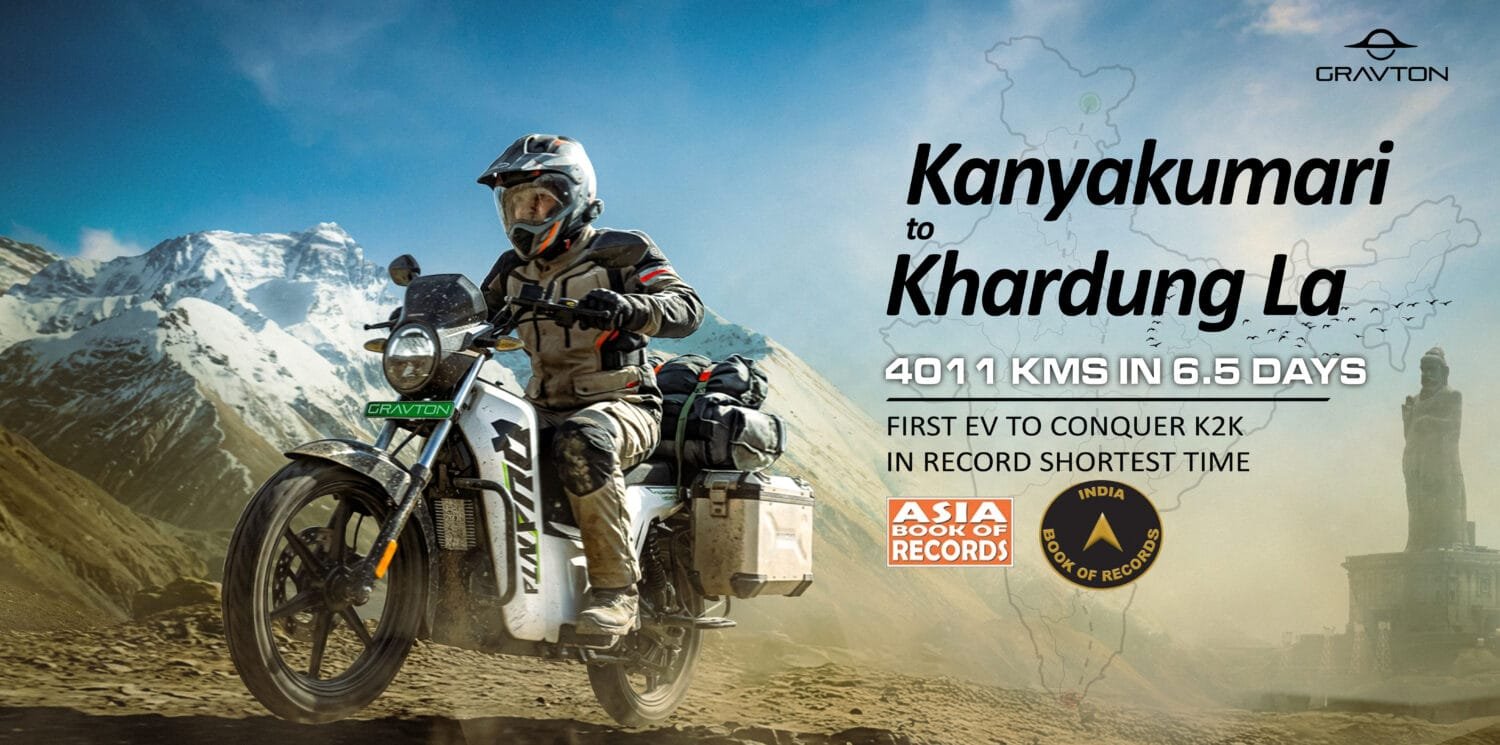
Quanta S: 125 KM · Quanta S+: 165 KM — certified real-world range. The same motorcycle completed Kanyakumari to Khardung La — 4,011 KM across 11 states in 6.5 days — on production-spec hardware. Range is not a brochure claim. It is a proven record.
A Battery You Can Actually Trust — Chemistry, Certification, and Safety
Battery safety is the most underreported dimension of the Indian EV market. The battery fires that made headlines in 2022 and 2023 were not random — they were almost exclusively vehicles using NMC (Nickel Manganese Cobalt) battery chemistry, which has a high energy density but a significantly lower thermal runaway threshold than safer alternatives.
Before you buy any electric motorcycle, ask three questions about the battery:
What chemistry? NMC is higher risk. LFP (Lithium Iron Phosphate) is safer. LMFP (Lithium Manganese Iron Phosphate) is the most advanced — combining LFP’s safety with higher energy density.
What certification? Ask whether the battery has been independently tested and certified for safety. Battery safety certifications are not universal — some vehicles on the market went through less rigorous testing than others. If a brand cannot answer this question clearly, that tells you something.
What warranty? A manufacturer confident in their battery chemistry backs it with a long warranty. Anything under 2 years should prompt questions about the product’s expected longevity.
“The battery you cannot see is doing the most important job in the vehicle. Buy the one that was designed to be safe — not the one that was designed to look impressive on paper.”
Gravton Quanta — Battery
LMFP battery — the safest chemistry in this segment. Fire-resistant by design. Active cell balancing. Smart BMS with real-time temperature monitoring. Leak-proof sealed construction for all-weather performance. 3-year / 30,000 KM warranty — on both motor and battery.
Gradability That Handles Real Indian Roads — Not Just Smooth Test Tracks
Gradability is the specification almost nobody talks about in EV reviews. It is also the specification that will determine whether your electric motorcycle is embarrassed by the flyover ramp on your daily commute.
Gradability measures a vehicle’s ability to climb a slope — expressed as a percentage. A 33% gradient means the road rises 33 metres for every 100 metres of horizontal distance. That is steep. And the Quanta handles it.
Most electric scooters offer 10 to 15% gradability. The flyover approach ramp outside many Indian cities often exceeds this. Loaded with a pillion or cargo, the performance drops further. The result is a motorcycle that stutters, slows significantly, or — in worst cases — cannot complete the ascent under full load.
The Quanta’s 33% gradability is powered by its proprietary BLDC Hub Motor delivering 172 Nm of torque directly to the rear wheel — no drivetrain loss, no lag. Loaded. Pillion. Steep incline. It does not hesitate.
Gravton Quanta — Gradability
33% gradability. More than double the capability of most electric scooters. Verified on the same motorcycle that climbed to Khardung La at 18,000 feet altitude. If it handled that, your flyover is not a conversation.
Smart Connectivity Built In — Not Bolted On as an Afterthought
The difference between built-in intelligence and an aftermarket GPS tracker is significant — and it goes beyond features. When connectivity is built into the vehicle at the hardware level, it can monitor things that a bolt-on device cannot. Individual battery cell voltages. Motor temperature. Real-time BMS data. These are not accessible to a device that sits on top of the vehicle — they require integration with the vehicle’s own systems.
For the festive season buyer, smart connectivity matters for three practical reasons. First, security — you need to know immediately if your new motorcycle is moved without authorisation. Second, battery visibility — you need to know the real state of your battery’s health, not just the displayed percentage. Third, service intelligence — predictive maintenance alerts mean you know when something needs attention before it becomes a breakdown.
When evaluating connectivity, ask whether the system is proprietary and integrated or a third-party device. Ask whether it can see battery cell data. Ask whether it supports remote immobilisation. Ask whether the companion app is available and functional before you complete the purchase.
Gravton Quanta — GOTAC Smart Connectivity
GOTAC Edge AI telemetrics — embedded at hardware level, not bolted on. Live GPS tracking, remote ignition off, geo-fencing, cell-level battery monitoring, charging history, distance to empty, nearest service station, roadside assistance, and share location. The Smart App gives you complete vehicle visibility from your phone.
EV Bikes Festival Offers 2026: A Total Cost of Ownership That Makes Financial Sense Over 3 Years
The purchase price of an electric motorcycle is the beginning of the financial conversation — not the end of it. The total cost of ownership over three years is what determines whether the vehicle was actually a good financial decision.
Total cost of ownership for an electric motorcycle includes four components: purchase price, running cost (electricity vs petrol), maintenance cost, and warranty coverage. A motorcycle that costs ₹20,000 less to buy but costs ₹15,000 more per year to run is a worse financial decision over any period beyond 18 months.
The running cost calculation is straightforward. At ₹0.10 per km, a rider covering 80 km per day spends approximately ₹2,400 per year on electricity. The same rider on a petrol motorcycle at ₹115 per litre and 45 km per litre spends approximately ₹72,000 per year on fuel. The difference — nearly ₹70,000 annually — accumulates rapidly over three years.
Maintenance cost is equally important and often overlooked. Electric motorcycles with fewer moving parts — no engine oil, no spark plugs, no clutch plates, no exhaust system — have significantly lower maintenance bills than petrol motorcycles. But the degree of difference depends on component quality and warranty coverage. A battery with a 1-year warranty is a different financial proposition than a battery with a 3-year warranty.
Gravton Quanta — Total Cost of Ownership
₹0.10 per km running cost. 3-year / 30,000 km warranty on both motor and battery. No engine oil, no spark plugs, no chain, no clutch — dramatically lower maintenance. Finance available through Shriram Finance, Bajaj Finance, and Creditbee. For an 80 km/day rider, the Quanta’s annual savings on fuel and maintenance alone typically exceed ₹79,000.
The Festive Season Checklist Before You Sign
Before you commit to any electric motorcycle this Navratri or Diwali, run it through these five questions:
Does it deliver at least 120 KM of real-world range — not just claimed range? Does the battery use LMFP or LFP chemistry and carry independent safety certification? Does it achieve at least 20% gradability under full load? Does it have built-in connectivity that integrates with the vehicle’s own systems — not a third-party tracker? And does the total cost of ownership over 3 years — purchase plus running cost plus maintenance — make better financial sense than the alternative?
If the answer to all five is yes, you have found a motorcycle worth buying. The Gravton Quanta answers all five. But use this checklist on every vehicle you consider — because the festive season offer that saves you ₹5,000 today should not cost you ₹50,000 over the next two years.
EV Bikes Festival Offers 2026: The Quanta Is Ready. Are You?
Book a test ride this festive season and see what all five must-haves feel like on a real road.
Book a Test RideFrequently Asked Questions
What features should I look for when buying an electric motorcycle in India?
The five most important features are: real-world range of at least 120 KM, a battery with safe chemistry and independent certification, gradability of at least 20% for Indian roads, smart connectivity integrated at the hardware level, and total cost of ownership including running cost per km and warranty coverage.
Which is the best electric motorcycle to buy this festive season in India?
The Gravton Quanta is one of the strongest choices for festive season 2026 — delivering 165 KM of real-world range, an LMFP fire-resistant battery, 33% gradability, GOTAC Edge AI connectivity, and ₹0.10 per km running cost. It holds a world record as the first electric two-wheeler to complete Kanyakumari to Khardung La in 6.5 days.
Is it a good time to buy an electric motorcycle during Navratri or Diwali?
Yes — festive season is historically the best time to buy an electric motorcycle in India. Dealers offer better pricing, festive exchange bonuses, and financing schemes during Navratri and Diwali. Government subsidies under FAME and state EV policies also apply year-round, reducing the effective purchase price further.
What is the minimum range I should look for in an electric motorcycle?
For Indian daily commuting, a minimum real-world range of 120 KM per charge is recommended. This provides buffer for stop-start city traffic, variation in temperature, and loading. The Gravton Quanta S delivers 125 KM and the Quanta S+ delivers 165 KM of real-world range.
What is LMFP battery and why does it matter?
LMFP — Lithium Manganese Iron Phosphate — is the most advanced and safest battery chemistry available in Indian electric two-wheelers. Unlike NMC batteries, LMFP has a significantly higher thermal runaway threshold making it far more resistant to fire. It also offers higher energy density than standard LFP. The Gravton Quanta uses LMFP chemistry — one of the safest available on any Indian electric two-wheeler today.