2026: The Year the Tide Turned for Electric Two Wheelers
Future of Electric Two Wheelers in India: What a year it has been for electric two-wheelers. Between January and September 2026, India registered 15.61 lakh electric two-wheelers across scooters, motorcycles and mopeds. That is 62.4% more than the same nine months of 2025, and it happened in a year when the central purchase subsidy for the category was being wound down.
And yet the more telling number is the one that has barely moved. Electric two-wheelers are still a small slice of the two-wheelers Indians buy. Roughly nine in ten buyers, or more, still ride out of the showroom on petrol.
Read those two facts together and the picture is clear. The category is no longer an experiment, but it is nowhere near saturation. The early adopters have already bought. The next wave of buyers is larger, more cautious and far more price-sensitive: the delivery partner in Secunderabad clocking 120 km a day, the schoolteacher in Warangal weighing an EMI against her monthly petrol bill, the farmer near Nalgonda who needs a bike that can carry a sack of fertiliser up a rutted village road.
That next wave will shape 2027. It will bring more models and variants, new battery chemistries, new ownership models such as battery subscriptions and rentals, sharper competition and, for the first time, a market that has to stand on its own feet without central demand incentives.
Policy will cut both ways. The government has stepped back from purchase subsidies while keeping production-linked support for local manufacturing in place. At the same time, it is actively backing ethanol-blended petrol, flex-fuel and CNG as parallel routes to cleaner mobility. Charging infrastructure, supply chain resilience and cheaper batteries will each play their part.
The tide has turned. 2027 is the year the industry finds out how far it can ride the wave. Here are the twelve shifts we believe will matter most.
1. Do Buyers Actually Go Electric to Save the Planet?
The honest answer is: some do, most don’t, and that is perfectly fine.
In the metros there is a real segment of buyers for whom the environment matters. They are typically young, salaried, digitally native and living in apartment complexes in Gachibowli, Whitefield or Gurugram. They follow AQI apps through the winter, have read about the climate crisis and like the idea that their daily commute adds nothing to the haze. For them an electric scooter is part practical choice, part statement. The silence, the instant torque and the app on the phone add to the appeal. This segment powered the first wave of adoption between 2019 and 2023, and it still sets the tone for how EVs are talked about online.
Now step outside that bubble. The average Indian two-wheeler buyer spends somewhere between ₹70,000 and ₹1.2 lakh on a vehicle, often finances most of it, and rides it hard for eight to ten years. For this buyer the purchase is a household financial decision. The questions are simple and unsentimental. What is the down payment? What is the EMI? How much will I save on petrol every month? Will it survive the monsoon? Will I get a fair price when I sell it? Emissions rarely make that list.
The say-do gap
Consumer surveys in India tend to show high stated concern for the environment. Purchase behaviour tells a more practical story. When a buyer has to choose between a greener option and a cheaper one, the cheaper one usually wins unless the green option also pays for itself. Researchers call this the say-do gap, and it is not unique to India. What makes India different is the sheer scale of price sensitivity in the mass market, where a ₹5,000 difference can decide a sale.
Where the two thoughts meet
It would be a mistake, though, to dismiss the environmental motive entirely in the mass market. It simply shows up in a different form.
- Air you can feel, not climate you read about. A commuter stuck at a signal behind a smoking bike does not think about global carbon budgets. They think about their lungs and their children’s lungs. Local air quality and noise are lived experiences, and they resonate far beyond the urban elite.
- Green as the tiebreaker. When the running-cost math already works, the environmental benefit becomes the reason to feel good about the decision. “I save ₹2,000 a month and I am not adding to the pollution” is a sentence we hear often on the ground.
- Pride and modernity. In smaller towns an electric vehicle still signals progress. Families talk about it with a certain pride, and that social reward is closely tied to the idea of doing something cleaner.
- The self-powered home. With rooftop solar spreading under PM Surya Ghar, a growing number of households can charge from their own roof. That turns the EV into a genuinely zero-fuel-cost vehicle and makes the green story and the money story the same story.
A note on honesty
For a sophisticated buyer, the green claim also deserves nuance. India’s grid still leans heavily on coal, so an EV’s emissions depend on where its electricity comes from. Most lifecycle studies still find electric two-wheelers cleaner than petrol ones in India, and the gap widens every year as solar and wind take a larger share of generation. Brands that acknowledge this build more trust than brands that claim “zero emissions” without qualification.
What this means for 2027
The winning message in 2027 will lead with economics and close with conscience. Buyers want the rupee math first, proven in plain numbers. The environmental benefit then becomes a reason to feel proud of a decision they have already made on merit. Brands that preach will lose the mass market. Brands that show the math and let the clean air speak for itself will win it.
2. Building a Supply Chain India Can Call Its Own
India is the world’s largest electric two-wheeler market outside China. That scale is a strength, but it has also exposed an uncomfortable truth. Much of what makes an electric two-wheeler work still comes from somewhere else.
The lithium-ion cells inside most battery packs are imported, largely from China and to a lesser extent from Korea. So are many of the cathode and anode materials, the rare earth magnets in the motor, and a good share of the semiconductors in the battery management system and motor controller. Assembly happens in Hosur, Pune, Bengaluru and Hyderabad. Value creation, for now, is still split with suppliers abroad.
The wake-up calls
Two episodes made this dependency impossible to ignore. The pandemic-era chip shortage showed how a single bottleneck could idle assembly lines. Then in 2025, China’s export restrictions on rare earth magnets forced several Indian OEMs to cut production for weeks. Bajaj’s Chetak was among the visible casualties. For an industry selling over a lakh units a month, that was a lesson delivered in lost sales.
The policy scaffolding
The government has been building towards self-reliance for several years, through a layered set of instruments:
- Phased Manufacturing Programme (PMP) under FAME-II tied subsidies to progressive localisation of components. Its enforcement, including action against companies found falling short, sent a clear message that “assembled in India” was not enough.
- PLI for Automobiles and Auto Components (₹25,938 crore) rewards advanced automotive technology with at least 50% domestic value addition.
- PLI for Advanced Chemistry Cells (₹18,100 crore) targets 50 GWh of domestic cell manufacturing capacity.
- National Critical Mineral Mission (approved in 2025) aims to secure lithium, cobalt, graphite and rare earths through domestic exploration, overseas assets and recycling. KABIL’s lithium exploration blocks in Argentina are one early example.
- Rare earth permanent magnet manufacturing support, approved in late 2025, is meant to seed domestic magnet production.
- Battery Waste Management Rules (2022) make producers responsible for recovering spent batteries, which turns recycling into a form of urban mining.
Where things stand going into 2027 for Future of Electric Two Wheelers in India
Progress is real but uneven. Domestic cell production has started. Ola Electric’s gigafactory in Krishnagiri has begun producing its own 4680 cells, and Amara Raja’s giga corridor in Mahabubnagar, Telangana, and Exide’s plant near Bengaluru are coming up. Battery pack assembly, BMS design and motor controllers are already largely localised among serious OEMs. On the other hand, the ACC PLI as a whole has moved slower than planned, and mineral processing remains thin.
What to expect in 2027
We expect 2027 to be a year of de-risking rather than full independence. Specifically:
- The first meaningful volumes of India-made cells entering two-wheeler packs, especially in LFP and related chemistries.
- Dual sourcing becoming standard practice for cells, magnets and chips, so that one supplier’s disruption no longer stops a line.
- Chemistry choices shaped by supply security. LFP and LMFP avoid cobalt and nickel entirely, and sodium-ion avoids lithium. Supply chain risk is becoming an engineering input, not just a procurement issue.
- Recycling and second-life businesses scaling as the first large cohort of 2021 to 2022 era batteries reaches the end of its vehicle life.
- Indian E2W makers pushing exports to Nepal, Sri Lanka, Southeast Asia, Africa and Latin America, using domestic scale as a cost advantage.
Full mine-to-motor self-sufficiency is a decade-long project. But every percentage point of localisation reduces the risk that a decision in Beijing stalls a delivery in Bhimavaram. It also creates the factory jobs in Hosur, Krishnagiri and Mahabubnagar that make the EV transition an Indian economic story, not just an Indian consumption story.
3. Scooters Won Round One. 2027 Is the Electric Motorcycle’s Turn.
Here is the great paradox of India’s EV story. Motorcycles make up roughly two-thirds of the petrol two-wheelers sold in India. Yet more than 90% of electric two-wheeler sales are scooters, and electric motorcycles account for only a low single-digit share. The vehicle that defines Indian mobility, the 100 to 150cc commuter bike, has barely been touched by electrification.
Why scooters went first
The reasons were mostly engineering and economics, not demand.
- Packaging. A scooter’s floorboard and under-seat space give designers a natural place to put a battery. A motorcycle frame does not, and fitting a 4 kWh pack without compromising balance, ground clearance and looks is genuinely hard.
- Duty cycle. Scooters live in cities, doing 20 to 40 km a day at modest speeds. Motorcycles are expected to do everything: highway runs, village roads, a pillion plus luggage, hill climbs. That needs more sustained power, better thermal management and much more range.
- Price point. The entry commuter motorcycle is one of the most cost-optimised products in Indian manufacturing. Matching its price with a battery big enough for 120 km of real-world range was not possible at 2021 cell prices.
- The early adopter profile. The first EV buyers were urban, and urban India rides scooters.
Why 2027 looks different
Almost every one of those barriers has weakened.
- Batteries are cheaper and tougher. Lower cell prices make 3.5 to 5 kWh packs affordable at mass-market price points. Safer, longer-lasting chemistries like LFP and LMFP suit the abuse a motorcycle takes.
- The product pipeline is filling up. Startups such as Revolt, Oben, Matter, Ultraviolette, Raptee and Tork have spent years learning the segment. Ola has entered with the Roadster range, Royal Enfield is bringing its Flying Flea brand, and Hero has partnered with Zero Motorcycles. When the largest names in Indian motorcycling commit, dealers and financiers follow.
- Gig and commercial riders want motorcycles. Delivery partners in many cities prefer bikes for stability, load and rough roads. As fleets electrify, demand for robust electric motorcycles grows with them.
- Rural and semi-urban India is a motorcycle market. As EV adoption moves beyond metros (see section 12), it inevitably moves towards motorcycles.
Built for the real job
The electric motorcycles that win will be the ones designed around how Indians actually ride, not adapted from scooter platforms. That means larger wheels for broken roads, a chassis that takes a pillion and a load without complaint, real gradability for flyovers and ghats, and range that holds up with the pillion on.
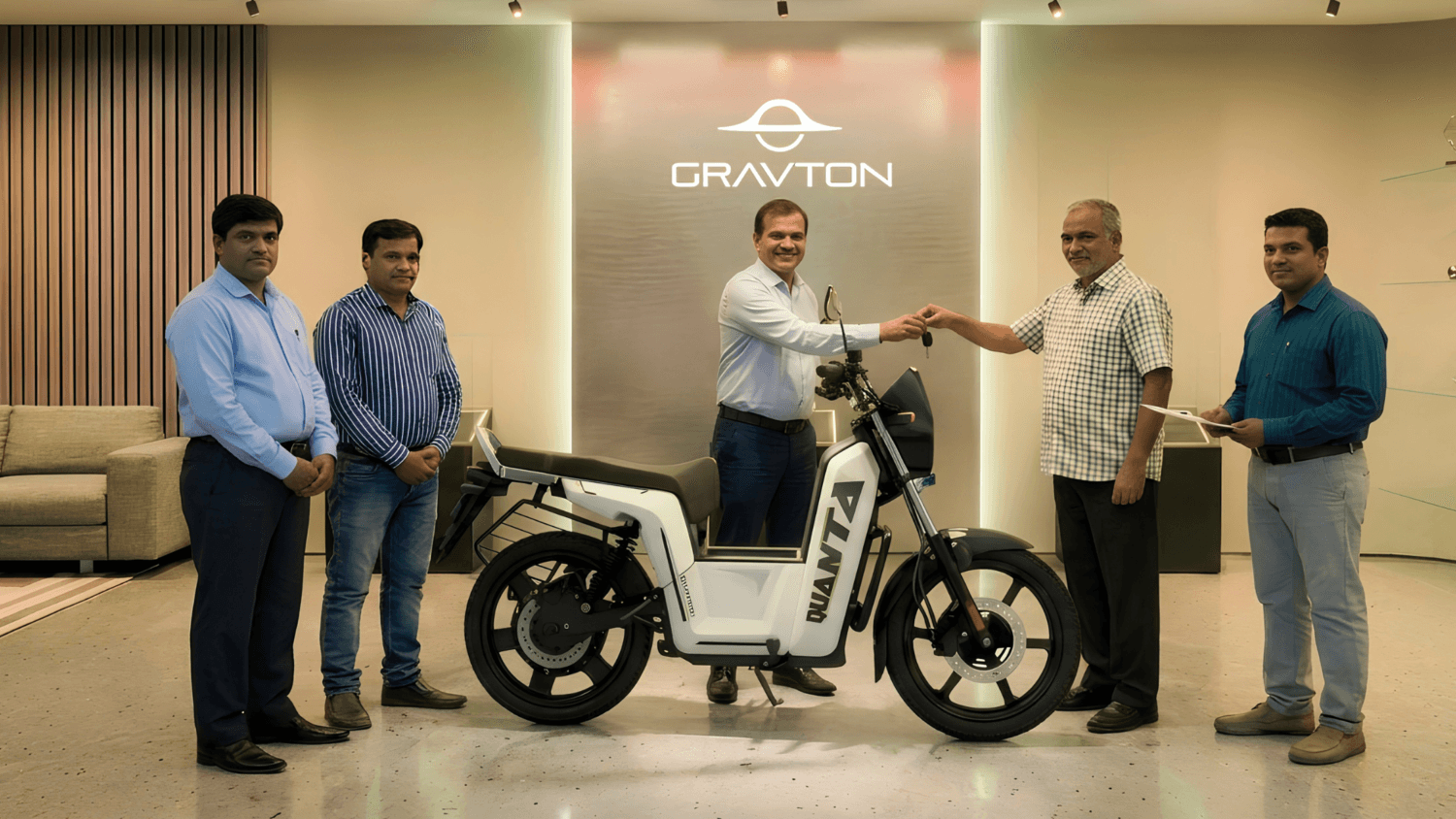
This is the space Gravton has built the Quanta for: 17-inch alloy wheels, a rib cage chassis, 33% gradability and a claimed range of 125 to 165 km depending on variant. When a Quanta rode from Kanyakumari to Khardung La in 6.5 days, covering 4,011.9 km across 11 states and climbing to 18,000 feet, the point was not a stunt. It was proof that an electric motorcycle can do what Indians ask of a motorcycle.
Our projection
We expect electric motorcycles to be the fastest-growing sub-segment of the E2W market in 2027, growing considerably faster than scooters from their smaller base. Their share of electric two-wheeler sales should move meaningfully up from today’s low single digits, with the commuter and utility segments leading rather than premium performance bikes. It will not overturn the scooter’s lead in a single year. But 2027 is likely to be remembered as the year the electric motorcycle stopped being a curiosity and became a serious commuter choice.
4. Life After Subsidies: What a Self-Supporting Market Looks Like
2027 will be the first full calendar year in which electric two-wheelers in India sell without a central purchase subsidy. For an industry that grew up on FAME, that sounds alarming. In practice, the cliff is far smaller than it looks.
The cliff has already been climbed down
By FY26, the PM E-DRIVE incentive for an electric two-wheeler was capped at ₹5,000 per vehicle. On a vehicle costing ₹1 lakh to ₹1.5 lakh, that is roughly 3 to 5% of the price. Its withdrawal is a bump, not a wall.
Compare that with June 2023, when the FAME-II subsidy was cut sharply overnight and the per-vehicle benefit on many popular scooters fell by ₹25,000 or more. Monthly registrations roughly halved in the following month. Within a few months, they had recovered and then grown past their earlier peak. The market absorbed a far bigger shock than the one it faces now.
The 2026 numbers point the same way. Registrations grew over 60% in a year when support was shrinking. That is the signature of demand driven by economics and product, not by incentives.
Who feels it most
- Entry-level buyers. At the bottom of the market, a few thousand rupees still decides a purchase. Expect OEMs to protect these price points with leaner variants, smaller battery options and financing offers.
- Smaller OEMs with thin margins. Brands whose pricing depended on the subsidy will struggle to absorb the difference. Consolidation, already under way, will accelerate.
- Fence-sitters. Some buyers wait for policy clarity before purchasing. The end of the subsidy, oddly, removes that reason to wait.
Why it may be good for the industry
Subsidies kept the market alive in its infancy, but they also distorted it. They rewarded designing to a subsidy formula rather than to a customer. They invited gaming, as the FAME-II localisation investigations showed. And they kept prices artificially anchored. A market without them competes on engineering, cost, service and trust. That is the kind of competition that produces better products.
What fills the gap
The end of the central demand subsidy does not mean the end of support.
- State incentives. Several states offer road tax and registration fee waivers. Telangana, for instance, has offered a 100% waiver on both for EVs, currently notified until 31 December 2026. Whether such waivers are renewed for 2027 will matter at the margin, especially for price-sensitive buyers.
- Supply-side support continues. The PLI schemes for auto components and battery cells keep rewarding local manufacturing, which lowers costs over time.
- Infrastructure funding. Public charging investment under PM E-DRIVE continues beyond the end of the vehicle subsidy.
- New ownership models. Battery-as-a-Service, subscriptions and rentals cut the upfront cost far more than a ₹5,000 subsidy ever could.
- Cheaper finance. As lenders gain confidence in EV resale values and battery life, interest rates and down payments for EVs should edge closer to those for petrol bikes.
The 2027 outlook
Expect entry-level prices to hold roughly flat, with falling battery costs offsetting the lost subsidy. Expect sharper financing and exchange offers. And expect the market to keep growing, more steadily than in 2026, on the strength of running-cost savings rather than government cheques.
5. From FAME to the End of the PM E-DRIVE Era
India’s decade of EV subsidies is a story in four acts: a cautious start, an accelerated boom, a hard correction and a managed exit. Understanding it explains much of why the market looks the way it does today.
| Period | Scheme | What it meant for electric two-wheelers |
| 2015 to 2019 | FAME I | A pilot-scale outlay of under ₹900 crore. Support reached many low-speed, lead-acid scooters, which did little for quality or consumer trust. |
| April 2019 | FAME II launched | ₹10,000 crore outlay (later ₹11,500 crore). Subsidy of ₹10,000/kWh, capped at 20% of price. Tighter eligibility: minimum range, top speed and localisation under the Phased Manufacturing Programme. |
| June 2021 | FAME II revised | Subsidy raised to ₹15,000/kWh and the cap to 40% of price. This triggered the real boom in E2W sales. |
| 2022 to 2023 | Localisation probe | Investigations found several OEMs had claimed subsidies without meeting localisation norms. Recoveries and debarments followed. |
| June 2023 | FAME II cut | Subsidy reduced to ₹10,000/kWh, capped at 15% of ex-factory price. Sales dropped sharply for a month, then recovered. |
| March 2024 | FAME II ends | The scheme closes after five years. |
| April to Sept 2024 | EMPS 2024 | A bridge scheme: ₹5,000/kWh, capped at ₹10,000 per E2W. |
| Oct 2024 | PM E-DRIVE begins | ₹10,900 crore across EVs, buses, trucks, ambulances, chargers and testing. E2W incentive of ₹5,000/kWh, capped at ₹10,000, with Aadhaar-authenticated e-vouchers. |
| April 2025 | PM E-DRIVE year two | E2W incentive halved to ₹2,500/kWh, capped at ₹5,000. |
| March 2026 | E2W support ends | The E2W demand incentive closes, while other parts of PM E-DRIVE continue. |
Act one: the cautious start
FAME I was more experiment than strategy. Its money was modest, its standards loose and much of its support went to slow, lead-acid scooters that did little to build consumer confidence. Its most useful legacy was the lesson it taught policymakers: subsidise quality, not just volume.
Act two: the boom
FAME II applied that lesson. It raised the bar on range, speed and localisation, and the 2021 revision made the subsidy generous enough to change buying behaviour. This was the period when Ather, Ola, TVS and Bajaj scaled up, investors poured in and EVs went from niche to normal in urban India.
Act three: the correction
Generous money attracted shortcuts. The localisation investigations revealed that some companies had imported components while claiming they were made in India. The 2023 subsidy cut, though painful, reset the market’s relationship with public money. It also proved that demand could survive a sharp withdrawal.
Act four: the managed exit
EMPS and PM E-DRIVE were designed as a glide path rather than a cliff. The incentive was halved, then ended, giving OEMs time to cut costs and buyers time to adjust. Notably, PM E-DRIVE shifted public money towards things the market cannot easily build on its own: charging infrastructure, testing facilities and electric buses and trucks.
The lesson for 2027
Subsidies did their job. They created a market, forced localisation and pushed the industry to scale. The next phase is different. It will be driven by product quality, cost of ownership and finance, with government acting as infrastructure builder and rule-maker rather than as co-payer at the showroom.
6. The GST Cut on Petrol Bikes: A Real Headwind, but a Narrow One
On 22 September 2025, GST on petrol two-wheelers up to 350cc fell from 28% to 18%. Electric two-wheelers stayed at 5%. Overnight, the tax advantage EVs had enjoyed shrank from 23 percentage points to 13.
What it did to prices
For a commuter motorcycle priced at about ₹80,000 ex-showroom, the cut works out to a reduction of around ₹6,000, or roughly 7 to 8%. Because road tax and insurance are often calculated on vehicle value, the on-road saving is slightly larger. Dealers reported a strong festive season for petrol two-wheelers in late 2025, helped by these lower prices.
For EV makers, the effect is easy to see. The upfront price gap between an entry-level electric two-wheeler and a comparable petrol model was already the biggest single objection on the showroom floor. The GST change widened it further, just as the central EV subsidy was shrinking.
Why the impact is smaller than it looks
A closer look suggests the damage is real but limited.
- A one-time saving against a recurring one. The GST cut saves a petrol bike buyer about ₹6,000 once. An EV rider covering 40 km a day saves roughly ₹1,800 to ₹2,000 a month on fuel. The tax advantage is erased in about three months of riding, and the fuel saving continues for the life of the vehicle.
- The 2026 evidence. EV registrations grew over 60% in the nine months after the cut. Whatever buyers the GST change diverted, it did not stop the category.
- It helps the industry’s biggest EV players too. Hero, TVS, Bajaj, Honda and Suzuki sell both petrol and electric vehicles. Stronger petrol cash flows fund their EV programmes, dealer networks and charging partnerships.
- The premium end flipped the other way. Petrol motorcycles above 350cc now attract 40% GST, while electric motorcycles of any power remain at 5%. For premium electric motorcycles, the tax gap against equivalent petrol bikes actually widened.
Where it does bite
The pressure is concentrated where margins are thinnest and buyers most price-sensitive: the entry commuter segment, especially in rural and semi-urban markets where financing is harder and where many buyers still compare sticker prices rather than five-year costs. A first-time buyer in a district town with a ₹15,000 down payment budget will notice ₹6,000.
The verdict
The GST cut is a sensible decision for a country where the two-wheeler is a household necessity. For electric two-wheelers, it is a short-term headwind at the entry level, not a structural threat. Its main effect will be to force EV brands to sell on total cost of ownership rather than sticker price. That is a conversation EVs win, provided they have it clearly.
7. Cheaper Batteries: Necessary, but Not Sufficient
LFP cells are cheaper today than at any point in history. Global battery pack prices have fallen steadily for over a decade, and in China, LFP cells have at times traded below $60 per kWh. For an industry where the battery makes up roughly 35 to 45% of a vehicle’s cost, that is enormous. But does a cheaper battery automatically mean more electric two-wheelers sold? Not quite.
What cheaper cells make possible
Take a 3 kWh pack. A fall of $20 per kWh in cell cost saves about ₹5,000 per vehicle at the cell level. An OEM can use that saving in one of three ways:
- Cut the price. This is the most direct route to new buyers, especially at the entry level.
- Add range at the same price. A bigger pack for the same money answers range anxiety, which remains the most common reason people hesitate.
- Rebuild margins. After the subsidy ended, many OEMs will quietly absorb some of the saving to restore profitability.
In 2027, expect a mix of all three. The saving will largely offset the end of the subsidy at the entry level. It will fund larger packs in electric motorcycles, which need 3.5 to 5 kWh to be credible. And some of it will stay on the balance sheet.
Why cell prices do not flow straight to the showroom
- The cell is only part of the pack. The battery management system, thermal management, enclosure, wiring and AIS-156 safety testing add cost that does not fall with cell prices.
- Currency and duties. Most cells are still imported, so rupee movements and import duties shape the landed cost.
- Commodity cycles. Lithium prices crashed in 2023 and 2024 but are cyclical. Planning a business on the assumption that they stay at the bottom is risky.
- Other barriers remain. A cheaper battery does not fix poor service, weak resale value, a missing charger in an apartment complex or a lender’s reluctance to finance an EV.
The less obvious benefit: trust
The most important effect of cheaper batteries may not be on the purchase price at all. It is on the fear of replacement cost. Buyers often ask what happens when the battery dies in year six. As replacement packs get cheaper and cycle life improves, that fear fades. Resale values firm up, lenders become more willing to finance, and the second-hand market starts to function. Each of those, in turn, makes the next new sale easier.
The verdict
Cheaper batteries are the foundation of a mass-market EV, but they are not the whole building. They will help EV prices hold steady in a subsidy-free 2027 and make longer-range electric motorcycles affordable. The brands that convert that cost advantage into sales will be the ones that also solve finance, service and trust.
8. The New Buyer Math: TCO, EMIs and the Monthly Petrol Bill
In 2027, the most important question in an EV showroom will not be “What is the price?” It will be “What will it cost me every month?” With subsidies gone and petrol bikes cheaper after the GST cut, total cost of ownership (TCO) becomes the EV’s strongest argument, and buyers are learning to ask for it.
A simple, honest comparison
Consider a daily commuter riding 40 km a day, 26 days a month, which comes to about 1,040 km a month or 12,500 km a year. The figures below are illustrative, based on a petrol price of about ₹107 per litre, real-world petrol mileage of 50 km per litre and home charging at about ₹8 per unit. Actual numbers will vary by city, tariff and riding style.
| Cost item | Petrol commuter bike | Electric two-wheeler |
| Energy cost per km | about ₹2.15 | about ₹0.30 |
| Monthly fuel or electricity | about ₹2,200 | about ₹330 |
| Annual routine maintenance | ₹4,000 to ₹5,000 | ₹1,500 to ₹2,000 |
| 5-year running cost (energy + maintenance) | about ₹1.55 lakh | about ₹30,000 |
Over five years, the electric rider spends roughly ₹1.25 lakh less on running costs. That is often more than the price of the vehicle itself.
EMI versus fuel: the framing that sells
Most two-wheelers in India are bought on finance, so buyers think in monthly outgoings. Suppose the EV costs ₹35,000 more than the petrol bike. Financing that difference at 12% over 36 months adds about ₹1,160 to the monthly EMI. Meanwhile, the rider saves roughly ₹1,900 a month on fuel and another ₹250 or so on maintenance. The EV is cash-positive from the very first month, and once the loan is closed, the full saving goes straight into the household budget.
For a delivery partner doing 120 km a day, the numbers become dramatic. Fuel costs fall from around ₹7,700 a month to about ₹1,100, a saving of over ₹6,500 every month. For a gig worker, that is the difference between a good month and a bad one. It is why commercial and rental fleets, including EV rental services, are electrifying faster than any other segment.
What buyers will start asking
As buyers become more sophisticated, the questions get sharper:
- What is the real-world range with a pillion, not the certified figure?
- What does a replacement battery cost, and when would I need one?
- What will this vehicle be worth in five years?
- How much does insurance cost? (Third-party premiums for EVs are discounted compared with equivalent petrol vehicles.)
- Does my state waive road tax and registration fees?
- What does it cost to charge at home versus at a public fast charger?
What this means for 2027
Expect TCO calculators on every serious brand’s website, EMI-versus-fuel comparisons in showroom conversations and financing products designed around monthly savings. The brands that win will be the ones that answer these questions honestly and with real-world figures. Buyers can do the math themselves now. Inflated range claims and hidden costs will be found out quickly, and in an industry that still depends heavily on word of mouth, that is costly.
9. The Rise of the Informed Buyer: Chemistry, Cycles and Safety
Five years ago, most buyers asked one question about the battery: how far will it go? In 2027, a growing number will ask what it is made of, how many cycles it lasts and how it is protected. The battery fires of 2022 left a lasting mark on public memory, and YouTube reviewers, owner forums and WhatsApp groups have turned battery literacy into something ordinary buyers now have.
The chemistries buyers will hear about
| Chemistry | Energy density | Thermal safety | Indicative cycle life | Cost | Best suited to |
| NMC (nickel manganese cobalt) | High | Lower; needs careful thermal management | 1,000 to 2,000 | Higher | Performance and lightweight designs |
| LFP (lithium iron phosphate) | Moderate | Very high | 2,000 to 4,000+ | Low | Mass market, fleets, hot climates |
| LMFP (lithium manganese iron phosphate) | Moderate to high, above LFP | High | Around 2,000+ | Low to moderate | Riders who want range and safety together |
| Sodium-ion | Lower | Very high | Still maturing | Potentially lowest | Entry-level and cold-weather use, still early |
Cycle life figures vary widely with cell quality, pack design, temperature and charging habits, so treat them as indicative.
Why the shift towards phosphate chemistries matters for India
India’s heat is hard on batteries. Summer temperatures above 40°C, parked vehicles in direct sun and stop-start traffic all add thermal stress. LFP and its cousin LMFP are far more resistant to thermal runaway than NMC, which is why they have become the default for much of the mass market. They also avoid cobalt and nickel, which ties chemistry choice to the supply chain resilience discussed in section 2.
LMFP adds manganese to the LFP structure, raising energy density while keeping most of its thermal stability. In practical terms, it means more range from the same size of pack without giving up the safety that Indian conditions demand. Gravton’s Quanta, for example, uses an LMFP pack rated for about 2,000 cycles.
Turning cycles into kilometres
Cycle life only means something when converted into distance. A cycle is one full discharge-and-charge equivalent, and a battery is usually considered at end of life when it holds 70 to 80% of its original capacity.
On paper, a 2,000-cycle pack delivering around 125 km per cycle could cover about 2.5 lakh km. Real-world figures will be lower, but even at half that, the pack would outlast a typical commuter’s ten years of riding at 12,500 km a year. Once buyers understand this, the fear of an expensive battery replacement in year five largely disappears.
Beyond chemistry: what else informed buyers will check
- Battery warranty in years and kilometres, and what capacity it guarantees at the end.
- Safety certification under AIS-156, India’s battery safety standard for EVs.
- Water and dust protection, typically IP67 for the battery pack, which matters in a monsoon country.
- The battery management system, which protects cells from overcharging, deep discharge and overheating.
- Charging guidance, such as whether regular fast charging affects battery life.
What this means for 2027
Battery specifications will move from the back page of the brochure to the front of the sales conversation. Brands will compete on chemistry, cycle life and warranty the way phone makers compete on cameras. The buyers asking these questions are not a niche. They are the leading edge of a mainstream market that has learned to look under the seat.
10. Rare-Earth-Free Motors: From Lab Curiosity to Line-Side Reality
Most electric two-wheeler motors in India today are permanent magnet motors that rely on neodymium-iron-boron (NdFeB) magnets. These magnets are powerful and compact, which is exactly what a two-wheeler needs. They also depend on rare earth elements such as neodymium, dysprosium and terbium, and China controls the overwhelming majority of the world’s rare earth processing and magnet production.
For years that was a theoretical risk. In April 2025 it became a practical one. China placed export controls on several heavy rare earths and the magnets made from them. Shipments to India slowed to a trickle, inventories ran down and production lines across the automotive industry felt it. It was the clearest possible demonstration that a supply chain is only as strong as its least diversified link.
The alternatives on the table
Engineers have known for decades how to build motors without rare earths. The challenge has always been matching NdFeB’s power density and efficiency in a package small and light enough for a two-wheeler.
- Ferrite magnet motors use cheap, abundant iron-oxide magnets. They are weaker per kilogram, so motors tend to be larger, but clever design closes much of the gap. Ola Electric has publicly announced a ferrite-based motor.
- Synchronous reluctance motors use no magnets at all, generating torque from the shape of the rotor. Modern power electronics have made them far smoother and quieter than earlier generations.
- Switched reluctance motors are simple and robust but historically noisy, a problem that smarter motor controllers are steadily solving.
- Reduced heavy rare earth magnets keep NdFeB but cut the use of the scarcest elements like dysprosium. This is the bridge for high-performance applications.
Will it finally become a thing in 2027?
We think so, at least in the segments where it matters most for volume. Commuter scooters and motorcycles need moderate, continuous power rather than extreme peak performance, which is exactly where ferrite and reluctance designs are most competitive. With the 2025 disruption fresh in every procurement head’s memory, OEMs now have a strong commercial reason to qualify these motors and run them alongside NdFeB designs.
Premium and performance motorcycles will keep using NdFeB magnets for some time, since the power density advantage still matters there. But they too will move towards magnets with fewer heavy rare earths and towards Indian magnet makers as domestic production, supported by the government’s magnet manufacturing scheme, comes online over the next few years.
The bigger picture
Rare-earth-free motors are part of a broader shift in how the industry thinks about risk. In the subsidy era, the question was “What is the cheapest component that meets the specification?” In 2027 the question becomes “What is the cheapest component that we can still get when a border closes?” That change in thinking, more than any single motor design, is what will make India’s EV industry resilient.
11. Ethanol, Flex Fuel and CNG: Rivals or Fellow Travellers?
India has never bet on a single route to cleaner mobility, and 2027 will make that clearer than ever. Alongside electrification, the government is actively backing ethanol-blended petrol, flex-fuel vehicles and CNG. The question for the EV industry is whether these are competitors for the same buyer or answers to different problems.
The ethanol push
India reached its E20 target, 20% ethanol blended into petrol, in 2025, five years ahead of the original 2030 timeline. The motivations are compelling and very Indian: a lower crude import bill, extra income for sugarcane and grain farmers, and better energy security. Policymakers are now discussing higher blends, and flex-fuel vehicles capable of running on much higher ethanol content have moved from concept to showroom. Honda has launched a flex-fuel version of its CB300F, and several other manufacturers have displayed flex-fuel motorcycles at industry expos.
The rollout has not been frictionless. In 2025 many owners of older vehicles complained of lower mileage and worried about long-term wear on engine parts not designed for E20. The government maintained that the effects were marginal, but the debate showed how sensitive Indian riders are to anything that touches running costs.
The CNG motorcycle
Bajaj’s Freedom 125, launched in 2024 as the world’s first CNG motorcycle, opened a different front. CNG offers a genuine running-cost advantage over petrol, and India’s CNG station network has expanded rapidly. For a buyer who cannot charge at home but lives near a CNG pump, it is a real option.
How they compare on the number that matters
For the buyer, the decisive figure is cost per kilometre:
- E20 petrol is not cheaper at the pump, and ethanol carries less energy than petrol, so the per-kilometre cost does not fall and may rise slightly.
- Higher ethanol blends in flex-fuel bikes reduce emissions and imports, but ethanol’s lower energy content means the per-kilometre saving depends entirely on how ethanol is priced at the pump.
- CNG typically runs at roughly half the per-kilometre cost of petrol, a meaningful saving, but with limited station availability, queues and a refuelling-only model.
- Electric still runs at a fraction of the per-kilometre cost of all three, with the convenience of charging at home overnight.
Different tools for different jobs
The most useful way to see these technologies is by what they are best at. India has more than 20 crore two-wheelers on its roads, and the vast majority will run on petrol for years to come. Ethanol blending is the fastest way to cut the emissions and import bill of that existing fleet, without anyone buying a new vehicle. Electrification is the most effective way to clean up new vehicle sales. CNG and flex fuel sit in between, serving buyers with specific needs or constraints.
What this means for EV growth in 2027
The multi-fuel approach will not derail electric two-wheelers, but it removes any assumption that EVs are the government’s only bet. Some ICE manufacturers may hedge with flex-fuel and CNG models rather than going all in on electric. Some price-sensitive buyers without home charging may choose CNG.
For EV makers, the response is the same as everywhere else in this article: win on economics, convenience and reliability. On cost per kilometre, the electric two-wheeler remains the clear leader. The job in 2027 is to make sure buyers know it.
12. Bharat Goes Electric: Is Tier 2 and Tier 3 Finally Ready?
Walk into a two-wheeler showroom in a district town and you will hear the same questions about EVs again and again. What if it stops in the middle of nowhere? Who will repair it? Will anyone buy it from me later? What happens during a power cut? These are not irrational fears. For a family whose two-wheeler is its only motorised vehicle, a breakdown is not an inconvenience. It means a missed day of work.
Resistance to change in Tier 2 and Tier 3 India has rarely been about ideology. It has been about risk. And the trends going into 2027 suggest that the risk is finally starting to shrink.
The barriers, honestly stated
- Service anxiety. The roadside mechanic who can fix any petrol bike with a spanner set cannot diagnose a motor controller fault.
- Resale uncertainty. Without a trusted used-EV market, buyers worry the vehicle will be worth nothing in five years.
- Finance. Lenders have been cautious about EVs in smaller towns, leading to higher interest rates and larger down payments.
- Power reliability and charging. Supply has improved enormously, but memories of long outages linger.
- Product fit. Many early EVs were designed for smooth city roads, not for rutted village lanes, a pillion and a load.
Signs of a systemic shift
Several changes are now reinforcing one another:
- Legacy brands bring their networks. When Bajaj, TVS, Hero and Honda sell EVs, they sell them through dealer and service networks that already reach deep into district India. That single fact does more to reduce service anxiety than any advertising campaign.
- The neighbour effect. In smaller towns, purchases spread through visible example. One rider in a mohalla who tells everyone at the chai stall how little he spends on charging becomes the most persuasive salesman a brand could ask for. As the number of EVs on the road grows, so does this social proof.
- Better electricity. Rural power supply has improved substantially over the past decade, and rooftop solar is reaching smaller towns.
- Finance is catching up. As repayment track records build and battery life proves itself, NBFCs, cooperative banks and microfinance lenders are getting more comfortable with EV loans.
- Women and self-help groups. EVs with no clutch, no gears and no trips to the petrol pump are opening mobility to more women, and SHG networks are emerging as a powerful channel for awareness, finance and trust.
- Products built for Bharat. Sturdier frames, larger wheels, higher gradability and longer range are making EVs viable on roads they could not handle before.
What 2027 could look like
We expect a growing share of electric two-wheeler registrations in 2027 to come from outside the top metros, with Tier 2 and Tier 3 markets growing faster than the big cities in percentage terms. The shift will be uneven. States with strong state-level EV policies, good power supply and dense dealer networks, much of the south and west, will lead. Others will follow more slowly.
The products that win here will look different from the ones that won in Bengaluru. Utility motorcycles, robust scooters with real load capacity and vehicles backed by service within a short ride will matter more than app features and acceleration figures.
The question is no longer whether Bharat will go electric. It is how quickly brands can earn its trust. That trust is earned one rider, one village and one honest conversation at a time.
The Road Ahead: Riding the Wave on Its Own Strength
Put the twelve shifts together and a clear picture emerges. 2027 is the year India’s electric two-wheeler market grows up.
The training wheels of central subsidies are off. Petrol bikes are cheaper than they were. Ethanol, flex fuel and CNG are competing for attention. On paper, that looks like a tougher year. In practice, it is the year the industry’s real strengths come into view: running costs that are a fraction of petrol’s, batteries that are cheaper and safer than ever, supply chains that are slowly becoming India’s own and a product range that is finally reaching beyond the city scooter to the motorcycle that India actually rides.
The winners will not be the brands with the loudest launches. They will be the ones that answer the questions real buyers ask: what will it cost me every month, how long will the battery last, who will fix it and will it carry my family up the hill to my village? They will be the ones whose vehicles are built for Indian roads, Indian loads and Indian summers.
Roughly nine out of ten two-wheeler buyers have not yet made the switch. Every one of them has a reason, and every one of them can be won over by a product that earns their trust. That is not a ceiling. It is the opportunity of the decade, and 2027 is when the race for it begins in earnest.
Frequently Asked Questions
Will there be a government subsidy for electric two-wheelers in 2027? The central PM E-DRIVE incentive for electric two-wheelers ended in March 2026, so buyers in 2027 should not expect a central purchase subsidy. Some states continue to offer benefits such as road tax and registration fee waivers, so check your state’s current EV policy before buying.
Is an electric two-wheeler still cheaper to own than a petrol bike after the GST cut? For most riders, yes. The GST cut reduced petrol bike prices by roughly 7 to 8%, a one-time saving. An EV typically costs a fraction of a petrol bike per kilometre to run, and for a rider covering 40 km a day, the fuel saving alone usually recovers the GST difference within a few months.
Are electric motorcycles good for long-distance and rural riding? Modern electric motorcycles with larger batteries, sturdy chassis and good gradability are increasingly capable on highways and rural roads. Check the real-world range with a pillion, the charging options on your route and the service network in your area.
Which battery chemistry is safest for Indian conditions? Phosphate-based chemistries such as LFP and LMFP are widely regarded as the most thermally stable, which makes them well suited to India’s heat. Also look for AIS-156 certification and an IP67-rated battery pack.
How long does an electric two-wheeler battery last? It depends on chemistry, usage and care. Good-quality packs are rated for anywhere from 1,000 to over 2,000 full cycles, which for a typical commuter translates to many years of riding. Always check the battery warranty in both years and kilometres.
Will ethanol-blended petrol make EVs less attractive? Unlikely. Ethanol blending reduces emissions and fuel imports for the existing petrol fleet, but it does not lower the per-kilometre cost of riding. On running costs, electric two-wheelers remain well ahead of petrol, ethanol blends and CNG.