An electric two-wheeler can have a capable battery and still deliver disappointing range if it is ridden without much thought for energy consumption. The opposite is also true. A rider who understands how speed, acceleration, braking and riding modes affect battery usage can often make better use of the range available.
This matters because an EV bike is expected to do more than travel a specified distance under test conditions. It needs to handle daily commutes, traffic, flyovers, unexpected detours and the occasional longer ride without making charging a constant concern.
The good news is that improving range does not necessarily require a larger battery or expensive accessories. Much of it comes down to how the vehicle is ridden, how its built-in features are used and how well it is maintained.
The Gravton Quanta, for example, offers three riding modes, ECO, POWER and SPORT, alongside a regenerative braking feature. Each has a role to play in the way the vehicle uses and recovers energy.
This guide explains the practical science behind electric two-wheeler range, how to use these features effectively and which habits are worth adopting for everyday riding.
1. Understand What Your EV Bike’s Range Figure Actually Means
Before trying to improve range, it helps to understand what the advertised number represents.
Manufacturers publish range figures under specified test conditions. These figures provide a basis for comparison, but they cannot account for every rider, route or operating condition.
In everyday use, the distance an EV bike covers on a full charge depends on several variables:
- Average riding speed and frequency of acceleration.
- Rider, passenger and luggage weight.
- Road gradients, surface conditions and traffic.
- Tyre pressure and general vehicle condition.
- Ambient temperature, wind and battery condition.
- The riding mode selected and how the throttle is used.
Consider the Gravton Quanta S. Gravton publishes a claimed range of up to 125 km in ECO mode, 100 km in POWER mode and 85 km in SPORT mode. These figures illustrate how the available riding modes correspond to different speed and range expectations.
| Quanta S riding mode | Speed limit | Published claimed range |
|---|---|---|
| ECO | 40 km/h | Up to 125 km |
| POWER | 55 km/h | Up to 100 km |
| SPORT | 75 km/h | Up to 85 km |
Figures are based on Gravton’s published Quanta S specifications. Actual range varies with riding conditions, load, speed and other factors. These are manufacturer claims, not guaranteed real-world distances.
The difference is worth understanding. The highest available speed is not necessarily the speed you need for every journey. If your normal commute involves urban roads and frequent stops, you may benefit more from efficient, consistent riding than from having the ability to reach the vehicle’s maximum speed.
The practical approach is to treat advertised range as a reference point and establish your own real-world range through regular use.
2. Use ECO, POWER and SPORT Modes According to the Journey
Riding modes are often treated as performance settings. They are also useful tools for managing energy consumption.
The Gravton Quanta provides three modes designed for different riding requirements. Choosing the appropriate mode allows the rider to balance speed availability and everyday efficiency.
ECO mode: Make efficiency your default
ECO mode limits the Quanta S to 40 km/h and carries the highest published range figure of the three modes.
For routine city commuting, this may be a sensible starting point. It is particularly relevant when traffic conditions do not require frequent acceleration or higher speeds.
Use ECO mode when:
- Travelling through congested city roads.
- Maintaining a moderate speed on familiar routes.
- Running everyday errands with frequent stops.
- Trying to maximise the remaining range on a longer journey.
The advantage is not simply the mode itself. Lower, steadier speeds and gentler acceleration generally reduce energy consumption, helping you get more distance from the available battery charge.
POWER mode: Balance responsiveness and efficiency
POWER mode offers a higher speed limit of 55 km/h on the Quanta S, with a published claimed range of up to 100 km.
It may be appropriate when traffic conditions require more speed flexibility or when a journey includes stretches of relatively open road.
However, switching to POWER mode does not automatically make every journey less efficient. Actual consumption depends on how the vehicle is ridden. Sustained higher speeds and repeated hard acceleration are more important than the mode label alone.
SPORT mode: Use performance when it serves a purpose
SPORT mode allows the Quanta S to reach its published maximum speed of 75 km/h. Its published claimed range is up to 85 km.
This mode is relevant when the rider needs the available performance and road conditions permit its safe use. It is less suitable as a default setting for someone whose priority is covering the greatest possible distance per charge.
Higher speeds increase aerodynamic resistance, while frequent acceleration demands additional energy. Using SPORT mode continuously without needing its performance can therefore reduce the distance available from a charge.
The practical rule is straightforward: use the mode that suits the road and the journey, rather than assuming that one mode is ideal for every situation.
3. Regenerative Braking: Recover Energy Instead of Losing It All
One of the useful features of an electric drivetrain is its ability to recover some energy during deceleration.
When an electric motor operates as a generator during regenerative braking, part of the vehicle’s kinetic energy is converted into electrical energy and returned to the battery. In a conventional braking event, much of that energy would otherwise be dissipated as heat through the braking system.
Regenerative braking cannot recover all the energy used to accelerate the vehicle. Energy is lost through aerodynamic drag, tyre resistance, electrical conversion and other processes. Nevertheless, recovery can contribute to efficiency, particularly in riding conditions that involve frequent deceleration.
The Gravton Quanta includes a regen indicator on its instrument display. Riders should refer to the relevant vehicle manual for the exact operating behaviour of their variant.
How to make better use of regeneration
Anticipate traffic instead of braking at the last moment.
Look ahead for traffic signals, speed breakers, slowing vehicles and junctions. Releasing the throttle earlier allows the vehicle to decelerate more progressively and gives the regenerative system an opportunity to recover energy where operating conditions permit.
Maintain a smoother riding rhythm.
Repeatedly accelerating hard and braking immediately afterwards wastes energy. Regeneration can recover only part of what was used to accelerate, so avoiding unnecessary acceleration is generally more effective than relying on braking to recover energy later.
Approach downhill sections thoughtfully.
During a descent, the vehicle may have an opportunity to recover some of the energy associated with slowing down. Follow the manufacturer’s instructions and maintain a safe speed. Never rely on regeneration alone for braking, particularly on steep or slippery roads.
Understand its limitations.
Regeneration depends on factors such as battery charge level, vehicle speed and system design. Energy recovery may be limited when the battery cannot accept additional charge or when the vehicle is moving very slowly.
Most importantly, regenerative braking is not a substitute for safe braking technique. Apply the brakes as required by traffic and road conditions, even when doing so limits energy recovery.
The objective is not to maximise regeneration at every opportunity. It is to avoid wasting energy unnecessarily and recover what the vehicle can safely recover.
What Makes Gravton Quanta a Contender for the Best Electric Bike in India?
4. Control Your Speed and Throttle Inputs
Of all the factors a rider can influence, riding style is among the most practical to change.
Electric motors respond quickly to throttle inputs. That responsiveness is useful when accelerating into traffic, but repeated aggressive inputs can increase energy consumption.
A smoother approach often produces a better balance between performance and range.
Accelerate progressively
Instead of opening the throttle sharply every time a signal turns green, increase speed progressively. Strong acceleration requires more energy, particularly when moving a vehicle and its load from rest.
This does not mean accelerating so slowly that you obstruct traffic. The objective is to avoid unnecessary bursts of acceleration when a measured input would achieve the same result.
Maintain a steady cruising speed
Repeatedly accelerating and slowing down consumes energy that could otherwise contribute to covering distance.
Where traffic and road conditions permit, maintain a consistent, moderate speed. The most suitable speed will depend on the road, traffic, vehicle and local speed limits.
Avoid unnecessary top-speed riding
Higher speeds increase aerodynamic drag significantly. The energy required to overcome aerodynamic resistance rises rapidly as speed increases, which is why the final portion of a vehicle’s speed capability can be particularly expensive in terms of energy consumption.
For everyday commuting, reaching the maximum speed is rarely the objective. Reaching your destination safely and efficiently is.
Read the road ahead
Anticipating traffic signals, junctions and congestion reduces the need for sudden changes in speed.
This habit is particularly useful in Indian cities, where traffic flow can change within seconds. A rider who maintains a smoother rhythm may achieve better efficiency than someone who constantly accelerates into gaps and brakes sharply a few metres later.
Gravton Quanta EV Bike Price: Check out listing on Zigwheels.
5. Keep Tyre Pressure at the Recommended Level
Tyres influence range through rolling resistance, which is the energy required to keep them moving against resistance from the road.
When tyre pressure falls below the manufacturer’s recommended level, rolling resistance can increase. The motor then needs to use more energy to maintain movement.
Under-inflation can also affect handling, tyre wear and safety, making it a maintenance issue rather than just an efficiency concern.
To manage it properly:
- Check tyre pressure regularly, preferably when the tyres are cold.
- Follow the pressure values specified in your vehicle’s owner’s manual.
- Inspect tyres for cuts, punctures, abnormal wear and embedded objects.
- Avoid assuming that a tyre’s appearance alone is a reliable pressure check.
Do not overinflate tyres in an attempt to improve range. The correct pressure is the one specified by the manufacturer for the relevant load and riding conditions.
For an EV bike used daily, a quick tyre check can help maintain predictable handling and avoid unnecessary energy losses.
6. Carry Only the Load You Need
Every additional kilogram requires energy when the vehicle accelerates and climbs an incline.
The impact of load varies with the journey. It becomes more noticeable when a vehicle repeatedly starts and stops, negotiates gradients or carries a substantial passenger and luggage load.
For everyday riding, remove unnecessary items from storage compartments and avoid carrying equipment you do not need. When travelling with a passenger, account for the additional load when estimating the distance you can cover.
This is especially relevant for riders using an electric two-wheeler for delivery work, business errands or frequent passenger trips. Their normal operating conditions may be quite different from those used to establish a manufacturer’s claimed range.
The answer is not to compromise on necessary equipment or exceed vehicle limits. It is to understand your typical load and use that information when planning charging and daily travel.
7. Pay Attention to Weather, Terrain and Road Conditions
Two journeys of the same distance can consume different amounts of battery energy.
A flat, steady route through moderate traffic places different demands on an EV bike from a journey involving steep inclines, strong headwinds, repeated stops and uneven surfaces.
Riding uphill
Climbing requires additional energy because the motor must move the vehicle against gravity. A steady throttle input and appropriate speed can help avoid unnecessary energy use, although the climb itself still requires energy.
Riding downhill
Descending can reduce the energy needed to maintain movement and may provide opportunities for regenerative recovery. However, the amount recovered depends on the gradient, riding conditions and the vehicle’s regeneration system.
Riding in strong winds
A headwind increases the aerodynamic resistance experienced by the vehicle. Reducing speed when safe and practical can help manage the additional energy demand.
Managing heat and parking
Battery performance and ageing are influenced by temperature. Where practical, park in a shaded, well-ventilated location and follow the manufacturer’s charging and storage instructions. Avoid charging a battery that is outside its specified operating conditions.
These factors explain why a rider should not assume that the same battery percentage will always translate into the same distance remaining. The route and conditions matter.
8. Charge Correctly to Preserve Long-Term Battery Performance
Range management is not only about what happens between charges. Battery condition over months and years also matters.
As a battery ages, its usable capacity can change. Sensible charging, proper maintenance and adherence to manufacturer guidance can help preserve performance.
For the Gravton Quanta, the following practices are worth keeping in mind.
Use the recommended charger. Use the charger supplied or approved by Gravton for the specific vehicle. Do not substitute an incompatible charger or modify the charging arrangement.
Follow the owner’s manual for charging intervals and battery levels. Avoid routinely allowing the battery to become deeply discharged unless the manufacturer specifically instructs you to do so.
Avoid unnecessary exposure to extreme temperatures. Follow the specified temperature limits for charging, use and storage.
Charge in a suitable location. Use an appropriate electrical socket and follow the manufacturer’s electrical safety instructions. Keep charging equipment dry and inspect cables and connectors for damage.
Follow the correct procedure when the vehicle will remain unused. Battery storage requirements can differ by model. Check the owner’s manual for the recommended charge level and steps for extended inactivity.
Do not assume that charging to 100% is always wrong or that a universal 20% to 80% rule applies to every electric two-wheeler. Follow the battery care instructions for your specific vehicle.
A healthy battery helps maintain usable capacity over time, while good riding habits help you make better use of that capacity on each trip. Both matter.
9. Measure Your Real-World Range Instead of Guessing
One of the simplest ways to improve range planning is to establish a baseline from your own riding.
Rather than relying entirely on the advertised figure or the estimated distance displayed on the instrument cluster, record what your EV bike actually delivers on your normal routes.
Here is a practical method:
- Charge the vehicle according to the manufacturer’s instructions.
- Reset the trip meter at the beginning of a representative journey.
- Ride as you normally would, using your regular routes, speeds and load.
- Record the distance travelled and the battery percentage consumed.
- Repeat the exercise across several journeys and conditions.
- Use the results to estimate a conservative working range for daily planning.
For example, suppose you travel 80 km while the battery’s state of charge falls from 100% to 30%.
You have used 70 percentage points of battery charge. If consumption were broadly proportional to the state of charge over that range, the implied full-charge distance would be approximately 114 km.
This is only an estimate. Battery percentage does not always translate into distance in a perfectly linear way, and route conditions can change the result. Repeating the exercise will provide a more useful picture than relying on a single trip.
Keep a reasonable reserve for detours, traffic, gradients and unexpected delays. Do not plan a routine journey on the assumption that every kilometre of the advertised range will always be available.
10. Putting It Together: A Practical Range Strategy for the Gravton Quanta
The Quanta’s riding modes and regenerative braking are most useful when they are combined with sensible riding habits.
| Riding situation | Practical approach | Why it helps |
|---|---|---|
| Daily city commute | Start with ECO mode when its speed limit suits the route | Encourages moderate speeds and supports the highest published range figure |
| Mixed city roads | Use ECO or POWER according to traffic and required speed | Balances efficiency with the need for responsiveness |
| Open roads | Maintain a steady, legal speed rather than riding continuously at top speed | Reduces unnecessary aerodynamic energy consumption |
| Approaching signals | Ease off the throttle early and slow progressively | Reduces wasted acceleration and can support regenerative recovery |
| Uphill sections | Maintain a controlled, steady pace | Avoids unnecessary surges while recognising that climbing requires additional energy |
| Longer trips | Use your measured real-world range and keep a reserve | Reduces the risk of running short of charge |
| Routine maintenance | Check tyre pressure and follow the recommended service schedule | Helps maintain efficiency, handling and reliability |
The central principle is to use each feature for its intended purpose. ECO mode is useful when efficiency and moderate speeds suit the journey. POWER and SPORT provide additional speed capability when required. Regenerative braking can recover some energy, but avoiding unnecessary acceleration remains important.
No individual setting can compensate for every factor affecting range. The best results come from combining suitable riding modes, smooth throttle control, good maintenance and realistic trip planning.
Frequently Asked Questions
1. How can I increase the range of my EV bike?
Use a suitable riding mode, maintain a steady speed, accelerate progressively, anticipate traffic and use regenerative braking where available. Keep tyres at the recommended pressure, avoid unnecessary loads and follow the manufacturer’s charging and maintenance instructions.
2. Which riding mode gives the best range on the Gravton Quanta?
ECO mode has the highest published claimed range for the Quanta S, at up to 125 km, compared with up to 100 km in POWER and up to 85 km in SPORT. These figures are manufacturer claims. Actual range depends on riding conditions and behaviour.
3. Does SPORT mode reduce EV bike range?
SPORT mode provides a higher available speed limit. If it results in sustained higher speeds or more aggressive acceleration, energy consumption can increase and range may decrease. The actual effect depends on how the vehicle is ridden.
4. Does regenerative braking fully recharge the battery?
No. Regenerative braking recovers only a portion of the vehicle’s kinetic energy during suitable deceleration conditions. It cannot replace the energy used for acceleration and overcome all the losses associated with riding.
5. Does riding at a lower speed improve range?
Generally, yes, when comparing otherwise similar conditions. Lower speeds reduce aerodynamic resistance, and steady riding can reduce unnecessary acceleration. The appropriate speed must always remain safe and legal for the road.
6. Does tyre pressure affect electric bike range?
Yes. Under-inflated tyres can increase rolling resistance, requiring more energy to keep the vehicle moving. Follow the pressure recommendations in your owner’s manual and check the tyres regularly.
7. Should I charge my EV bike to 100% every day?
Charging requirements depend on the battery and vehicle manufacturer’s recommendations. Follow the guidance provided for your specific model instead of applying a universal charging rule.
8. Why does my EV bike deliver less range than advertised?
Advertised figures are obtained under specified test conditions. Real-world range can be affected by speed, traffic, load, road gradients, weather, tyre pressure, battery condition and riding habits.
9. How should I estimate my EV bike’s usable range?
Track the distance travelled alongside the battery percentage consumed over several representative journeys. Use those observations to estimate a conservative working range and retain a reserve for unexpected conditions.
Disclaimer: This article is intended for general informational purposes only. The explanations, recommendations and opinions expressed are based on general electric vehicle operating principles and should not be treated as a guarantee of battery performance or range. Product specifications, riding modes, charging recommendations and operating characteristics may vary by vehicle variant and may be updated by the manufacturer. Readers should refer to the applicable owner’s manual and confirm current specifications with the manufacturer before making operational or purchasing decisions. Gravton Motors Pvt. Ltd. cannot be held responsible for errors, omissions, or the insights and opinions shared in this article, or for decisions made based on its contents.
-
Why More Riders Choose Electric Over Petrol in 2027
Riders are doing the sums again as 2027 begins. See the real cost gap, what electric saves over five years, and when petrol still makes sense.
-
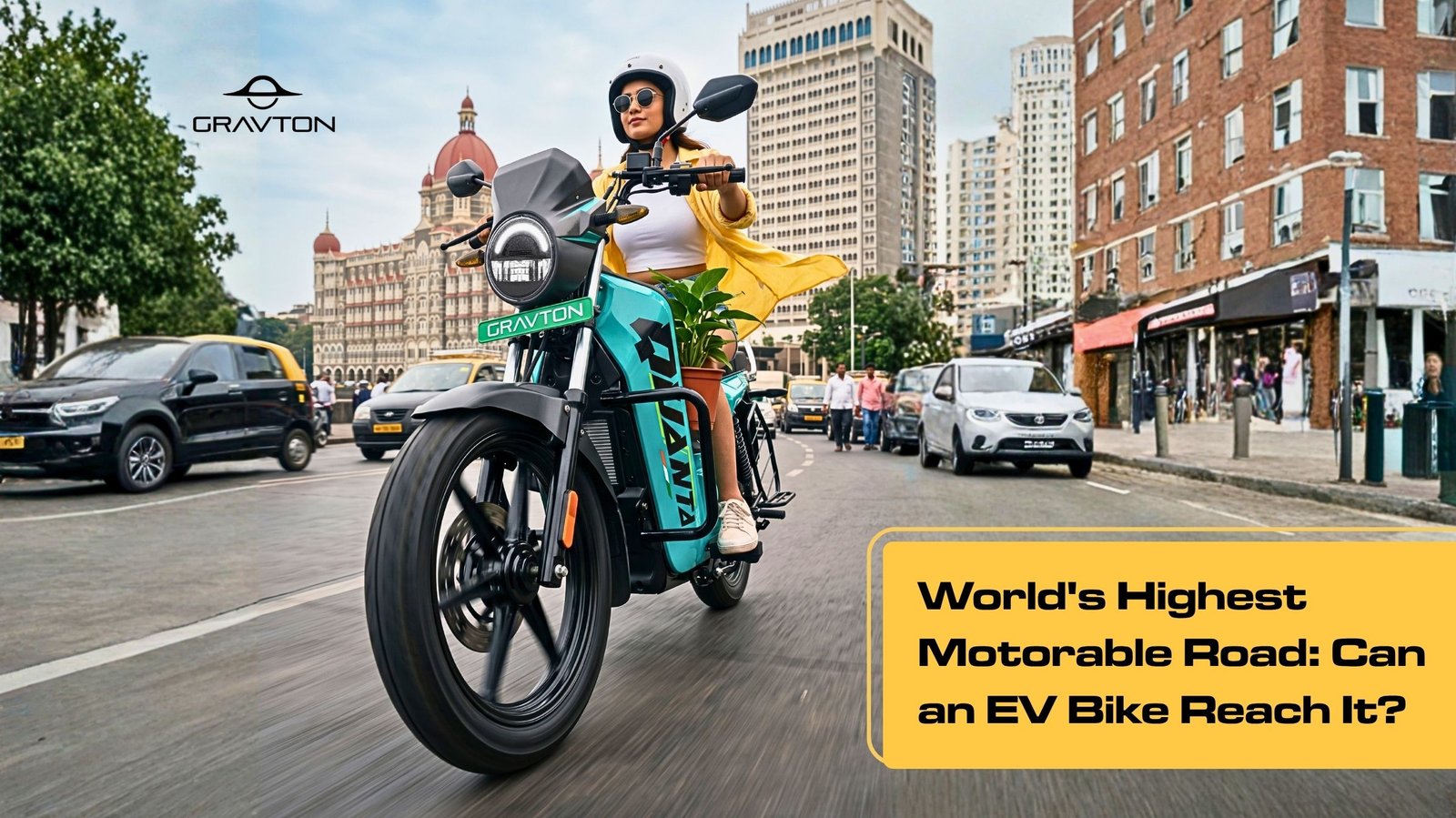
World’s Highest Motorable Road: Can an Electric Bike Conquer the World’s Highest Roads?
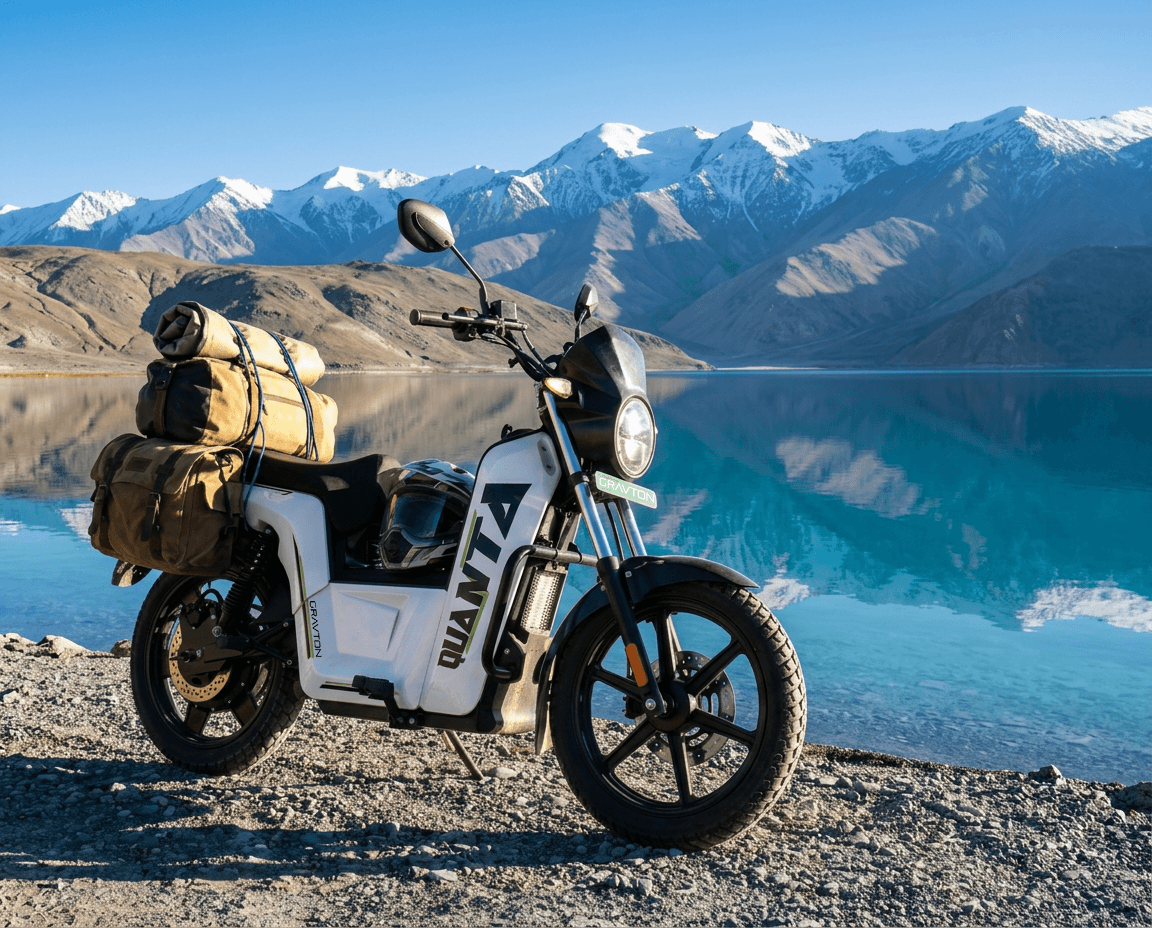
The World’s Highest Motorable Road in Ladakh presents a formidable challenge for riders and machines alike. But can an electric bike handle extreme altitude, cold temperatures, steep climbs and remote roads? Explore the engineering challenges, the realities of high-altitude EV riding and what Gravton Quanta’s Kanyakumari to Khardung La record tells us about electric mobility.
-
Maximising EV Bike Battery Range: How to Get More Kilometres From Every Charge
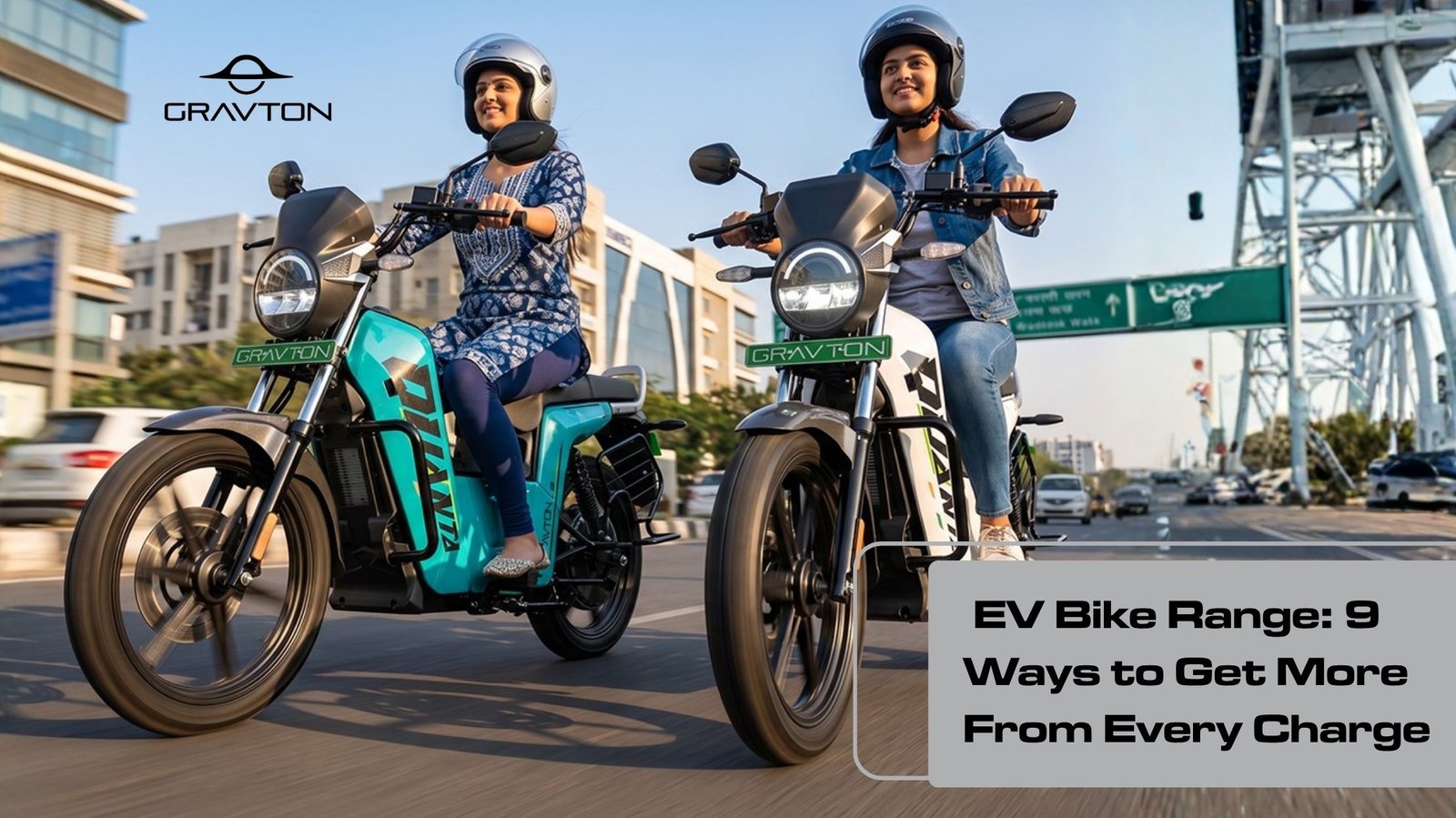
Getting the most range from an EV bike is not just about battery capacity. Riding speed, throttle control, regenerative braking, riding modes, tyre pressure and charging habits all influence how far you travel. Learn how to make every charge count, with practical examples from the Gravton Quanta.