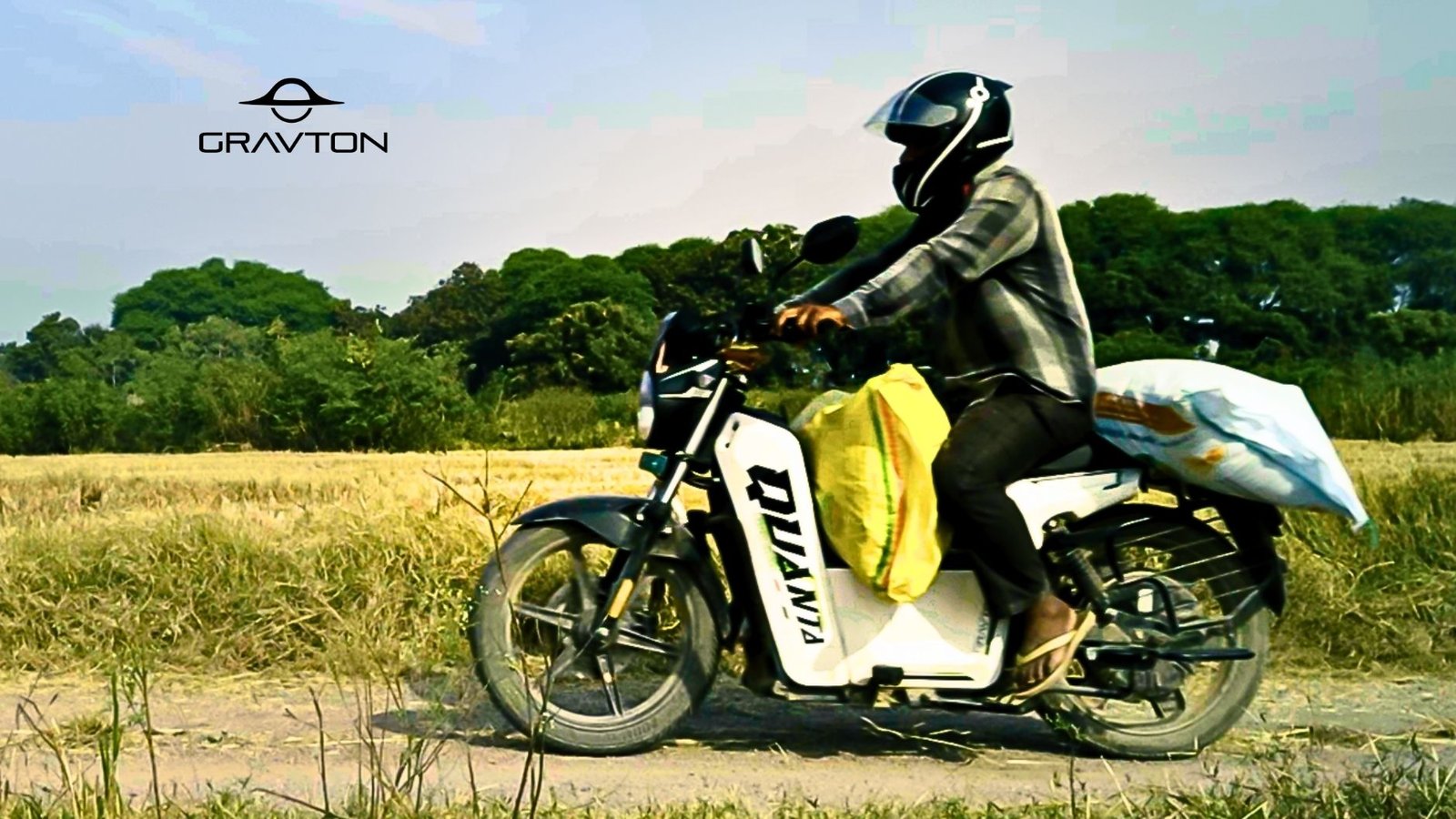
Two riders, the same electric bike, the same fully charged battery. One commutes alone with a laptop bag. The other drops a child at school each morning and carries groceries home. By evening their battery gauges tell two very different stories, and the difference comes down to one thing most riders never think about: weight.
If you own an electric two-wheeler, the link between weight and electric bike range is one of the most useful things you can understand. It explains why range changes from day to day, why a pillion makes the gauge fall faster, and what you can do about it. This guide explains the physics in plain language, shows the numbers in charts, and gives you practical ways to protect your range.
The short answer
- Each extra 10 kg costs roughly 2 to 4% of range in our model, depending on how and where you ride.
- Weight matters most in the city and on hills, where you accelerate, brake and climb often. It matters least at steady highway speeds.
- An adult pillion can cost about 18% of range in city riding.
- Everyday items add up. A laptop bag costs little. Heavy luggage, a full delivery box and a pillion cost a lot.
- You can offset much of it with the right tyre pressure, smooth riding, regenerative braking and a sensible range buffer.
Weight and Electric Bike Range: The Short Answer
Your electric bike spends battery energy on four jobs: pushing the tyres along the road, pushing through the air, climbing slopes and speeding up after every stop. Three of those four jobs get harder when the total weight goes up. Only air drag mostly ignores weight.
That is why weight and electric bike range are so closely linked, and why the link is strongest in stop-start city traffic and on hilly roads.
Typical range lost for every extra 10 kg of rider, pillion or load (illustrative model, see assumptions below)
Why Weight Changes Range: Four Forces at Work
Understanding the four forces makes everything else easy to follow.
Rolling resistance
Scales with weight? Yes
Tyres squash and flex under load. More weight means more flex and more energy lost, every metre.
Air drag
Scales with weight? Barely
Depends on speed and body shape, not on weight. It dominates at higher speeds.
Climbing
Scales with weight? Yes
Lifting a heavier load up a slope costs energy in direct proportion to its weight.
Accelerating and braking
Scales with weight? Yes
Heavier vehicles carry more kinetic energy, so every stop-start cycle costs more.
Everything about weight and electric bike range follows from these four forces. The pattern is clear. Rolling resistance, climbing and stop-start energy all grow in direct proportion to total weight. Air drag depends on speed and shape. So the more of your riding is slow, stop-start or uphill, the more weight matters.
Weight and Electric Bike Range in Three Riding Conditions
Here is how weight and electric bike range interact in practice. We built a simple physics model for a typical electric two-wheeler and tested three common conditions. In each case the rider and vehicle together weigh 190 kg at the start, and we add weight in steps.
Look at the right-hand labels. At a steady 40 km/h, only about 41% of your energy depends on weight. In stop-start city riding it rises to about 64%, and on a hilly commute to about 69%. That single difference explains why the same pillion feels cheap on an empty road and expensive in traffic.
| Added weight | Steady 40 km/h, flat road | City stop-start, 30 km/h | Hilly commute with stops |
|---|---|---|---|
| +10 kg | -2% | -3% | -4% |
| +25 kg | -5% | -8% | -8% |
| +50 kg | -10% | -14% | -15% |
| +75 kg | -14% | -20% | -21% |
Range lost compared with the rider alone (190 kg total). Illustrative model results.
These numbers show how weight and electric bike range move together, and they give you a quick way to plan.
How we modelled it. Vehicle 120 kg and rider 70 kg. Rolling resistance coefficient 0.015, drag area 0.55 square metres, air density 1.2 kg per cubic metre, battery-to-wheel efficiency 80%. City riding: 30 km/h cruise with 2 full stops per kilometre. Hilly commute: 30 km/h, 1 stop per kilometre, and 15% of the distance uphill at a 6% grade. No energy is recovered on descents or braking unless stated. These are simplified, illustrative assumptions, not test results for any specific vehicle.
What Everyday Loads Cost You in Range
Charts and formulas are useful, but riders want to know how weight and electric bike range play out in their own day. Here is what common loads cost in city riding.
- A laptop bag or small backpack costs about 1 to 3% of range. Not worth worrying about.
- A grocery run or delivery bag of 10 to 15 kg costs about 3 to 5%.
- An adult pillion costs about 18%. Add shopping and the figure reaches about 20%.
For riders who carry loads for a living, such as delivery riders, these percentages translate directly into charging stops and earnings. See our guide on choosing an OEM partner for an electric delivery fleet.
Pillion, Luggage and Delivery Boxes: Weight and Electric Bike Range in Real Life
Pillion. Carrying a passenger is the largest single weight change most riders make. Plan with a buffer: if your normal range is 100 km, expect roughly 82 to 88 km with an adult pillion, depending on conditions.
Luggage. Heavy luggage matters, and so does where you put it. Keep it low and close to the centre of the vehicle for stability, and take out anything you do not need.
Delivery boxes and top boxes. A box adds its own weight and, at higher speeds, extra air drag. Remove the box when you are not working, and avoid carrying empty weight.
The rider. Rider weight is simply part of the total load, like any other. Two riders on the same vehicle will see slightly different ranges, and that is normal.
Tyre Pressure and Load: The Hidden Multiplier
Tyre pressure changes the relationship between weight and electric bike range. Weight and tyre pressure work together. Under-inflated tyres flex more, which raises rolling resistance, and the penalty grows when the load is heavier.
How much pressure loss produces these increases depends on the tyre, so treat the chart as a guide to the size of the effect. The fix is simple and free. Check tyre pressure when the tyres are cold, at least once a week, and follow the manufacturer’s recommended pressure for the load you carry. Your owner’s manual may list a different setting for a pillion.
Does a Heavier Battery Help or Hurt Range?
A bigger battery changes weight and electric bike range in a subtler way. A bigger battery weighs more, so does it cancel its own benefit? In practice, no. A larger battery adds much more stored energy than the energy needed to carry its extra weight, so range still goes up. The gains simply taper off as batteries get larger. That is why designers balance battery size, frame strength and total weight.
It also means a lighter vehicle is not automatically a longer-range one. Battery capacity, motor efficiency and overall design matter alongside weight. For example, Gravton lists the QRX at a kerb weight of 105 kg with a 3 kWh battery.
Can Regenerative Braking Offset the Weight Penalty?
Partly, and regenerative braking softens the link between weight and electric bike range. It is a nice bit of physics. A heavier vehicle carries more kinetic energy, which means there is more energy to recover when you slow down. Where regenerative braking is fitted, it gives some of that energy back. In the city model, with 25 percent of braking energy recovered, each extra 10 kg costs about 3.2% of range instead of 3.3%.
Smooth, early braking helps regeneration work best.
How to Protect Your Range When You Carry More
Use these seven habits to manage weight and electric bike range together.
- Take out what you do not need. Empty tool kits, spare gear and unused boxes all count.
- Keep tyres at the recommended pressure, including the pillion setting if your manual lists one.
- Accelerate smoothly. Gentle throttle saves the energy that heavy stop-start riding would otherwise waste.
- Look ahead and brake early so regenerative braking, where fitted, can recover energy.
- Use Eco mode when it suits the route, and avoid sustained top speed.
- Plan a 25 percent buffer when you carry a pillion or a heavy load, and start with a full charge.
- Distribute the load well. Low and central is more stable and easier on handling.
For more riding technique, read our guide to electric vehicle charge time, cost and battery life tips, and see how charging works day to day in our guide to electric two-wheeler charging in India.
Payload vs Range: Do Not Confuse Them
Payload is a different question from weight and electric bike range. Payload is the maximum weight a vehicle is rated to carry safely. Range is how far it goes on a charge. They are different things. Gravton rates both the Quanta and the QRX for a 150 KG payload, which tells you what the vehicle can carry safely. It does not mean range stays the same at that load.
- Stay within the payload rating. It is a safety limit for braking, stability and component stress.
- Expect lower range when you load up. Plan for it, using the charts above.
- Check braking and handling. A heavier load needs more distance to stop.
Climbing Is Where Weight Hurts Most
Hills raise the stakes for weight and electric bike range, because you are lifting the load as well as moving it. That is also why gradability matters. If your routes include flyovers and slopes, read our explainer on gradability and why your EV’s climbing power matters.
Weight and Electric Bike Range: The Bottom Line
Weight is one of the biggest levers on range that riders control every day. Each extra 10 kg costs roughly 2 to 4% of range, more in the city and on hills, less on open roads. Small items hardly matter, a pillion matters a lot, and good habits recover much of the loss. Know your usual load, plan a sensible buffer and keep your tyres right, and your range will stop being a surprise.
For context. Range figures for any electric vehicle, including the Gravton Quanta (Quanta S up to 125 KM and Quanta S+ up to 165 KM, claimed), are quoted under standard test conditions. Real-world range depends on load, speed, terrain, temperature and riding style, so use the charts here to plan.
Feel the Difference Yourself
Book a test ride and see how an electric motorcycle handles a real load on your own route.
Book a Test Ride Explore the QuantaFrequently Asked Questions
How are weight and electric bike range related?
Weight and electric bike range are inversely related: the more total weight the bike carries, the less distance a charge delivers. Heavier loads increase rolling resistance, climbing energy and stop-start energy, while air drag barely changes.
How much does weight affect electric bike range?
In a simple physics model, each extra 10 kg reduces range by roughly 2 to 4 percent depending on the riding conditions. The effect is smallest at steady cruising speeds and largest in stop-start traffic and on hills.
Does carrying a pillion reduce range on an electric bike?
Yes. An adult pillion of about 65 kg can reduce range by roughly 12 to 19 percent in the model, with city riding in between at about 18 percent. Real-world results vary with the vehicle, riding style and route.
Does the rider's own weight matter for range?
Yes. Rider weight is part of the total mass the motor has to move, just like luggage or a pillion. A heavier rider can expect a slightly shorter range than a lighter rider on the same vehicle, all else being equal.
Does weight matter more in the city or on the highway?
Weight matters more in the city and on hills. Stop-start riding turns weight into repeated acceleration energy, and climbing lifts the load against gravity. At higher steady speeds, air drag dominates and weight matters less.
Does a heavier battery reduce range?
A larger battery adds weight, but it also adds much more stored energy, so range still rises in practice. The gain is smaller than the battery capacity alone suggests, because the extra mass costs some energy to carry.
Do top boxes and delivery boxes reduce range?
Yes, in two ways. They add weight, and a large box can increase air drag, especially at higher speeds. Keep boxes empty of unneeded items and securely mounted.
Does tyre pressure matter more when carrying extra weight?
Yes. Low pressure raises rolling resistance, and the penalty grows when the load is heavier. Check pressure when the tyres are cold and follow the manufacturer's recommended pressure for the load you carry.
Does regenerative braking help when carrying more weight?
Yes, partly. A heavier vehicle has more kinetic energy to recover when it slows, so regenerative braking, where fitted, offsets some of the weight penalty. In the city model with 25 percent recovery, each extra 10 kg costs about 3.2 percent instead of 3.3 percent.
What is the difference between payload and range?
Payload is the maximum weight a vehicle is rated to carry safely. Range is the distance it can travel on a charge. Staying within the payload rating is a safety matter, and carrying a heavy load inside the rating will still reduce range.
How can I protect my electric bike range when carrying more weight?
Remove unneeded items, keep tyres at the right pressure, accelerate smoothly, use Eco mode where suitable, brake early to use regenerative braking and plan a 25 percent range buffer when you carry a pillion or a heavy load.
About this article. Published by Gravton Motors, Hyderabad, an electric two-wheeler manufacturer, so Gravton details are manufacturer-provided. The charts on weight and electric bike range come from a simplified physics model with the assumptions stated above. They are illustrative and not test results for any specific vehicle.
Website: www.gravton.com | Email: connect@gravtonmotors.com | Phone: 7995252220
Disclaimer: This article is published by Gravton Motors Pvt. Ltd. for general informational purposes only. The insights, opinions, estimates and recommendations shared here are illustrative, may not apply to every vehicle, location or situation, and do not constitute professional, technical, legal or financial advice. While we aim to be accurate, Gravton Motors makes no guarantee of the accuracy, completeness or timeliness of the content and cannot be held responsible for any loss, damage or inconvenience arising from reliance on it. Always refer to your vehicle's owner's manual and consult the manufacturer or a qualified professional before acting. References to third-party organisations and links are provided for convenience and do not imply endorsement.
World’s Highest Motorable Road: Can an Electric Bike Conquer the World’s Highest Roads?