Choosing a two-wheeler is a personal decision. For some women, it begins with the convenience of commuting independently. For others, it is about travelling to work, managing everyday errands, riding with family or simply enjoying the freedom of being on the road.
Yet the conversation around motorcycles for women often centres on a narrow set of assumptions. Smaller vehicles, lower power and lighter weight are frequently presented as the obvious answers. These characteristics can be relevant, but they do not tell the whole story.
What matters more is how a vehicle fits the rider. Can she mount and dismount comfortably? Can she reach the controls naturally? Does the seat allow her to maintain a stable riding position? Is the throttle predictable in traffic? Can she manoeuvre the vehicle at low speeds and bring it to a controlled stop when required?
These are practical considerations that apply to every rider, but they deserve particular attention when choosing a motorcycle that feels comfortable and manageable for the individual.
Electric motorcycles offer an additional advantage: their electric drivetrains eliminate the need to operate a conventional clutch and manually shift gears. This can make stop-and-go riding simpler for people who prefer a less complicated riding experience.
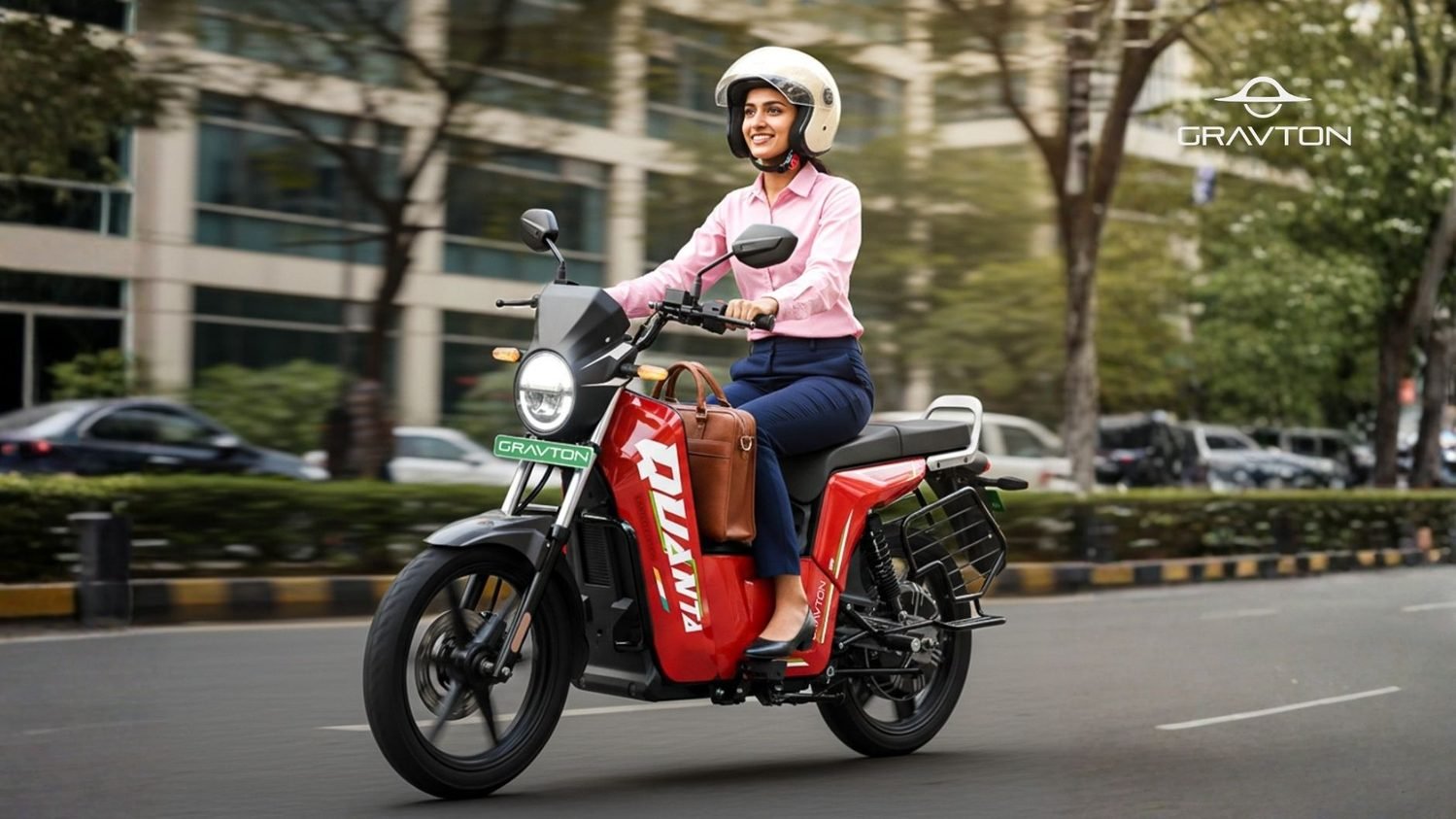
The Gravton Quanta takes a different approach to this combination of convenience and capability. Its step-through frame makes mounting and dismounting more accessible than on many conventional motorcycle layouts, while its 17-inch wheels, motorcycle-style riding position, hub motor and dual disc brakes with a combi-braking system bring a different set of characteristics to the experience.
The important question is not whether one motorcycle is universally better for all women. It is which design features make a vehicle better suited to an individual rider’s height, strength, experience, daily routes and expectations.
1. Start With Ergonomics, Not Gender Stereotypes
A motorcycle should fit the person riding it. Height, inseam length, arm reach, upper-body strength, riding experience and intended use all influence how comfortable and manageable a vehicle feels.
Two riders of the same height may have different inseam lengths or proportions. One may feel comfortable on a particular seat, while another may struggle to place her feet securely when stopping.
This is why choosing an electric motorcycle for women riders should begin with ergonomics rather than assumptions about what women can or cannot ride.
There are five important areas to evaluate.
- Mounting and dismounting: Can the rider get on and off without awkward movements?
- Seat and foot reach: Can she maintain a stable position when stationary?
- Handlebar reach: Can she steer comfortably without stretching or leaning excessively?
- Throttle and brake control: Can she operate the controls smoothly and confidently?
- Low-speed balance: Can she manoeuvre the vehicle through traffic, parking spaces and tight turns?
A motorcycle that performs well on paper may not be the right fit if its ergonomics make everyday riding uncomfortable. Conversely, a motorcycle with substantial performance capability can be perfectly appropriate for a rider who finds its dimensions and controls manageable.
The best starting point is therefore a vehicle that fits the rider, rather than a category defined by gender.
2. Why a Step-Through Frame Can Make a Difference
Mounting a conventional motorcycle typically involves swinging one leg over the seat. Depending on the seat height, the rider’s mobility and the clothing she is wearing, this movement can sometimes be inconvenient.
A step-through frame changes that experience by providing an open space through which the rider can mount the vehicle.
This is one reason many riders appreciate scooter-style ergonomics. The convenience is particularly noticeable during journeys involving frequent stops, such as commuting through traffic, visiting shops or making several short trips throughout the day.
The Gravton Quanta brings this convenience into an electric utility motorcycle.
Its step-through design allows the rider to mount and dismount without the conventional leg-swinging movement associated with many motorcycles. This can be useful for riders who prefer a more accessible frame layout, including those who regularly wear long or restrictive clothing.
The distinction is important because the Quanta does not simply follow a conventional scooter layout. It combines the step-through frame with a motorcycle-style riding experience and 17-inch wheels.
For riders who want the accessibility of a step-through design without limiting their choice to a conventional scooter, this combination is worth considering.
However, the frame design is only one part of the equation. A step-through motorcycle still needs to be balanced at low speeds, and the rider must be comfortable reaching the ground when stopping. The benefit is easier mounting and dismounting, not the elimination of every physical demand associated with riding.
3. Seat Height and Seat Design: What Should Women Riders Look For?
Seat design is often discussed in terms of cushioning alone. In practice, comfort depends on several factors working together.
Seat height influences how easily a rider can place her feet on the ground. Seat width affects how far the legs must spread when reaching for the road. Seat shape determines how the rider’s weight is distributed, while cushioning and suspension influence comfort over longer journeys.
For a rider who is still developing confidence, being able to place both feet securely on the ground may be more important than having a particularly soft seat.
Seat height is only part of the story
The Gravton Quanta has a published seat height of 800 mm. That measurement should be considered honestly when evaluating fit.
For some riders, the height may feel natural. Others, particularly those with shorter inseams, may find it difficult to place both feet flat on the ground. The step-through frame helps with mounting and dismounting, but it does not change the seat height or guarantee that every rider can comfortably reach the ground.
This is why a test ride is essential. Riders should check their actual foot reach while seated, rather than relying on height specifications alone.
Seat shape and riding posture matter too
A well-shaped seat should allow the rider to maintain a comfortable position without excessive pressure or the need to keep shifting around.
The Quanta features individual seats for the rider and pillion. Its front suspension uses a telescopic arrangement, while the rear uses dual spring-type suspension.
These features form part of the overall riding experience. Actual comfort will depend on the rider’s body proportions, road conditions, suspension response and journey duration.
During a test ride, pay attention to how the seat feels after more than a few minutes. Check whether the handlebars are within comfortable reach and whether the riding position allows you to maintain control without unnecessary strain.
A motorcycle should feel manageable when stationary and comfortable enough for the journeys you intend to make.
What Makes Gravton Quanta a Contender for the Best Electric Bike in India?
4. Throttle Response and Riding Modes: Confidence Comes From Control
Throttle behaviour can make a noticeable difference to the riding experience, particularly in congested traffic.
A rider frequently needs to move away from a traffic signal, adjust speed in a narrow lane, negotiate a junction or slow down behind another vehicle. A predictable throttle response helps make these adjustments more controlled.
Electric motorcycles do not require clutch operation or manual gear changes. This removes two tasks associated with conventional geared motorcycles and can simplify the experience for riders who prefer a more straightforward control arrangement.
However, electric motors can deliver torque quickly. That responsiveness makes appropriate throttle control important, especially for a new rider.
The Gravton Quanta offers three riding modes: ECO, POWER and SPORT.
| Riding mode | Published speed limit for Quanta S | Where it may be useful |
|---|---|---|
| ECO | 40 km/h | Moderate-speed commuting and everyday urban journeys |
| POWER | 55 km/h | Situations requiring more speed flexibility |
| SPORT | 75 km/h | When additional speed capability is needed and road conditions permit |
These are published speed limits for the Quanta S, not recommendations for the appropriate speed on every road.
For a rider becoming familiar with the vehicle, ECO mode can provide a useful starting point when its speed limit suits the route. It allows the rider to become accustomed to the throttle response and vehicle behaviour before exploring the other modes.
The mode itself does not replace good riding technique. Smooth throttle inputs, appropriate speed and anticipation of traffic remain essential.
More experienced riders may prefer the additional responsiveness available in POWER or SPORT mode, depending on their riding needs. The advantage is having a choice rather than being restricted to one fixed performance setting.
The objective is not to assume that women need less power. It is to give each rider the opportunity to select a level of performance that suits the situation and her comfort with the vehicle.
5. Handling and Stability: What Makes a Motorcycle Feel Manageable?
A motorcycle’s handling is influenced by its wheelbase, wheel dimensions, weight distribution, tyres, steering geometry, suspension and overall construction.
These factors determine how the vehicle responds to steering inputs, how it behaves over uneven surfaces and how manageable it feels at different speeds.
For women evaluating electric motorcycles, the practical questions are straightforward. Does the vehicle respond predictably when turning? Is it comfortable to manoeuvre through traffic? Can it be controlled at walking speed? Does it feel manageable when parking or moving it in a confined space?
The Gravton Quanta uses 17-inch alloy wheels and a 1,260 mm wheelbase. It also features a rib-cage chassis and telescopic front suspension with dual spring-type rear suspension.
These are relevant design characteristics when evaluating its road behaviour. The larger wheel format is intended to support road handling across varied surfaces, while the chassis and suspension contribute to the vehicle’s overall structure and ride characteristics.
Nevertheless, wheel size alone does not prove that a motorcycle is more stable than another. Handling depends on the complete vehicle design, road conditions, tyre condition and rider inputs.
Weight also deserves attention. The Quanta S has a published kerb weight of 117 kg, while the S+ is listed at 123 kg. These figures are important because a rider needs to feel comfortable not only while moving but also when balancing the vehicle at a stop or manoeuvring it without motor assistance.
A test ride should include slow turns, controlled stops and parking manoeuvres in a safe environment. The right motorcycle is one the rider can manage comfortably, not simply one with impressive dimensions or performance figures.
6. Braking and Safety: Confidence Depends on Predictable Responses
Braking is one of the most important aspects of motorcycle control. Traffic can stop unexpectedly, pedestrians may cross the road, and uneven surfaces can demand immediate adjustments.
A good braking system must work in conjunction with the tyres, suspension, vehicle geometry and the rider’s technique.
The Gravton Quanta features dual disc brakes with a Combi-Braking System (CBS). The braking arrangement is designed to distribute braking effort between the wheels according to the system’s configuration.
Disc brakes provide braking capability at both ends of the vehicle, while CBS is intended to coordinate braking inputs. The actual stopping distance depends on speed, tyre grip, road surface, load, brake condition and how the rider applies the brakes.
For a rider choosing her first electric motorcycle, the key is to understand how the brakes respond under controlled conditions.
During a supervised test ride, check whether the brake levers are comfortable to reach, whether the controls feel progressive and whether the vehicle remains predictable during normal braking.
New riders should also practise controlled stopping in a safe, open area before riding in heavy traffic.
Other details matter as well. The Quanta includes a side-stand immobiliser designed to prevent motor operation while the stand is engaged, along with a crash guard intended to help protect the vehicle and rider in a fall.
These features contribute to the vehicle’s safety-oriented design, but no individual feature can eliminate the risks of riding. Proper protective equipment, a correctly fitted helmet, appropriate speed and defensive riding remain essential.
Confidence comes from knowing how the vehicle responds and developing the skills to operate it safely.
7. Everyday Comfort on Indian Roads
A motorcycle may feel comfortable on a smooth road but behave differently when faced with potholes, speed breakers, uneven surfaces and repeated changes in road level.
This is why suspension and ground clearance deserve attention when choosing an electric two-wheeler for daily commuting.
The Gravton Quanta has a published ground clearance of 190 mm. Its telescopic front suspension and dual spring-type rear suspension are intended to accommodate everyday road conditions.
Ground clearance provides space beneath the vehicle when crossing road obstacles. It does not, by itself, guarantee a comfortable ride. Suspension tuning, tyre pressure, load and riding speed also influence how the vehicle behaves.
For women who commute daily, practical comfort includes more than how the vehicle feels over a bump. It also includes the ease of mounting and dismounting repeatedly, maintaining a comfortable posture, reaching the controls and managing the vehicle during frequent stops.
A useful test ride should therefore include a representative mix of road surfaces where possible. Pay attention to whether the riding position feels natural, whether the suspension response is comfortable and whether the vehicle remains manageable at the speeds you normally use.
The best choice is one that fits your everyday environment rather than one that feels impressive only during a short ride on a smooth road.
8. Range and Running Costs for Independent Daily Mobility
For someone relying on a two-wheeler to get to work, attend appointments or manage household responsibilities, range is a practical consideration.
The Gravton Quanta is available in two variants with different battery capacities and manufacturer-claimed ranges.
| Specification | Quanta S | Quanta S+ |
|---|---|---|
| Battery capacity | 2.78 kWh | 3.8 kWh |
| Claimed range | Up to 125 km | Up to 165 km |
| Maximum speed | Up to 75 km/h | Up to 75 km/h |
| Quoted running cost | Approximately ₹0.10/km | Approximately ₹0.10/km |
Range and running-cost figures are manufacturer claims. Actual results depend on riding style, speed, road conditions, load, charging losses and electricity tariffs.
The choice between the two variants should reflect how far you travel and how much range flexibility you need.
A rider with a predictable daily commute may find the Quanta S sufficient, while someone covering longer distances may prefer the S+ and its larger battery.
The published running cost can also help buyers estimate everyday expenses. However, the actual cost will vary with local electricity rates and usage. A complete ownership calculation should include the purchase price, insurance, financing, servicing and other relevant expenses.
Range should be evaluated realistically. Riders should not assume that the advertised maximum will always be available in traffic, on inclines or with additional load.
For independent daily mobility, the goal is to choose a vehicle that covers the journeys you actually make with enough reserve to accommodate unexpected changes.
9. Family Use and Carrying a Passenger
For many riders, a two-wheeler serves both individual and family needs. A vehicle used for commuting may also be expected to carry a partner, parent or another passenger.
This makes the seating arrangement, passenger comfort, braking, suspension and permitted load important considerations.
The Quanta features individual seats for the rider and pillion, along with a published gross vehicle weight rating that varies by variant. Riders should check the applicable payload and gross vehicle weight limits in the official specifications and ensure that the combined weight of occupants and luggage stays within those limits.
When evaluating passenger use, pay attention to the space available, the passenger’s seating position and the vehicle’s behaviour when moving off and slowing down.
A rider who is comfortable operating a motorcycle alone may need additional practice before carrying a passenger. Extra weight changes the vehicle’s balance and braking requirements.
The safest approach is to become familiar with the vehicle first, then practise passenger riding in controlled conditions before using it in demanding traffic.
10. What Makes the Gravton Quanta Different?
The Gravton Quanta is worth considering for riders who want the convenience of a step-through design without giving up the characteristics of a motorcycle-oriented electric two-wheeler.
Its proposition is based on the combination of features rather than any single specification.
- Step-through frame: Provides an alternative to the conventional leg-swinging mounting movement.
- Three riding modes: ECO, POWER and SPORT let the rider choose between different speed limits and performance characteristics.
- 17-inch alloy wheels: Form part of the vehicle’s road-oriented design.
- Dual disc brakes with CBS: Provide a coordinated braking arrangement.
- 190 mm ground clearance: Offers space beneath the vehicle when negotiating common road obstacles.
- Individual rider and pillion seats: Provide separate seating positions.
- Two battery options: Allow buyers to choose between different capacities and claimed ranges.
- Electric drivetrain: Eliminates conventional clutch operation and manual gear changes.
Together, these characteristics make the Quanta a different proposition from a conventional motorcycle that requires the rider to swing a leg over the seat.
The design may be particularly relevant to women who value the convenience of a step-through frame but want a motorcycle-style riding experience. It may also suit other riders who prioritise the same characteristics.
There are, however, important considerations. The Quanta’s published seat height is 800 mm, and its kerb weight varies from 117 kg to 123 kg depending on the variant. These dimensions may work well for some riders but may not suit everyone.
That is precisely why the buying decision should be based on the individual rider’s fit, not a general claim that one motorcycle is ideal for all women.
11. A Practical Test-Ride Checklist for Women Buying an Electric Motorcycle
Specifications can narrow down the options, but a test ride helps establish whether a vehicle is genuinely comfortable and manageable.
Before making a decision, work through the following checks.
Mounting and dismounting
- Can you get on and off comfortably?
- Does the frame design suit your usual clothing and movement?
- Can you do this without feeling unbalanced?
Seat and reach
- Can you place your feet securely when stationary?
- Can you reach the handlebars without stretching?
- Does the seat remain comfortable after several minutes?
Throttle and controls
- Is the throttle response predictable?
- Can you operate the brakes comfortably?
- Do the riding modes feel appropriate for your experience and route?
Handling and parking
- Can you manoeuvre the vehicle slowly in a safe area?
- Does it feel manageable when making a tight turn?
- Can you park it and move it in a confined space without excessive strain?
Braking and road comfort
- Do the brakes respond predictably during controlled stops?
- Does the suspension feel suitable for your regular roads?
- Does the vehicle remain comfortable and controllable over ordinary road irregularities?
Ownership requirements
- Is the claimed range suitable for your daily distance?
- Can you charge the vehicle conveniently?
- Is authorised service support available where you live?
- Have you checked the current price, warranty and service terms?
Do not feel obliged to choose a vehicle simply because its specifications look impressive. A good purchase is one that you can use comfortably and confidently in your everyday life.
You can book a Gravton Quanta test ride to assess its ergonomics, throttle response and handling for yourself.
Frequently Asked Questions
1. Which electric motorcycles are better for women riders?
The best electric motorcycle depends on the rider’s height, inseam, strength, experience, daily distance and comfort preferences. Look for an accessible frame, suitable seat height, comfortable handlebar reach, predictable throttle response, manageable weight and effective braking. A test ride is essential before making a decision.
2. Is a step-through electric motorcycle easier for women to ride?
A step-through frame can make mounting and dismounting more convenient because the rider does not need to swing a leg over a conventional motorcycle seat. However, it does not eliminate the need to balance the vehicle or ensure that the rider can reach the ground comfortably.
3. Is the Gravton Quanta suitable for women riders?
The Quanta may suit women who prefer a step-through frame combined with a motorcycle-style riding experience. It offers three riding modes, 17-inch wheels and dual disc brakes with CBS. Its published seat height of 800 mm and kerb weight of 117 kg for the S or 123 kg for the S+ should be evaluated during a test ride.
4. What seat height is best for a woman riding an electric motorcycle?
There is no single ideal seat height for all women. Inseam length, seat width and shape, suspension sag and riding posture influence how easily a rider can reach the ground. Choose a motorcycle that allows you to stop and maintain balance comfortably.
5. Are electric motorcycles easier to ride than petrol motorcycles?
Electric motorcycles generally eliminate clutch operation and manual gear changes, which can simplify riding in stop-and-go traffic. However, weight, throttle response, braking, balance and overall ergonomics still influence how easy a particular vehicle is to manage.
6. Why are dual disc brakes important on an electric motorcycle?
Dual disc brakes provide braking capability at both wheels. When combined with CBS, the system is designed to distribute braking effort between the wheels according to its configuration. Actual stopping performance depends on tyres, road conditions, speed, load and braking technique.
7. Is the Gravton Quanta suitable for shorter women?
It depends on the rider’s proportions and comfort with the vehicle. The Quanta’s step-through frame can make mounting easier, but its published seat height is 800 mm. Shorter riders should assess foot reach and low-speed balance during a supervised test ride before purchasing.
8. What should a woman look for when buying her first electric motorcycle?
Prioritise fit, predictable controls, manageable low-speed behaviour, comfortable braking and convenient charging. Learn the riding modes, practise stopping and turning in a safe environment, and choose a vehicle that feels appropriate for your experience rather than buying solely on performance specifications.
Conclusion: The Right Motorcycle Is the One That Fits the Rider
The conversation about electric motorcycles for women riders needs to move beyond the assumption that women require smaller or less capable vehicles. The more useful question is whether a motorcycle has been designed in a way that makes everyday riding convenient, comfortable and manageable for the person using it.
Frame design, seat height, foot reach, throttle response, braking and low-speed handling all contribute to that experience. So do range, charging convenience and the ability to use the vehicle for more than one part of daily life.
The Gravton Quanta brings together a step-through frame and a motorcycle-style riding experience, supported by three riding modes, 17-inch wheels and dual disc brakes with CBS. This combination makes it worth considering for riders who want an alternative to a conventional motorcycle layout.
It will not be the right fit for everyone, and its seat height and weight deserve careful consideration. The most reliable way to judge it is to assess the vehicle in person, understand its controls and take a test ride that reflects your actual riding needs.
A well-chosen electric motorcycle should not limit a rider’s ambitions. It should give her a vehicle she can operate comfortably, maintain confidently and rely on for the journeys that matter to her.
Disclaimer: This article is intended for general informational purposes only. Vehicle specifications, features, prices, warranty terms and availability may change. The suitability of a motorcycle depends on the individual rider’s physical proportions, riding experience, intended use and operating conditions. Product features do not guarantee accident prevention or eliminate riding risks. Readers should verify current specifications with Gravton Motors, follow the applicable owner’s manual and traffic regulations, wear appropriate protective equipment and undertake a test ride before purchasing. Gravton Motors Pvt. Ltd. cannot be held responsible for errors, omissions, or the insights and opinions shared in this article, or for decisions made based on its contents.