When people search for the best electric bike in India, they usually begin with a few familiar questions. How far can it travel on a single charge? How quickly does it accelerate? What does it cost to run? How well will it handle Indian roads? And, perhaps most importantly, will it fit the way they actually use a two-wheeler every day?
These are the right questions, but they rarely tell the whole story. An electric two-wheeler can offer an impressive range figure and still fall short when it comes to carrying a pillion, negotiating broken roads or managing a full day of commuting and errands. Performance matters, but so does practicality.
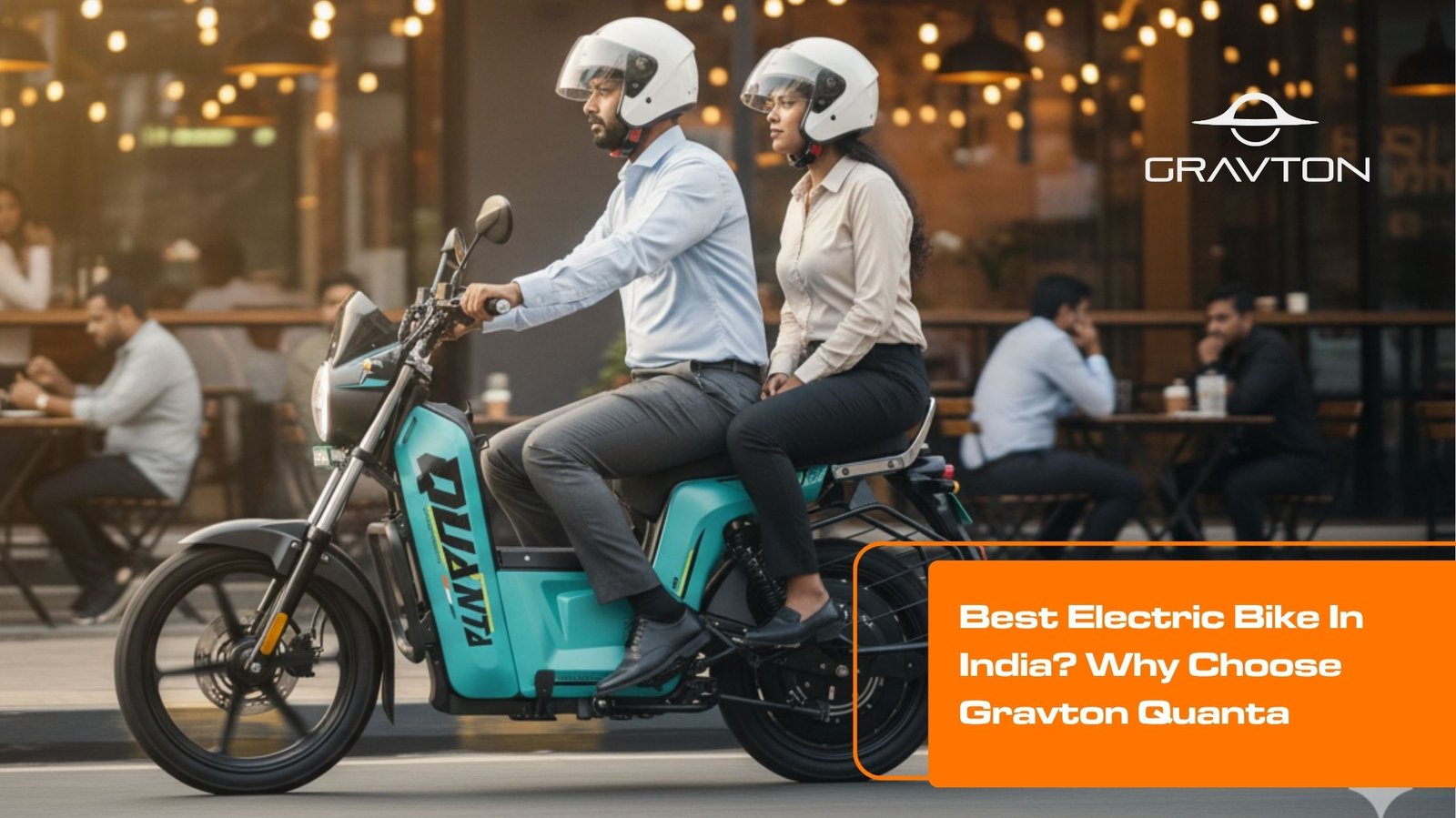
This is where the Gravton Quanta offers a different proposition. Developed by Hyderabad-based electric two-wheeler manufacturer Gravton Motors, the Quanta is an electric utility motorcycle designed around the demands of everyday Indian mobility. Its defining features include a step-through frame, a 172 Nm hub motor, 17-inch alloy wheels, 190 mm ground clearance and a claimed range of up to 165 km on the Quanta S+.
Rather than competing on a single headline specification, the Quanta brings together several characteristics that matter in real-world use.
So, does that make it the best electric bike in India? The answer depends on what you expect from your vehicle. For riders who value utility, road capability, carrying capacity and economical everyday travel, the Quanta deserves serious consideration.
1. A Different Approach to Electric Two-Wheeler Design
The Indian electric two-wheeler market offers plenty of options, from compact urban scooters to performance-oriented electric motorcycles. Each category serves a purpose, but the needs of everyday riders do not always fit neatly into one of them.
Consider a typical day. A rider may commute to work, pick up groceries, carry a passenger, navigate uneven roads and make several unplanned stops. A vehicle designed only around commuting efficiency may not be the most suitable choice for all these tasks.
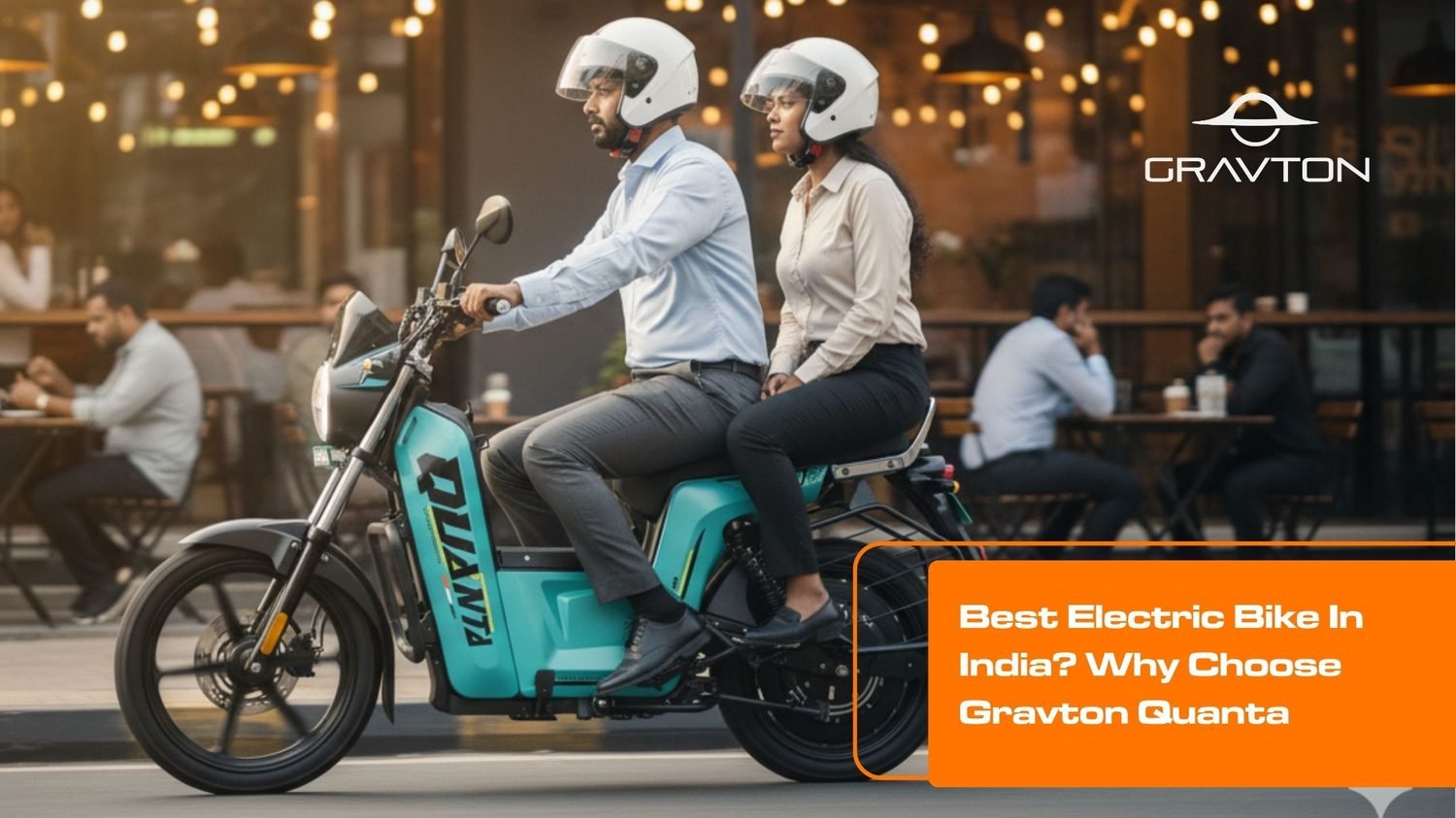
The Quanta approaches this problem through the idea of an urban electric utility motorcycle. Its design combines the riding characteristics of a motorcycle with the accessibility of a step-through frame.
That distinction is important. A step-through design allows the rider to mount and dismount without swinging a leg over a conventional motorcycle seat. It can be particularly convenient during frequent stops, while carrying everyday items or riding in clothing that makes a conventional motorcycle less comfortable to mount.
The Quanta is not designed around a single use case. Its appeal lies in accommodating several everyday requirements within one vehicle, without treating utility as an afterthought.
For a more detailed look at this design philosophy, read our article on India’s urban electric utility motorcycle, the Gravton Quanta.
2. Range That Supports Everyday Travel
Range remains one of the most important considerations when choosing an electric two-wheeler. A rider needs enough usable distance to complete daily journeys without constantly planning around the next charging opportunity.
Gravton offers two Quanta variants with different battery capacities and claimed ranges.
| Specification | Quanta S | Quanta S+ |
|---|---|---|
| Battery chemistry | LMFP | LMFP |
| Battery capacity | 2.78 kWh | 3.8 kWh |
| Claimed range | Up to 125 km | Up to 165 km |
| Maximum speed | Up to 75 km/h | Up to 75 km/h |
| Maximum wheel torque | 172 Nm | 172 Nm |
| Ground clearance | 190 mm | 190 mm |
| Wheels | 17-inch alloy | 17-inch alloy |
Specifications are based on Gravton Motors’ published product information. Range figures are manufacturer claims and should not be interpreted as guaranteed real-world distances.
The choice between the two variants should depend on how far you travel, how frequently you ride and the flexibility you need during the day.
The Quanta S may be suitable for riders whose daily journeys are relatively predictable. The higher-capacity battery in the S+ provides additional claimed range for those who cover longer distances or prefer a greater charging buffer.
Actual range will vary with rider and passenger weight, road gradients, speed, riding mode, tyre pressure, traffic and weather conditions. Riders who regularly travel long distances should evaluate the vehicle against their own usage rather than relying exclusively on advertised figures.
For anyone comparing the best electric bike in India for daily commuting, this distinction between claimed range and usable range is worth keeping in mind.
3. Torque and Climbing Ability Matter Beyond Top Speed
Top speed is easy to compare on a specification sheet. Everyday riding, however, involves much more than reaching a particular speed on an open road.
Starting from traffic signals, climbing flyovers, negotiating inclines and accelerating with a passenger all place different demands on a vehicle. This is why torque and climbing capability deserve attention alongside maximum speed.
The Gravton Quanta features a BLDC hub motor with a published maximum wheel torque of 172 Nm. Gravton also specifies a gradability figure of 33%.
For riders, the practical relevance is straightforward. Torque influences the force available at the wheel, while gradability indicates the vehicle’s ability to negotiate an incline under specified test conditions.
Together, these specifications help explain why the Quanta is positioned as a utility-focused electric motorcycle rather than simply an economical city commuter.
There is an important qualification, however. A gradability figure alone does not establish how a vehicle will perform on every slope or under every load. Surface conditions, battery charge, total vehicle weight and test methodology all affect actual performance.
The Quanta’s published specifications provide a useful starting point, but a test ride on roads similar to those you use every day is the best way to judge its response and handling.
4. Designed Around Indian Road Conditions
Road conditions are an important part of the electric two-wheeler buying decision in India. Riders frequently encounter speed breakers, damaged road surfaces, uneven patches, potholes and abrupt changes in road level, sometimes within the same journey.
A vehicle’s suitability for these conditions depends on several engineering decisions working together. Wheel dimensions, suspension, ground clearance, chassis construction, tyres and weight distribution all influence how it behaves on the road.
The Quanta features 17-inch six-spoke alloy wheels and 190 mm of ground clearance. Its rib-cage chassis is another defining element of the design.
The larger wheel format is relevant when considering how a wheel encounters road irregularities, although wheel size alone cannot establish ride comfort or handling performance. Suspension calibration, tyre construction and rider technique remain important.
Ground clearance is equally practical. At 190 mm, the Quanta offers space beneath the vehicle to help negotiate common road obstacles. Riders should still approach tall speed breakers, steep ramps and broken surfaces carefully, particularly when carrying a passenger or additional load.
The rib-cage chassis forms part of the vehicle’s structural architecture. It is designed around the demands of a utility motorcycle, where structural integrity and the protection of internal components matter alongside everyday usability.
These details may not be as immediately noticeable as a large touchscreen or an impressive acceleration figure. Yet they are precisely the kinds of considerations that matter when choosing a vehicle for regular use on Indian roads.
5. Practical Carrying Capacity for Everyday Needs
For many Indian households, a two-wheeler serves several purposes. It is a means of getting to work, taking a family member somewhere, running errands and occasionally carrying goods.
The vehicle therefore needs to accommodate more than the rider alone.
Gravton specifies a payload capacity of 150 kg for the Quanta. This provides a useful reference for riders who regularly travel with a passenger or carry everyday items.
Payload must be understood correctly. It refers to the permitted load carried by the vehicle, not the weight of luggage that can be added regardless of the rider and passenger. The manufacturer’s limits and the vehicle’s gross vehicle weight rating must always be respected.
The step-through frame also contributes to everyday convenience. Repeatedly mounting and dismounting becomes part of the riding experience when a journey involves multiple stops. A more accessible frame can make these movements easier for riders who prefer not to use a conventional motorcycle layout.
This combination of accessibility and carrying capacity is central to the Quanta’s utility proposition. It is designed for people who expect their two-wheeler to accommodate the practical details of daily life, not just the journey between two addresses.
For delivery riders and small business owners, the same characteristics may be relevant. However, commercial users should assess their actual load requirements, daily distance, charging arrangements and vehicle suitability before making a purchase decision.
6. Running Costs and the Economics of Electric Mobility
For most buyers, the cost of owning an electric two-wheeler extends beyond its purchase price. Electricity consumption, maintenance, battery warranty, financing and expected daily usage all contribute to the overall economics.
Gravton quotes an approximate running cost of ₹0.10 per kilometre for the Quanta. This is a manufacturer-stated estimate, not a universal cost applicable to every rider.
To understand what it could mean for your own usage, consider the following illustration.
| Daily distance | Monthly distance, assuming 30 days | Estimated monthly running cost at ₹0.10/km |
|---|---|---|
| 20 km | 600 km | ₹60 |
| 40 km | 1,200 km | ₹120 |
| 60 km | 1,800 km | ₹180 |
Illustrative calculations based on Gravton’s quoted running cost. Actual electricity costs may differ according to tariffs, charging losses, usage and operating conditions. These figures exclude purchase price, financing, insurance, maintenance and other ownership expenses.
The table illustrates the potential contribution of low energy costs, but it should not be mistaken for a complete ownership-cost comparison.
A meaningful comparison with a petrol two-wheeler should use the same annual distance and account for the actual petrol price, fuel efficiency, electricity tariff, servicing costs, insurance and financing. Buyers should also consider the purchase price difference and their expected ownership period.
For someone who rides extensively, even a modest difference in running cost can accumulate over time. The more relevant question is whether the vehicle’s overall cost of ownership makes sense for the distance you cover and the way you use it.
The Quanta’s electric powertrain makes it worth evaluating on those terms rather than judging its value on the showroom price alone.
7. Battery Technology, Charging and Warranty
Battery performance affects range, charging requirements, operating costs and the long-term ownership experience. It should therefore be one of the central considerations when evaluating any electric two-wheeler.
The Quanta uses an LMFP battery. The S has a published capacity of 2.78 kWh, while the S+ uses a 3.8 kWh battery.
Gravton lists a standard three-pin socket charging arrangement and quotes a full charging time of approximately 5.4 hours for the S+. The published charging information for the S+ also specifies approximately 3.46 hours for charging from 20% to 90%.
Charging times vary according to the starting battery level, charger output, ambient temperature and other operating conditions. Buyers should confirm the applicable charging time for their chosen variant and charger before purchase.
Both variants are listed with a three-year battery warranty, with the published warranty terms specifying 30,000 km. The motor warranty is also listed as three years, subject to the manufacturer’s applicable conditions.
Warranty duration is an important part of the decision, but buyers should read the actual warranty document to understand coverage, exclusions, service requirements and any conditions relating to battery performance.
For prospective owners, the practical questions are simple: Can you charge conveniently at home or at your workplace? Does the available range fit your normal travel pattern? And are the warranty and service arrangements suitable for the period you intend to own the vehicle?
Answering these questions will provide a more reliable basis for choosing an electric bike than battery chemistry or charging speed in isolation.
8. Connected Technology That Adds Practical Value
An electric vehicle’s usefulness is not determined by its mechanical components alone. Connected technology can make it easier to understand vehicle status, monitor usage and manage day-to-day ownership.
Gravton’s GOTAC platform provides connected vehicle and telematics capabilities. Published features include live tracking, geofencing, anti-theft functions, driver scoring, battery and charging analytics, reporting, and tyre and maintenance management.
For an individual owner, vehicle tracking and status information can support day-to-day monitoring. For a business operating multiple vehicles, fleet-oriented features may help with oversight, vehicle utilisation and maintenance planning.
The value of such technology depends on the features available for the specific vehicle and subscription, connectivity, app functionality and the user’s requirements. Buyers should confirm which capabilities are included and whether any require an active subscription.
This is particularly relevant for delivery operations and other businesses where vehicle utilisation and maintenance visibility can affect operating costs. Connected features should be evaluated in terms of the tasks they help the owner perform, rather than simply the number of features listed.
9. What About Real-World Capability?
Specifications tell buyers what a vehicle is designed to deliver. Real-world experience helps establish whether it meets their expectations.
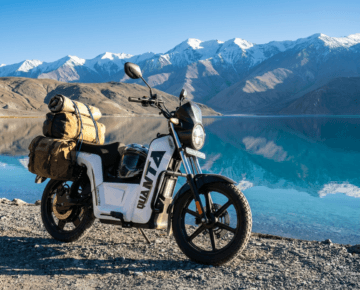
Gravton highlights the Quanta’s Kanyakumari to Khardung La journey as a demonstration of its long-distance capability. The company reports a journey of 4,011.9 km across 11 states, completed in 6.5 days.
This is a notable part of the brand’s story and provides context for the engineering ambitions behind the vehicle. However, a long-distance achievement should not be treated as a guarantee of everyday range, reliability or performance for every owner. Route conditions, charging arrangements, rider practices and the configuration used during the journey all matter when interpreting such an achievement.
For prospective buyers, a local test ride remains essential. Ride the vehicle with your normal posture, assess its acceleration and braking, check mounting comfort, and ask the dealer about service availability and warranty support in your area.
If your routine involves carrying a passenger, riding on inclines or travelling over uneven roads, try to assess those requirements as closely as practical during the test ride.
You can book a Gravton Quanta test ride to evaluate the vehicle against your own needs.
Check out Gravton Quanta listing and reviews on BikeDekho
Is Gravton Quanta the Best Electric Bike in India for You?
There is no single electric two-wheeler that is automatically the best choice for every rider. The right vehicle depends on the balance between price, range, performance, comfort, charging access, carrying requirements and after-sales support.
The Gravton Quanta makes a strong case for riders looking beyond a conventional commuter scooter. Its combination of a step-through frame, 172 Nm of published wheel torque, 17-inch alloy wheels, 190 mm ground clearance, 150 kg payload capacity and two battery options gives it a distinct utility-oriented proposition.
The S and S+ also allow buyers to choose between different battery capacities and claimed ranges according to their daily travel needs. Low quoted running costs and connected vehicle capabilities add further reasons to evaluate the vehicle.
That does not mean every buyer should choose the Quanta. Someone prioritising a different body style, a lower purchase price, a particular service network or a different performance profile may find another vehicle better suited to their needs.
The more useful way to approach the search for the best electric bike in India is to identify your requirements first, compare specifications carefully, calculate the likely cost of ownership and take a test ride before deciding.
For riders who need an electric two-wheeler built around practical everyday mobility, the Gravton Quanta is a compelling option to put on that shortlist.
Frequently Asked Questions
1. Is Gravton Quanta the best electric bike in India?
The answer depends on your riding requirements. The Gravton Quanta is designed as an urban electric utility motorcycle, combining a step-through frame, a 172 Nm hub motor, 17-inch alloy wheels, 190 mm ground clearance and a claimed range of up to 165 km on the S+. Buyers should compare these characteristics with their own needs, budget and local service availability before deciding.
2. What is the range of the Gravton Quanta?
Gravton publishes a claimed range of up to 125 km for the Quanta S and up to 165 km for the Quanta S+. Actual range varies with riding speed, passenger and cargo weight, road conditions, riding mode and other factors.
3. What is the top speed of the Gravton Quanta?
The published maximum speed is up to 75 km/h for both the Quanta S and S+. Actual performance depends on operating conditions and the selected riding mode.
4. How much does it cost to run a Gravton Quanta?
Gravton quotes an approximate running cost of ₹0.10 per kilometre. This is an estimate, and the actual cost depends on electricity tariffs, charging losses and usage. Buyers should calculate their own running costs using their local electricity rates.
5. How long does the Gravton Quanta take to charge?
Gravton lists approximately 5.4 hours for a full charge of the Quanta S+. Charging time depends on the battery variant, charger and charging conditions. Confirm the charging specifications for your selected model before purchase.
6. Is the Gravton Quanta suitable for Indian roads?
The Quanta features 17-inch alloy wheels, 190 mm ground clearance and a rib-cage chassis, characteristics relevant to everyday riding on varied road surfaces. Actual ride comfort and handling also depend on suspension, tyres, load and road conditions. A test ride on familiar roads is recommended.
7. Does the Gravton Quanta support connected vehicle technology?
Yes. Gravton’s GOTAC platform offers telematics features such as live tracking, geofencing, anti-theft functions, driver scoring and battery and charging analytics. Buyers should confirm the availability and subscription requirements of specific features.
8. Where can I book a Gravton Quanta test ride?
You can visit the official Gravton Motors test ride page to enquire about a test ride.
Disclaimer: This article is intended for general informational purposes only. Product specifications, range, charging times, running costs and warranty details are based on information published or provided by Gravton Motors and may change. Actual performance and ownership costs vary according to usage, operating conditions and other factors. Readers should verify current specifications, prices, warranty terms and availability directly with Gravton Motors before making a purchase decision. The views, comparisons and assessments expressed in this article are for informational purposes and should not be treated as a guarantee of performance or suitability. Gravton Motors Pvt. Ltd. cannot be held responsible for errors, omissions, interpretations, or any insights or opinions shared in this article, or for decisions made based on its contents.
-
Why More Riders Choose Electric Over Petrol in 2027
Riders are doing the sums again as 2027 begins. See the real cost gap, what electric saves over five years, and when petrol still makes sense.
Read more about PDI Checklist before taking EV Two Wheelers Delivery.
-
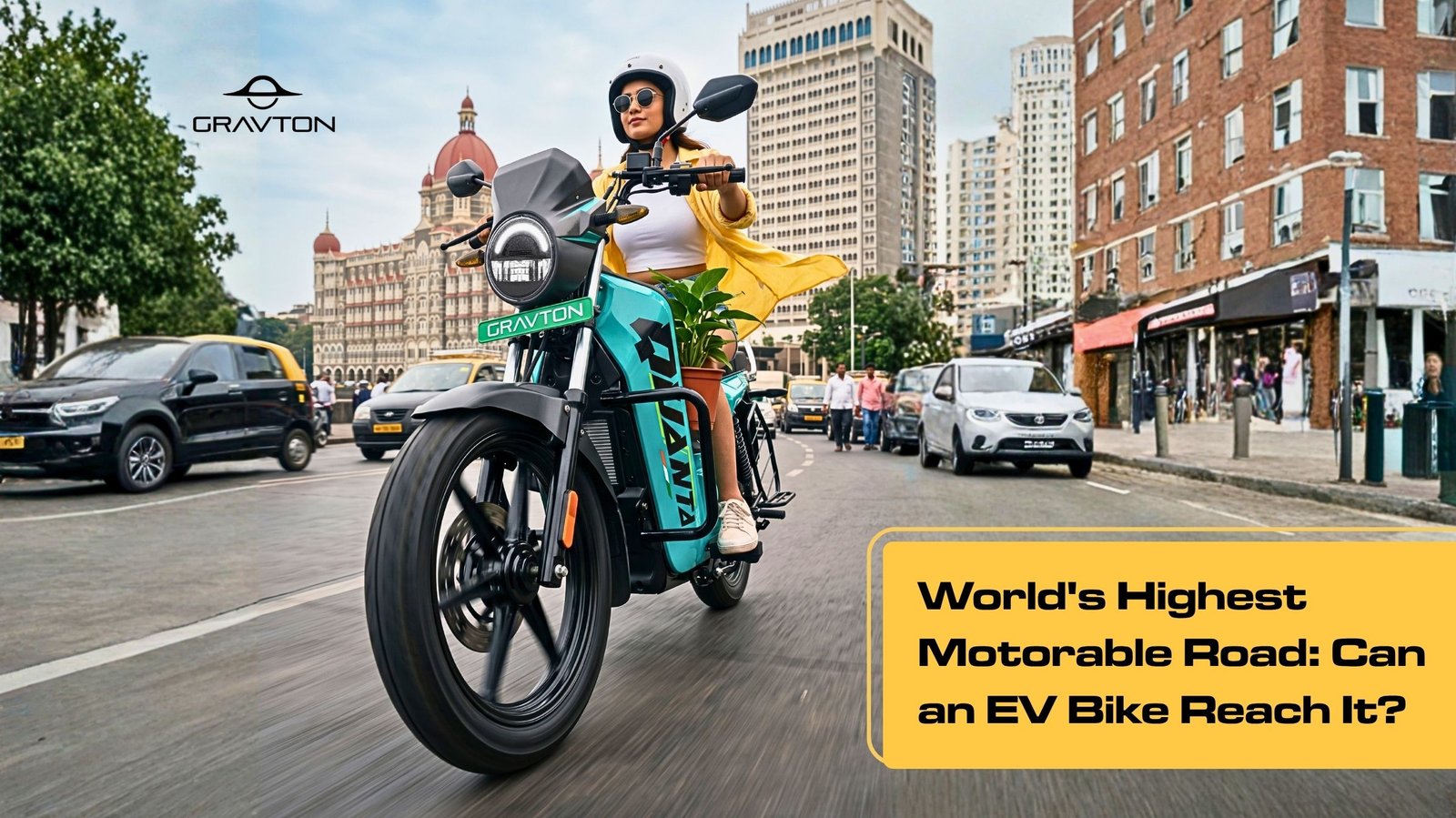
World’s Highest Motorable Road: Can an Electric Bike Conquer the World’s Highest Roads?
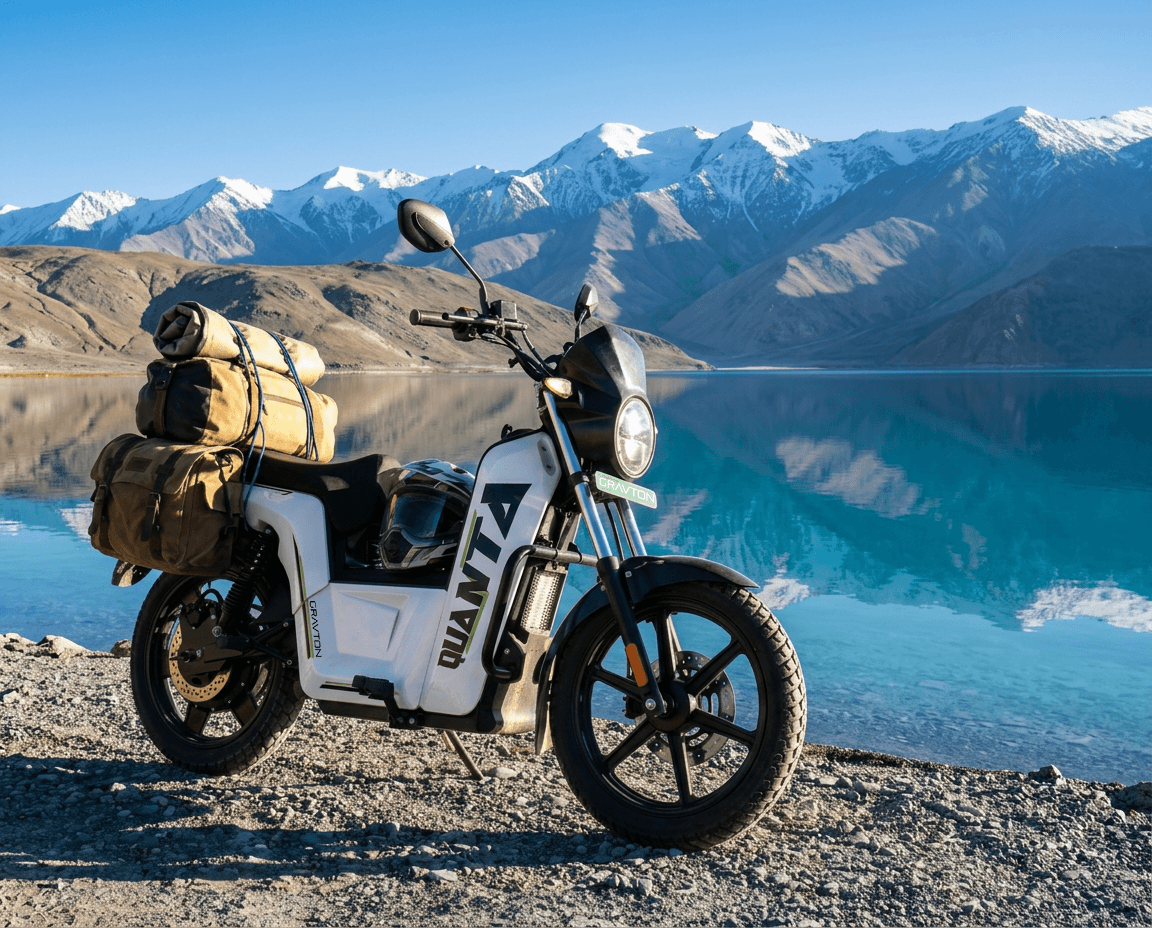
The World’s Highest Motorable Road in Ladakh presents a formidable challenge for riders and machines alike. But can an electric bike handle extreme altitude, cold temperatures, steep climbs and remote roads? Explore the engineering challenges, the realities of high-altitude EV riding and what Gravton Quanta’s Kanyakumari to Khardung La record tells us about electric mobility.
Read more about PDI Checklist before taking EV Two Wheelers Delivery.
-
Maximising EV Bike Battery Range: How to Get More Kilometres From Every Charge
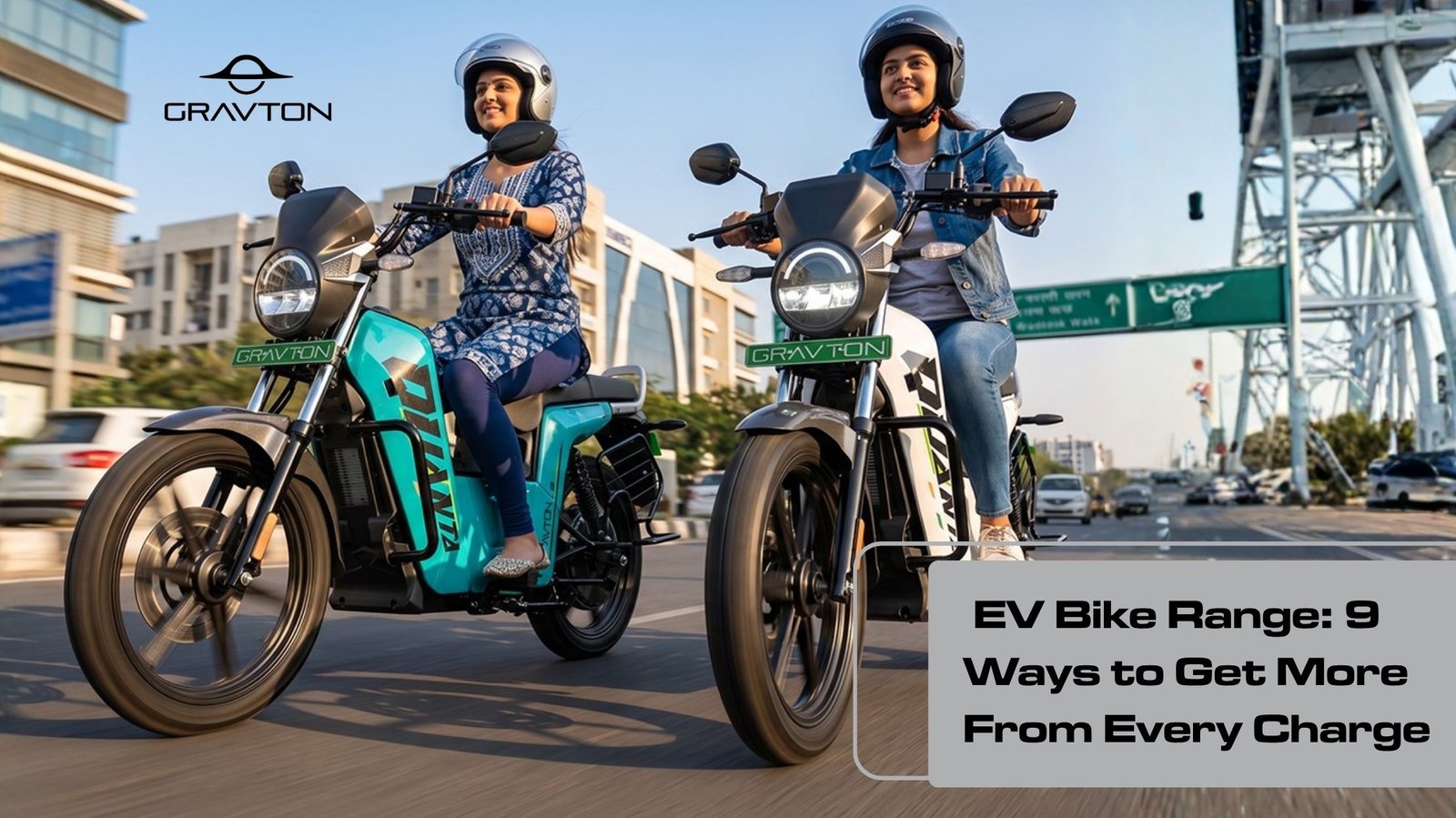
Getting the most range from an EV bike is not just about battery capacity. Riding speed, throttle control, regenerative braking, riding modes, tyre pressure and charging habits all influence how far you travel. Learn how to make every charge count, with practical examples from the Gravton Quanta.
Read more about PDI Checklist before taking EV Two Wheelers Delivery.