Electric Vehicles | EV Industry Updates | 6 November 2026 | 17 min read
The keys are on the table. The vehicle you booked weeks ago is finally in front of you, polished and ready. It is tempting to sign, smile for a photo and ride out. But the twenty minutes before you take delivery quietly decide a lot about the next five years: your paperwork, your warranty, your costs and your peace of mind.
This electric two wheeler pre delivery checklist walks you through every check worth making, from the price breakup and Form 22 to the odometer, the electricals, the battery and the fine print. It works for any electric scooter or motorcycle, from any brand, and it ends with a printable checklist you can carry to the showroom.
Quick summary: Use this electric two wheeler pre delivery checklist in order. Check the paperwork first (invoice, Form 21, Form 22, insurance, warranty). Verify the price breakup. Inspect the vehicle in daylight. Test every electrical function. Read the warranty and service terms. Record the handover on camera. Do not sign anything blank. Rules and processes vary by state, so confirm local requirements with the dealer and your RTO.
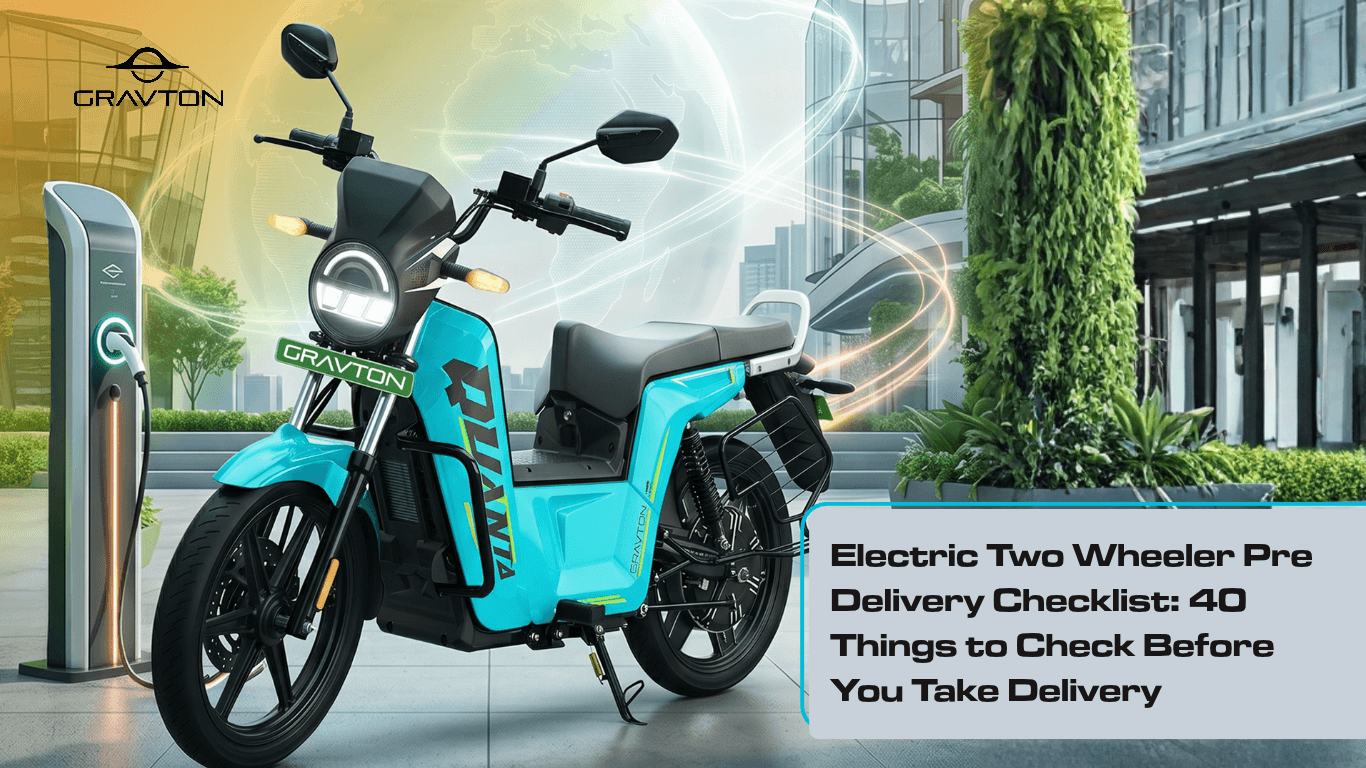
Why an Electric Two Wheeler Pre Delivery Checklist Matters
Dealers carry out a pre delivery inspection (PDI) on every new vehicle, and most are careful. But the PDI is the dealer’s check. A buyer’s electric two wheeler pre delivery checklist is different: it confirms that the vehicle in front of you matches what you paid for, what is written on the documents and what the warranty will cover.
Electric vehicles add a few extra things to look at. The battery matters more than any single part, so its charge level, serial number and warranty terms deserve attention. Software, charging equipment and telematics are also part of what you are buying. A calm, methodical check at the dealership takes about twenty minutes. Fixing a problem after you have ridden away can take weeks.
- It protects your money by making sure the price, taxes and add-ons are exactly as agreed.
- It protects your warranty by making sure the documents and serial numbers are correct.
- It protects your safety by catching loose parts, weak brakes or electrical faults before the first ride.
- It protects your time by turning small issues into a signed note at the dealership, instead of a long call later.
Before Delivery Day: Get the Price and Booking Terms Right
The best electric two wheeler pre delivery checklist items start before you reach the showroom. A day or two earlier, ask the dealer for a written on-road price breakup. Then check every line against what you were quoted.
| ITEM ON THE BREAKUP | WHAT TO CHECK |
| Ex-showroom price | Matches the quote or brochure for your exact variant and colour |
| GST | Shown separately. Electric vehicles generally attract a concessional GST rate, so check the rate on the invoice |
| Registration fee | Matches your state’s current rate. Some fees are waived for electric vehicles, so ask what applies |
| Road tax | Many states waive or reduce road tax for EVs. If the dealer is charging it, ask which state policy applies and get it in writing |
| Insurance | Compare the dealer’s quote with one or two others. You can generally choose your own insurer |
| Handling, documentation and logistics charges | Ask what each covers. Question anything unclear or not agreed at booking |
| Accessories and extended warranty | Optional extras should be listed separately, priced, and only included if you asked for them |
| Subsidy or incentive | If a subsidy applies, confirm the amount and that it is reflected in the invoice, not promised for later |
Also re-read your booking receipt. Confirm the booking amount, the price validity, the promised delivery date and what happens if you cancel. If anything on the final invoice differs from what you agreed, raise it before you pay, not after.
Electric Two Wheeler Pre Delivery Checklist: The Documents to Verify
Paperwork is the first page of any electric two wheeler pre delivery checklist, and the part buyers skip and later wish they had not. Ask to see every document before you inspect the vehicle, and check the details against the vehicle itself.
- Tax invoice: your name and address, the model, variant and colour, the price and the GST shown.
- Form 21 (sale certificate): issued by the dealer, and normally required for registration.
- Form 22 (manufacturer’s certificate): issued by the manufacturer, and normally part of the registration application. More on this below.
- Insurance policy or cover note: your name, the vehicle’s chassis number, the start date, the coverage period and what is included.
- Warranty card or booklet: stamped, dated and filled in, with the vehicle, battery and charger details.
- Owner’s manual and service booklet.
- Registration papers or temporary registration, or a written acknowledgement with a clear timeline for the registration certificate (RC) and number plate.
- Loan agreement and related documents, if you are financing the purchase.
What is Form 22 and why does it matter?
Form 22 is a certificate issued by the vehicle manufacturer confirming that the vehicle complies with the applicable safety and pollution standards. It typically lists the vehicle’s identifying details, such as the chassis number, the motor number and the month and year of manufacture, and it is normally one of the documents needed to register a new vehicle.
Why check it? Because these numbers must match the vehicle exactly. Read the chassis number and motor number on the paperwork, then find them on the vehicle itself and compare them character by character. A mismatch can delay registration or complicate warranty and insurance claims later.
Check the manufacturing month and year
The manufacturing date appears on Form 22 and on the vehicle’s identification plate. A recent date is reassuring. If the vehicle has been in stock for several months, that is not automatically a problem, but ask a few questions: how long has it been in stock, how was it stored, and when was the battery last charged? Batteries stored for long periods should be maintained at a sensible charge level, so ask the dealer to show you the current charge and any records they have.
Registration, Number Plate and Insurance: What to Confirm Before You Ride Out
This part of the electric two wheeler pre delivery checklist varies by state. Practices differ from state to state. Some dealers can complete registration at the dealership, some give a temporary registration, and some hand over the vehicle with an acknowledgement while the RTO processes the application. Whatever the process, make sure you leave with clarity.
- Ask how and when the registration certificate (RC) and number plate will be issued, and get the timeline in writing.
- If you are given a temporary registration, note its validity and what to do if the RC is delayed.
- Check whether the vehicle will carry a high security registration plate (HSRP). Electric vehicles carry a green plate. Ask who will fit it and when.
- Confirm that insurance starts from the day of delivery, in your name, with the correct chassis number.
- Ask what the policy covers and what add-ons are included. Check the coverage period and the claim process.
- If you are financing the vehicle, check that the hypothecation entry and loan details match what you agreed.
- Registered motor vehicles need registration and a licensed rider. If you are unsure whether a particular electric two-wheeler needs registration, confirm with the dealer and your RTO before you buy.
The Physical Inspection: Check the Vehicle in Daylight
Take delivery in daylight. Showroom lighting and evening dusk both hide scratches, dents, paint patches and uneven panel gaps that bright daylight shows at once. If possible, bring a friend or family member for a second pair of eyes.
Walk around the vehicle slowly and work through these items from your electric two wheeler pre delivery checklist.
- Paint, panels and decals: look for scratches, dents, patches of different shade, loose trim and uneven gaps.
- Identification numbers: chassis number, motor number and battery number match the documents.
- Odometer: it should show a very low reading, usually only the distance covered during the dealer’s inspection and movement. If it shows more than a few kilometres, ask why and have the explanation noted on the invoice. Photograph the reading.
- Tyres: check the pressure, tread and sidewalls for cuts or cracks. Look for the four-digit manufacturing date on the sidewall, which shows the week and year the tyre was made. Very old tyres on a new vehicle are worth questioning.
- Brakes: squeeze both levers and press the pedal if fitted. They should feel firm and even, with no sponginess.
- Suspension and steering: press down on the handlebar and seat. Turn the handlebar lock to lock and check that it moves smoothly.
- Fasteners, mirrors and fittings: bolts should be tight, mirrors adjustable, and the seat, side stand and storage secure.
- Cables and wiring: visible wiring should be neat, secured and free of rubbing or exposed sections.
Take a camera. Photograph and film the vehicle from every side, the odometer, the chassis, motor and battery numbers, the accessories and the documents. It gives you a record of the condition at handover, and it also gives you a memory of a day you will want to remember.
Electricals and Battery: The Electric Part of Your Electric Two Wheeler Pre Delivery Checklist
This part of the electric two wheeler pre delivery checklist is specific to electric vehicles. Take your time over it and ask the dealer to demonstrate anything you are unsure of.
- Lights: headlamp (low and high beam), tail lamp, brake light, all four indicators and hazard lights.
- Horn, display and warning lights: the display should boot normally, show the charge level and speed correctly, and show no error or warning messages.
- Ride modes and throttle: cycle through the available modes and check that the throttle response is smooth and progressive, with no jerks.
- Reverse or assist features: if the vehicle has them, ask for a demonstration.
- Key, lock and kill switch: check the key or lock system, the seat lock, the side-stand sensor (the vehicle should not move with the stand down) and the kill switch.
- Battery: note the charge level at delivery, check that the battery serial number matches the documents, and ask where the battery’s warranty details are recorded.
- Charging: inspect the charging port, the charger and the cable. Ask for a short charging demonstration, and confirm what socket and circuit the charger needs at home.
- App and telematics: if the vehicle has an app or connected features, pair it at the dealership, check that it shows battery and location correctly, and ask which software version the vehicle runs.
- Water and dust: look for moisture or dust inside connectors and compartments, and check that port covers close properly.
If you plan to charge at home, read our guide to electric two-wheeler charging in India, and for daily charging habits see electric vehicle charge time, cost and battery life tips.
Take a short test ride
Ask for a short test ride around the dealership. You are not testing performance. You are checking for problems: smooth acceleration, even braking, straight steering, no unusual noise or vibration, correct speedometer and charge readings, and clean switching between modes. A few minutes is enough.
Warranty, Services and Terms: Read Before You Sign
Warranty questions belong on every electric two wheeler pre delivery checklist. An electric two-wheeler usually comes with separate warranty terms for the vehicle, the battery, the motor and controller, and the charger. Do not rely on a verbal summary. Ask for the warranty terms in writing and read them before you take delivery.
| QUESTION TO ASK | WHY IT MATTERS |
| What is covered, and for how long? | Vehicle, battery, motor, controller and charger may each have different periods and kilometre limits |
| What are the conditions? | Servicing at authorised centres, using the original charger and avoiding unauthorised modifications are common conditions |
| What is excluded? | Some warranties exclude commercial use, accidents, water damage or misuse. Check whether your intended use is covered |
| Is there a battery capacity clause? | Some battery warranties promise a minimum capacity over time. Ask how it is measured and who decides |
| How do claims work? | Ask where to go, what proof is needed and how long repairs or replacements usually take |
| Is the warranty transferable? | Matters if you plan to resell the vehicle |
Free and mandatory services
Ask how many free services you get, at what time or kilometre intervals, and what each costs after the free period. Also ask whether missing a scheduled service affects the warranty. Note the date of the first service in your calendar before you leave the dealership.
Terms and conditions worth reading
- Cancellation, return and refund terms for the booking and the delivery.
- Roadside assistance: what is covered, the contact number and the response expectations.
- Spare parts availability and the nearest authorised service centres.
- Telematics and data: if the vehicle collects location or usage data, read what data is collected, how it is used and whether you can opt out.
- Extended warranty or service plans: what they add, what they cost and whether they are optional.
Accessories, Charger and Extras: Ask Before You Pay
Add accessories to your electric two wheeler pre delivery checklist, because they are a common source of confusion at handover. Ask for a list of everything that comes with the vehicle, and check each item on the list against what you receive.
- Charger and cable: confirm that the charger is included, working and correct for the vehicle, and ask whether a spare is available.
- Keys: confirm how many keys or key fobs you will receive, and what a replacement costs.
- Tool kit and manual: confirm they are in the box or under the seat if they are supposed to be.
- Accessories fitted by the dealer: ask for each one to be listed with its price, and confirm that it does not affect the warranty.
- Free items: if the dealer has promised free accessories, get them listed on the invoice.
If an accessory was promised and is not available on the day, ask for a written commitment with a date, not a verbal assurance.
Delivery Day: A Step-by-Step Routine
Use this routine to run through your electric two wheeler pre delivery checklist on the day.
- Arrive in daylight, ideally with a friend or family member, and bring a charged phone or camera.
- Ask to see all documents first, and check names, numbers, dates and amounts against the vehicle.
- Inspect the vehicle slowly, using the physical inspection list above, and photograph anything that concerns you.
- Check the electricals and the battery, and ask for a charging demonstration.
- Take a short test ride.
- Read the warranty and service terms, and ask questions about anything unclear.
- If you find a problem, ask for it to be fixed or the vehicle replaced before you accept delivery, and have it noted in writing.
- Sign only complete documents. Never sign a blank form, and keep copies of everything.
- Take photos and a short video of the handover, with the vehicle, the odometer and the documents.
- Collect the keys, charger and accessories as listed, and save the service and roadside assistance numbers.
If something is wrong, you generally have the right to ask for it to be put right, replaced or refunded under the terms of sale and consumer protection law. Keep a record of what you found and what the dealer agreed.
After Delivery: The First Seven Days
Your electric two wheeler pre delivery checklist does not end at the showroom door.
- Day one: charge the battery at home, using the supplied charger and a safe, properly earthed socket.
- Register on the app, if there is one, and check that location and battery readings look correct.
- Note your real-world range over the first few rides, so you have a baseline.
- Check tyre pressure, and check that the vehicle runs smoothly after the first few days of use.
- Store digital copies of the invoice, Form 21, Form 22, insurance, warranty card and registration papers in one folder.
- Set a reminder for the first service and for the insurance renewal.
- Report any issue to the dealer in writing, and keep a record of the date and reply.
For a deeper look at charging and battery life, see electric vehicle charge time, cost and battery life tips.
Common Mistakes to Avoid at Delivery
Most problems with an electric two wheeler pre delivery checklist come from skipped steps.
- Rushing the handover because the vehicle is exciting, and the showroom is busy.
- Accepting verbal promises about accessories, price or warranty instead of written ones.
- Signing blank forms, or forms you have not read.
- Skipping the daylight inspection and finding scratches the next morning.
- Not checking that the chassis, motor and battery numbers match the documents.
- Not asking how long the vehicle has been in stock, or what the battery’s charge status is.
- Ignoring the warranty conditions, and then missing a mandatory service.
- Assuming that insurance and registration are ‘taken care of’ without seeing the papers.
The Printable Electric Two Wheeler Pre Delivery Checklist
Print this electric two wheeler pre delivery checklist, or save it on your phone, and tick off each item at the showroom. It brings together all 40 checks from this guide.
| PRICE AND BOOKING | |
| ☐ | Written on-road price breakup showing every line item |
| ☐ | Ex-showroom price matches the quote or brochure for your variant and colour |
| ☐ | Registration fee, road tax and insurance amounts checked against current state rates and your own insurance quotes |
| ☐ | Handling, documentation or logistics charges explained in writing, and any you did not agree to removed |
| ☐ | Any subsidy or incentive confirmed, with the amount shown on the invoice |
| DOCUMENTS | |
| ☐ | Tax invoice with the correct name, address, model, variant and colour |
| ☐ | Form 21 (sale certificate) received |
| ☐ | Form 22 (manufacturer’s certificate) received, with chassis number, motor number and manufacturing month and year matching the vehicle |
| ☐ | Insurance policy with correct details, start date and coverage period |
| ☐ | Warranty card or booklet filled in and stamped |
| ☐ | Owner’s manual and service booklet received |
| ☐ | Registration papers, temporary registration or a written acknowledgement with a clear timeline |
| ☐ | Loan documents (if financed) checked against the agreed terms |
| VEHICLE CONDITION | |
| ☐ | Delivery scheduled in daylight |
| ☐ | Chassis, motor and battery numbers match the paperwork |
| ☐ | Manufacturing month and year acceptable, and stock age asked |
| ☐ | Odometer reading very low, and any distance explained |
| ☐ | Paint, panels and decals free of scratches, dents and mismatched shades |
| ☐ | Tyres checked for pressure, tread, sidewall condition and manufacturing date |
| ☐ | Brakes, suspension and stand work smoothly, and fasteners are tight |
| ☐ | Mirrors, seat, locks, storage and fittings work properly |
| ELECTRICALS AND BATTERY | |
| ☐ | Headlamp (low and high beam), tail lamp, brake light, indicators and hazard lights work |
| ☐ | Horn, display and warning lights work, with no error messages |
| ☐ | Ride modes and throttle response work smoothly, plus any reverse or assist feature |
| ☐ | Key or lock system and side-stand sensor work |
| ☐ | Battery charge level at delivery noted, and battery number recorded |
| ☐ | Charging port, charger and cable inspected, and a charging demonstration given |
| ☐ | App or telematics paired and working if offered, and software version asked |
| ☐ | Short test ride done to check brakes, steering, acceleration and noise |
| WARRANTY, SERVICE AND TERMS | |
| ☐ | Warranty terms in writing for the vehicle, battery, motor, controller and charger |
| ☐ | Warranty conditions and exclusions understood |
| ☐ | Free and mandatory services understood: number, schedule and costs |
| ☐ | Roadside assistance and service contact details saved |
| ☐ | Accessories itemised, fitted and priced |
| ☐ | Telematics data and privacy terms, plus cancellation and return terms, read |
| HANDOVER | |
| ☐ | Photos and video taken of the vehicle, odometer, numbers and accessories |
| ☐ | No blank forms signed, and copies of everything received |
| ☐ | Spare keys, charger and tool kit received as listed |
| ☐ | First service date noted and reminder set |
| ☐ | Any issue noted in writing with the dealer before you leave |
Frequently Asked Questions
What is a pre delivery inspection (PDI) for an electric two-wheeler?
A pre delivery inspection is the check a dealer carries out on a new vehicle before handing it over, covering the physical condition, electricals, battery and basic functions. A buyer’s electric two wheeler pre delivery checklist is your own review of the vehicle, paperwork, price and warranty terms before you accept delivery.
What is Form 22 and why is it important?
Form 22 is a certificate issued by the vehicle manufacturer confirming compliance with applicable safety and pollution standards. It typically lists identifiers such as the chassis number, motor number and month and year of manufacture, and it is normally needed to register a new vehicle. Check that its details match the vehicle exactly.
What is Form 21?
Form 21 is the sale certificate issued by the dealer to the buyer. It is normally one of the documents needed to register a new vehicle.
How much should the odometer show on a new electric two-wheeler?
A new vehicle should show a very low reading, usually only the distance covered during the dealer’s inspection and movement. If it shows more than a few kilometres, ask for an explanation, have it noted on the invoice and photograph the reading.
Why should I take delivery in daylight?
Daylight shows scratches, dents, paint patches and uneven panel gaps that showroom lighting or dusk can hide. It also makes it easier to check tyres, wiring and fittings.
Should I check the manufacturing date of a new electric two-wheeler?
Yes, and put it on your electric two wheeler pre delivery checklist. The date appears on Form 22 and the vehicle’s identification plate. If the vehicle has been in stock for a long time, ask how it was stored and when the battery was last charged, and check the current charge level.
What should I check in the electricals and battery before delivery?
Check all lights, the horn, the display and warning messages, ride modes and throttle response, the key and side-stand sensor, the battery charge level and serial number, and the charging port, charger and cable. Ask for a charging demonstration and pair the app if one is offered.
What warranty questions should I ask for an electric two-wheeler?
Ask what is covered for the vehicle, battery, motor, controller and charger, for how long and up to what kilometres, what conditions and exclusions apply, whether there is a battery capacity clause, how claims work and whether the warranty is transferable. Get the terms in writing.
Can I refuse delivery if I find a defect?
If you find a defect before accepting delivery, ask the dealer to fix it or replace the vehicle, and have the issue noted in writing. You generally have remedies under the terms of sale and consumer protection law, so keep records of what you found and what was agreed.
Which documents should I receive at delivery?
Typically the tax invoice, Form 21, Form 22, the insurance policy, the warranty card, the owner’s manual and service booklet, and registration papers or a written timeline for the RC and number plate. If you are financing the vehicle, you should also have the loan documents.
About this guide. Published by Gravton Motors, Hyderabad, an electric two-wheeler manufacturer. This checklist is general guidance and works for any brand. Registration, documentation, taxes and consumer rules vary by state and change from time to time, so confirm current requirements with the dealer, your RTO and your insurer.
Disclaimer: This article is published by Gravton Motors Pvt. Ltd. for general informational purposes only. The insights, opinions, estimates and recommendations shared here are illustrative, may not apply to every vehicle, location or situation, and do not constitute professional, technical, legal or financial advice. While we aim to be accurate, Gravton Motors makes no guarantee of the accuracy, completeness or timeliness of the content and cannot be held responsible for any loss, damage or inconvenience arising from reliance on it. Always refer to your vehicle’s owner’s manual and consult the manufacturer or a qualified professional before acting. References to third-party organisations and links are provided for convenience and do not imply endorsement.