Gravton Motors
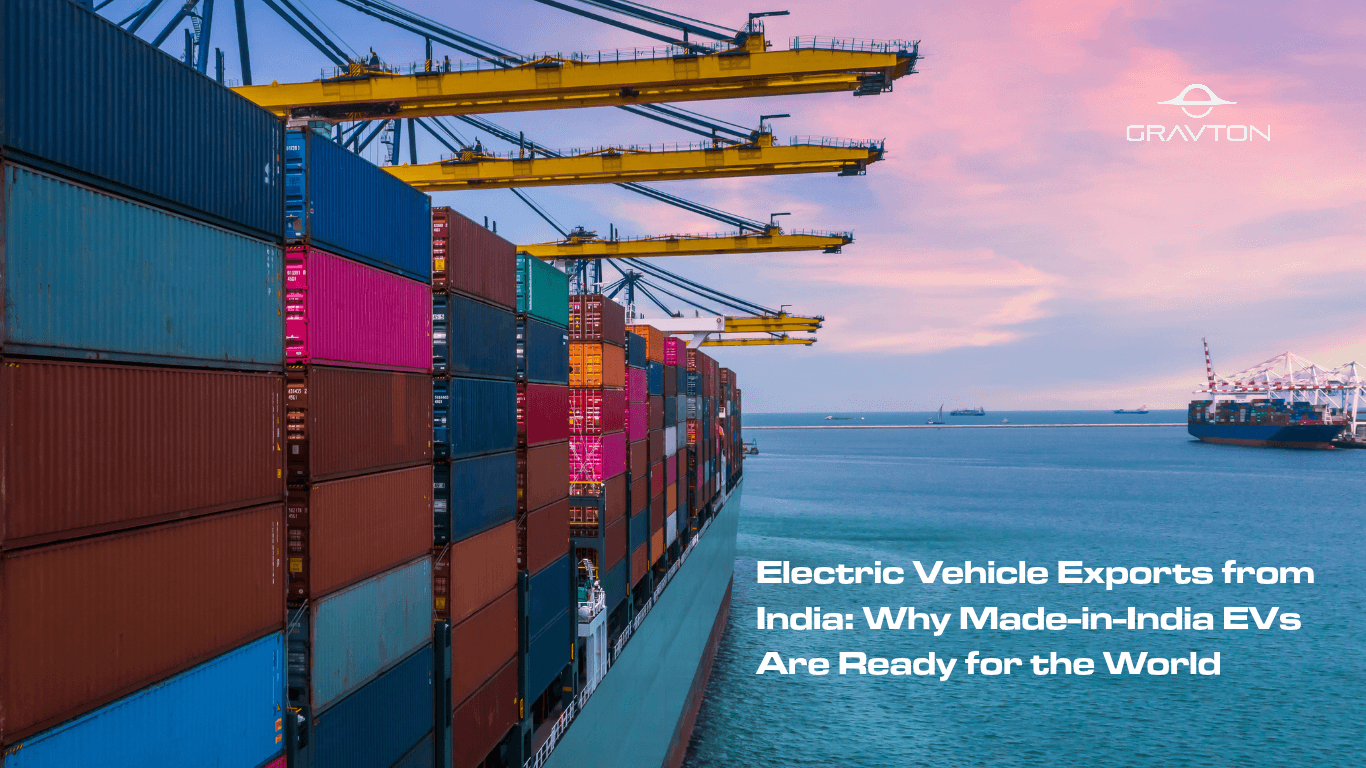
Electric Vehicle Exports from India: Why Made-in-India EVs Are Ready for the World
From manufacturing scale and engineering talent to resilient supply chains and rugged design, here is why electric vehicle exports from India are gaining momentum, how the export process works, and what global importers should look for.
By Gravton Motors|5 November 2026|13 min read
When a distributor in Nairobi, a fleet owner in Jakarta or an importer in Dubai looks for electric two-wheelers, the questions are practical. Can the vehicle handle our roads? Is the supply chain dependable? Will it clear customs and get support after it arrives? This guide to electric vehicle exports from India answers those questions, and shows why made-in-India EVs are ready for the world.
The Short Answer
Electric vehicle exports from India are growing because India combines two-wheeler manufacturing scale, engineering and design talent, cost competitiveness and growing domestic capability in motors, controllers and batteries, with strong demand for affordable electric mobility abroad.
What importers should check: how much of the vehicle is designed and built in India, whether the motor depends on heavy rare earth magnets (non-HRE designs reduce supply risk), certifications, UN 38.3 battery transport compliance, and after-sales support.
Gravton is positioned as a 100% made-in-India electric two-wheeler company with in-house motors, controllers and batteries. Enquiries are welcome on the Gravton exports page.
Why Electric Vehicle Exports from India Are Growing
Electric vehicle exports from India are gaining momentum for a simple reason: several long-term strengths are coming together at the same time. India already runs one of the largest two-wheeler industries in the world, with a deep base of manufacturers, component suppliers and skilled engineers, and a long record of shipping vehicles to markets across Africa, Latin America, South Asia and Southeast Asia. As the industry electrifies, that experience carries over.
Demand is rising on the other side too. Many countries want to cut fuel import bills, improve urban air quality and electrify delivery and last-mile transport. Electric two-wheelers are often the fastest and most affordable way to do that, because they serve everyday riders, motorcycle taxis and delivery fleets at a cost that works for emerging markets. That combination makes electric vehicle exports from India a natural fit.
- Scale and ecosystem. A mature automotive base gives manufacturers access to suppliers, tooling and talent.
- Engineering and design talent. India has a large pool of mechanical, electrical and software engineers working on EV design.
- Cost competitiveness. Manufacturing in India can deliver strong value without compromising on quality.
- Policy support. Initiatives such as Make in India, production-linked incentives for automobiles and batteries, and demand incentives for electric vehicles have encouraged local manufacturing and technology development.
- Strong demand abroad. Fuel costs, urban pollution and the growth of delivery and ride services are pushing markets toward electric.
Together, these strengths power electric vehicle exports from India. For a view of how Indian states are building electric mobility, manufacturing and jobs, see our guide to the EV industry in India.
The Manufacturing Advantage Behind Electric Vehicle Exports from India
Beyond cost, electric vehicle exports from India offer qualities that matter to importers.
Designed for demanding conditions. Vehicles built in India are engineered for heat, dust, monsoon rain, potholed roads and heavy daily loads. These are the same conditions faced in a large number of export markets, so the design lessons transfer directly. A motorcycle that handles an Indian city and an Indian highway is well prepared for much of the developing world, which is why electric vehicle exports from India suit these markets so well.
A broad supplier base. India's automotive industry supports precision machining, castings, wiring, electronics and tooling at scale, which helps manufacturers control cost and lead times.
Strong logistics access. Major ports on both coasts, established freight forwarders and experience with dangerous goods handling make shipping vehicles and batteries a routine activity for Indian exporters.
Growing capacity and technology. Domestic capability in motors, controllers, battery packs and software is growing, and manufacturers are investing in their own research and development rather than relying only on imported designs. Electric vehicle exports from India benefit as that capability deepens.
Supply Chain Resilience in Electric Vehicle Exports from India
Anyone buying electric vehicle exports from India in volume soon learns that the vehicle is only as dependable as its supply chain. Recent export controls on rare earth materials and magnets in some countries showed how a single dependency can slow production for manufacturers around the world. For importers and distributors, this makes supply resilience a real purchasing criterion, not a footnote.
Rare earth magnets and why non-HRE designs matter. Many electric motors use permanent magnets, and some high-performance magnets add heavy rare earth elements (HRE), such as dysprosium and terbium, to withstand heat. These elements are concentrated in a small number of supplying countries. A motor design that avoids heavy rare earths, known as a non-HRE design, reduces exposure to export restrictions and price swings, and the industry is increasingly looking in that direction. Non-HRE does not mean free of all rare earths. It means the design does not depend on the scarcest and most supply-constrained ones. Magnet choice is a fair question to put to any motor manufacturer.
In-house powertrain. When a manufacturer designs its own motors, controllers and battery systems, it controls specifications, quality and upgrades, and it is less exposed to a supplier changing a part. This also makes after-sales support and spares planning for electric vehicle exports from India simpler for importers.
Battery chemistry. LMFP (lithium manganese iron phosphate) belongs to the phosphate family, known for strong thermal stability and long cycle life, which suits hot climates and long-term fleet use.
Local manufacturing. India is also building domestic capability in magnets and batteries, and the government has announced support for domestic rare earth permanent magnet manufacturing. As these ecosystems mature, electric vehicle exports from India become more resilient still.
Supply chain claims should always be checked for each manufacturer. Ask exporters what is designed, made and sourced in India, and for which components.
Technology and Design Innovations That Travel Well
Exports succeed when a vehicle is genuinely better suited to its roads. These design and technology choices help electric vehicle exports from India travel well:
- Strong, protective frames. Gravton's rib cage chassis, the first on an electric two-wheeler in India, encages the battery and builds strength into the structure, which matters on rough roads and under heavy loads.
- Step-through convenience with motorcycle capability. A step-through frame with 17-inch alloy wheels and good ground clearance lets riders of all kinds mount easily while handling potholes and speed breakers with confidence.
- An in-house hub motor. Gravton's BIS certified hub motor, the first in India, is built around direct drive and strong low-speed torque, which helps in loaded, hilly and stop-start conditions.
- Edge AI telematics. GOTAC adds live tracking, geofencing, anti-theft, driver scoring and battery analytics, which is especially valuable for importers who manage fleets or want remote diagnostics across a large distance.
- Battery swap technology. Swappable battery options suit fleets, delivery operators and markets with limited charging infrastructure.
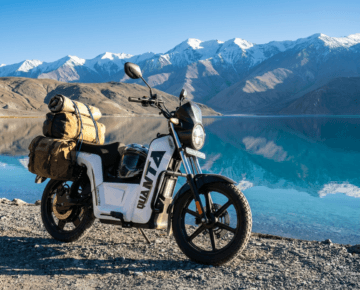
- Proven endurance. The Gravton Quanta is the first and only electric two-wheeler to ride from Kanyakumari to Khardung La, 4,011.9 km across 11 states in 6.5 days, up to 18,000 feet. The route covered heat, cold, dust and altitude.
If rough-road capability matters in your market, read our explanation of gradability and why your EV's climbing power matters.
Which Markets Want Electric Two-Wheelers from India?
Interest in electric vehicle exports from India is strongest where fuel is costly, roads are demanding and fleets are growing.
| Region | What drives demand | What matters most to buyers |
|---|---|---|
| Africa | Motorcycle taxis, delivery, fuel import costs | Durability, payload, service support |
| Southeast Asia | Dense cities, ride-hailing and delivery growth | Cost, battery swap, reliability in heat and rain |
| South Asia | Fuel costs, hilly terrain, urban air quality | Climbing ability, affordability, warranty |
| Latin America | Delivery and commuting, fuel savings | Rugged design, parts availability |
| Middle East | Delivery fleets, hot climate | Thermal stability, fleet telematics |
General market patterns. Specific import rules, standards and demand differ by country, so check each market's requirements.
The common thread is that these buyers need vehicles that are tough, efficient and supportable. That is a natural fit for electric vehicle exports from India.
How Electric Vehicle Exports from India Work, Step by Step
Here is how electric vehicle exports from India work in practice, from the first market check to the first delivery.
- Research the destination market. Check import duties, vehicle standards, type approval rules, registration requirements and any restrictions on lithium batteries.
- Confirm homologation. Many countries require type approval or conformity checks. India's own approvals, including battery and motor standards, are a useful base, but each country may add its own requirements.
- Agree commercial terms. Settle price, payment, delivery terms (Incoterms such as FOB or CIF), warranty, spares and service responsibilities.
- Choose the shipment form. CBU (completely built unit), SKD (semi-knocked down) or CKD (completely knocked down). SKD and CKD can reduce duties in some countries and support local assembly.
- Prepare documents. Typically an Importer Exporter Code (IEC), commercial invoice, packing list, shipping bill, bill of lading and a certificate of origin where required.
- Handle battery transport correctly. Lithium batteries and battery-powered vehicles are dangerous goods (Class 9). Batteries generally need UN 38.3 test certification, and packing, labelling and declarations must follow international rules.
- Clear customs and classify correctly. Electric motorcycles and scooters are typically classified under HS heading 8711 (8711.60 for electric two-wheelers). Confirm with a customs broker.
- Register and support locally. Plan registration, training, spares, warranty handling and service before the first shipment arrives.
Experienced exporters handle most of this through freight forwarders and customs brokers, but importers should still understand the steps, because planning early avoids delays.
What to Look for in Electric Vehicle Exports from India: An Importer's Checklist
Use this checklist when you assess any manufacturer offering electric vehicle exports from India.
| Question to ask | Why it matters |
|---|---|
| What is designed, built and sourced in India? | Shows supply chain depth and exposure to outside disruptions |
| Does the motor depend on heavy rare earths? | Affects supply risk and price stability |
| Which certifications and test reports exist? | Speeds homologation in your market |
| How are batteries packed and shipped? | UN 38.3 and dangerous goods compliance protect against delays |
| What warranty, spares and training come with the vehicle? | Determines long-term ownership experience |
| Is fleet telematics included? | Enables remote monitoring and diagnostics at scale |
| What is the proof of durability? | Independent endurance records and field data reduce risk |
| Can the vehicle be supplied as CBU, SKD or CKD? | Flexibility can lower duties and enable local assembly |
Gravton and Electric Vehicle Exports from India
Gravton Motors, based in Hyderabad, is positioned as a 100% made-in-India electric two-wheeler company. Its vehicles are designed, engineered and built in India, with motors, controllers and batteries designed in-house, and its in-house design gives it direct control over specifications and quality.
For importers, distributors and fleet buyers considering electric vehicle exports from India, that means vehicles with proven road capability, in-house technology and a manufacturer in direct control of its product. The Gravton Quanta is India's urban electric utility motorcycle, and fleet and delivery operators can explore why Gravton is the right OEM partner for an electric delivery fleet.
To learn about export enquiries, visit the Gravton exports page.
Importing or Distributing Electric Vehicles?
Talk to Gravton about electric vehicle exports from India: made-in-India vehicles, in-house technology and a manufacturer you can work with directly.
Visit the Exports Page Email UsThe Road Ahead
The long-term direction is encouraging. India's manufacturing base is deepening, domestic capability in motors, controllers, batteries and magnets is growing, and global demand for affordable electric mobility is rising. Together these trends make electric vehicle exports from India an increasingly important part of global electrification.
For importers, the opportunity is to partner with manufacturers who can show real depth: in design, in supply chain control, in compliance and in after-sales support. The strongest partners will be those that can prove each of these with evidence, not slogans.
Frequently Asked Questions
Does India export electric vehicles?
Yes. India is among the world's largest two-wheeler producers and exporters, and a growing number of Indian manufacturers now export electric two-wheelers and other electric vehicles. Electric vehicle exports from India are still developing compared with petrol vehicles, and they are expanding as local capacity in motors, controllers and batteries grows.
Which countries import electric two-wheelers from India?
For electric vehicle exports from India, the natural markets are the regions that Indian two-wheeler exports have long served: Africa, Latin America, South Asia and Southeast Asia. Specific destinations vary by manufacturer and by each country's import rules, so check with the exporter.
What is the HS code for exporting electric motorcycles from India?
Electric motorcycles and scooters are typically classified under HS heading 8711, with 8711.60 used for two-wheelers propelled by an electric motor. Always confirm the exact code and duty treatment with your customs broker, since classification and tariffs differ by country.
How are lithium batteries shipped in exported electric vehicles?
Lithium batteries are regulated as dangerous goods (Class 9) for transport. Batteries and battery-powered vehicles must be packed, labelled and documented according to international rules, and the battery design generally needs UN 38.3 test certification. Your freight forwarder and the exporter will manage the specifics.
What documents are needed to export an electric vehicle from India?
Typically an Importer Exporter Code (IEC), commercial invoice, packing list, shipping bill, bill of lading or airway bill, and a certificate of origin where required, plus battery transport documents such as UN 38.3 test summaries and dangerous goods declarations. The destination country may require type approval and import permits as well.
What is the difference between CBU, SKD and CKD exports?
CBU means completely built unit, shipped fully assembled. SKD means semi-knocked down, shipped partly assembled. CKD means completely knocked down, shipped as components for local assembly. SKD and CKD can reduce import duties in some countries and support local assembly, subject to local rules.
What does non-HRE magnet mean in an electric motor?
HRE stands for heavy rare earths, such as dysprosium and terbium, which are added to some high-performance magnets to withstand heat. A non-HRE magnet design avoids those heavy rare earths. It does not necessarily mean the magnet is free of all rare earths, but it reduces exposure to supply constraints and price swings.
Why does made in India matter for EV importers?
For electric vehicle exports from India, a vehicle that is designed, engineered and built in India with in-house powertrain technology can offer importers cost competitiveness, tested performance on demanding roads and climates, and less exposure to disruptions in other countries' supply chains.
Can I become an importer or distributor for Gravton?
Gravton welcomes enquiries from importers, distributors and fleet buyers. Visit the Gravton exports page at gravton.com/exports or write to connect@gravtonmotors.com.
Does India offer incentives for exporters?
India has export promotion measures, such as duty remission and drawback schemes, that exporters may be eligible for. Schemes and rates change, so exporters should check current eligibility with the relevant authorities or a customs advisor.
Are Indian electric two-wheelers suitable for rough roads and hot climates?
Vehicles designed for Indian conditions are built around heat, dust, potholes and heavy loads, which are common in many export markets. Features such as large wheels, good ground clearance, strong frames and a stable battery chemistry help.
About this guide. Published by Gravton Motors, Hyderabad, an electric two-wheeler manufacturer. This guide to electric vehicle exports from India is general information. Export regulations, tariffs, certification requirements and incentives differ by country and change over time, so confirm current rules with the relevant authorities, a customs broker and your freight forwarder.
Website: www.gravton.com | Email: connect@gravtonmotors.com | Phone: 7995252220
Disclaimer: This article is published by Gravton Motors Pvt. Ltd. for general informational purposes only. The insights, opinions, estimates and recommendations shared here are illustrative, may not apply to every vehicle, location or situation, and do not constitute professional, technical, legal or financial advice. While we aim to be accurate, Gravton Motors makes no guarantee of the accuracy, completeness or timeliness of the content and cannot be held responsible for any loss, damage or inconvenience arising from reliance on it. Always refer to your vehicle's owner's manual and consult the manufacturer or a qualified professional before acting. References to third-party organisations and links are provided for convenience and do not imply endorsement.