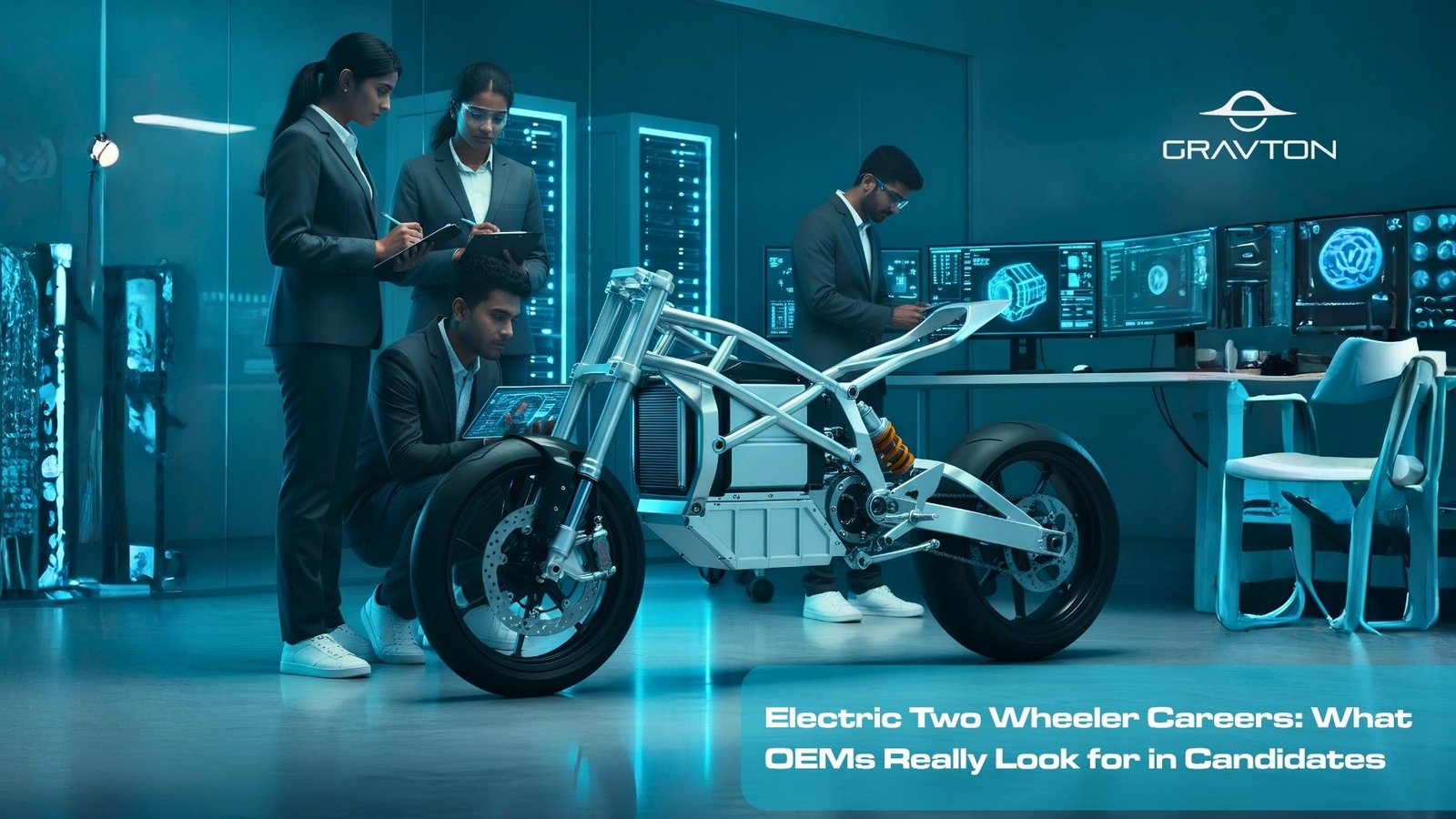
Riya is in her final year of mechanical engineering. Karthik has six years in a conventional two-wheeler plant. Sana is a service supervisor who keeps hearing that everything is going electric. Three different people ask the same question: what does it actually take to build a career in this industry, and what are OEMs really looking for?
Interest in electric two wheeler careers is growing fast, and so is the confusion. Job descriptions list long lists of tools, courses promise shortcuts and every company seems to want “passion”. This guide cuts through it. It explains how an electric two-wheeler is built, what OEMs look for across the most important roles, how to prove you are ready and how to prepare, with role-by-role detail and a 12-month roadmap.
Key takeaways
- Fundamentals beat buzzwords. OEMs hire people who understand mechanics, electronics and materials deeply, not people who only list tools.
- Hands-on proof is the strongest signal. A built, tested and explained project outweighs a long list of courses.
- Every role touches the whole vehicle. Systems thinking across motor, battery, controller and frame is highly valued.
- Safety matters. High-voltage and battery safety awareness is a quiet requirement in many roles.
- Electric two wheeler careers are open to many backgrounds, including design, CAE, production, quality and service.
Why Electric Two Wheeler Careers Are Getting So Much Attention
A few forces are pulling talent toward electric two wheeler careers at the same time.
- A fast-changing industry. Electrification is reshaping how vehicles are designed, built and serviced, and new roles are appearing alongside traditional ones.
- Local manufacturing and technology. More companies are designing and building motors, controllers, batteries and software in India, which creates demand for engineers who can do real design work.
- Responsibility early. Compared with very large, long-established organisations, many OEMs and startups let engineers own more of a product earlier in their careers.
- Purpose. Cleaner, cheaper mobility is a mission many engineers want to be part of. For more on where the industry is heading, read our guide to the EV industry in India, its states, manufacturing and jobs.
How an Electric Two-Wheeler Gets Built: Where Careers Fit
Before choosing a role, understand the journey from idea to rider. Every vehicle goes through concept and styling, engineering, simulation, prototyping and validation, production, quality checks and finally sales and service.
A full-stack OEM, one that designs its own motors, controllers and batteries, as Gravton does, gives engineers exposure to several of these stages at once. That breadth is a big reason many engineers find this industry exciting.
What OEMs Look for in Every Candidate
Whatever the role, the same qualities show up again and again in how OEMs evaluate people for electric two wheeler careers.
- Strong fundamentals. Mechanics, electrical basics, thermal behaviour and materials. Interviewers test these first, because they last longer than any tool.
- Hands-on proof. Something you built, tested, broke and fixed, and can explain in detail.
- Tool fluency. Depth in one or two tools that match the role, rather than a list of ten you barely used.
- Systems thinking. Understanding how the motor, battery, controller, frame and software affect each other.
- A safety mindset. Respect for high-voltage systems, battery handling and safe working practice.
- Data and problem solving. The habit of measuring, finding the root cause and explaining your reasoning.
- Ownership and pace. Taking responsibility, asking good questions and moving quickly without cutting corners.
- Communication. Explaining technical ideas clearly to engineers, suppliers and non-engineers.
- Learning agility. The ability to pick up new topics fast, since the technology keeps changing.
Electric Two Wheeler Careers: Role by Role
Here is what OEMs look for in seven of the most important roles in electric two wheeler careers, with the tools to learn, the proof that stands out and the kind of questions to prepare for.
R&D Engineer: Powertrain, Battery and Controls
What they do: Designs and validates the motor, controller, battery pack, battery management system (BMS) and vehicle software, then tests, breaks and improves them.
What OEMs look for
- Strong fundamentals in electrical machines, power electronics and control systems.
- Understanding of battery behaviour: cell chemistry basics, thermal limits and safety.
- Embedded C or C++, CAN communication and comfort debugging on real hardware.
- Data analysis: reading logs, finding patterns and explaining failures.
- A calm attitude to failure and a habit of documenting what was learned.
Tools worth knowing
Proof that stands out
A BLDC motor controller, a BMS prototype, a data logger, an electric powertrain built for a student competition, or a thesis on battery thermal behaviour.
Typical interview questions
- How does field-oriented control differ from six-step commutation?
- What happens inside a lithium cell if it is charged in freezing temperatures?
- How would you debug a CAN message that goes missing now and then?
Product Design Engineer
What they do: Designs the mechanical parts and assemblies of the vehicle, such as the frame, swing arm, covers, mounts and battery enclosure, and makes sure they can be built, serviced and sold at the right cost.
What OEMs look for
- CAD mastery, with clean models, assemblies and drawings.
- GD&T and tolerance stack-up skills.
- Knowledge of materials and processes: casting, sheet metal, injection moulding, welding.
- Design for manufacture, assembly and serviceability.
- Packaging thinking: fitting a motor, battery, controller and wiring into a tight space.
- Cost awareness and reliability thinking.
Tools worth knowing
Proof that stands out
A designed component with full drawings, a bill of materials and a cost estimate, or the frame of a competition vehicle with notes on what you would change.
Typical interview questions
- How do you choose between casting and sheet metal for a bracket?
- Walk me through a tolerance stack-up for a shaft and bearing fit.
- How would you design a battery enclosure for water protection and easy service?
Transportation Design Engineer
What they do: Shapes how the vehicle looks and feels: proportions, surfaces, colour and materials, rider ergonomics and brand identity, in close work with engineers.
What OEMs look for
- A portfolio that shows process: research, sketches, refinement and final model.
- A feel for proportion, stance and surfacing.
- Understanding of ergonomics and real riders, including what different people wear and carry.
- Respect for engineering and regulatory constraints, such as lighting, mirrors and rider position.
- Ability to explain design choices and take feedback well.
Tools worth knowing
Proof that stands out
A portfolio of three to five projects that show the full journey from brief to final model, including a redesign done within real engineering constraints.
Typical interview questions
- Walk me through one project from brief to final model.
- How did you balance styling with packaging limits?
- How would you design a step-through frame for a rider in a saree or formal wear?
CAE Engineer
What they do: Uses simulation to predict stress, fatigue, vibration and heat before a prototype exists, then checks the results against physical tests.
What OEMs look for
- FEA fundamentals: loads, boundary conditions, mesh quality and material behaviour.
- Fatigue and durability thinking for frames and suspension parts.
- Basics of vibration and NVH, and of thermal analysis for the battery and motor.
- Judgement: knowing when a result is wrong, and correlating with tests.
- Scripting to automate work, and clear report writing.
Tools worth knowing
Proof that stands out
A frame stiffness or fatigue study with a mesh convergence check and a comparison with a physical test.
Typical interview questions
- How do you decide on mesh density?
- What boundary conditions would you apply to a swing arm under a bump load?
- How do you know a simulation can be trusted?
Production Engineer
What they do: Plans and runs the assembly line: processes, tooling, line balancing and yield, including the safe assembly of battery packs.
What OEMs look for
- Process thinking and lean basics: takt time, line balancing, 5S, kaizen, poka-yoke.
- Knowledge of assembly, welding and tooling, including jigs and fixtures.
- Safety and ergonomics, with awareness of ESD and high-voltage handling for battery assembly.
- Data-driven problem solving and clear shift-to-shift communication.
- Comfort leading operators and technicians on the floor.
Tools worth knowing
Proof that stands out
A process improvement project with measured before-and-after results, or a line study from an internship.
Typical interview questions
- How would you balance an assembly line with uneven cycle times?
- What poka-yoke would you add to a battery pack assembly station?
- How do you reduce rework without slowing the line?
Quality Engineer
What they do: Makes sure every part and every vehicle meets the specification: incoming inspection, in-process checks, end-of-line testing, supplier quality and root cause analysis.
What OEMs look for
- Quality tools: FMEA, control plans, SPC, MSA, 8D, 5 Why and Pareto.
- Ability to read drawings and GD&T and use measuring instruments.
- Awareness of battery and electrical safety testing.
- Supplier audit and corrective action skills.
- Data analysis, documentation discipline and the ability to be firm and diplomatic.
Tools worth knowing
Proof that stands out
A project that reduced a defect rate with clear data, or a Six Sigma project, even a small one.
Typical interview questions
- Walk me through an 8D for a recurring defect.
- What is the difference between DFMEA and PFMEA?
- How would you set up an end-of-line test for a motor controller?
Service Manager
What they do: Leads service operations: diagnostics, safe high-voltage repairs, warranty handling, spare parts availability, technician training and customer satisfaction, and feeds field learning back to engineering and quality.
What OEMs look for
- Strong two-wheeler diagnostics and willingness to learn electric and high-voltage systems.
- People leadership and the ability to train technicians.
- Process discipline: turnaround time, first-time-right repairs and spares planning.
- Customer empathy and calm handling of complaints.
- Use of data: warranty trends, customer feedback and telematics-based diagnostics.
- Clear communication with the engineering and quality teams.
Tools worth knowing
Proof that stands out
A workshop turnaround or satisfaction improvement, a technician training programme you built, or a warranty cost reduction.
Typical interview questions
- How would you handle rising warranty claims on one component?
- How do you train technicians for high-voltage safety?
- How would you plan a day with 30 vehicles and six technicians?
Other roles worth exploring include validation and test engineer, battery pack engineer, embedded and telematics software engineer, homologation and compliance engineer, and supply chain and sourcing. Non-engineering careers in finance, sales, marketing and people operations are also part of every OEM.
Skills Heat Map: What Each Role Needs Most
This map shows where each of the electric two wheeler careers puts the most weight. It is a guide to emphasis, not a list of requirements for any one company.
Notice the pattern. Design and CAE lean on CAD and simulation. R&D leans on electronics and software. Production and quality lean on process and quality systems. Service leans on customers and diagnostics. Knowing your own strengths helps you choose where to focus.
Freshers vs Experienced Candidates: What Changes
Here is how expectations differ for freshers and experienced people entering electric two wheeler careers.
| What OEMs weigh | Freshers | Experienced candidates |
|---|---|---|
| Fundamentals | Tested closely | Assumed, tested through depth |
| Proof of skill | Projects, internships, competitions | Delivered products, improvements, results |
| Tools | One or two, used well | Deep, with real-world judgement |
| Ownership | Potential and attitude | Track record of owning outcomes |
| Leadership | Team contribution | Leading people and decisions |
| Domain knowledge | Willingness to learn EV topics | Transferable experience plus EV learning |
How to Build a Profile OEMs Notice
Here is how to stand out for electric two wheeler careers.
- Build something real. Design a part, build a controller, run a simulation study or improve a process, and document what you learned.
- Join a competition or club. Student events such as BAJA SAEINDIA and Formula Bharat give you design, build and testing experience that OEMs value.
- Seek internships and live projects. Even a short internship shows you can work with real constraints.
- Create a portfolio. Show your process, your results and your mistakes, with pictures, drawings, plots and clear summaries.
- Add focused learning. Short courses and certifications help when they support a project you can discuss.
- Write and share. A short post on LinkedIn about a project you completed helps recruiters find you.
The Typical Hiring Process and How to Prepare
Hiring for electric two wheeler careers usually follows a similar pattern.
- Resume and portfolio screening. Keep it to one or two pages with clear project results.
- Technical round. Fundamentals, role-specific questions and a deep dive into your projects.
- Task or case. A design exercise, simulation problem, process puzzle or root cause analysis, depending on the role.
- Manager and culture round. How you work, take feedback and handle pressure.
- Offer and onboarding. Expect structured onboarding and, in many OEMs, plenty of cross-team exposure.
Common mistakes to avoid: listing tools you cannot discuss, describing a team project without saying what you did, ignoring fundamentals, and not knowing the company’s products.
Your First 12 Months: A Roadmap Into Electric Two Wheeler Careers
Here is a practical plan for electric two wheeler careers, month by month.
- Months 1 to 2: pick your target role and refresh fundamentals, then learn one tool well.
- Months 3 to 4: build a project that fits the role and document it as you go.
- Months 5 to 6: join a competition, club or internship to work with others on a real problem.
- Months 7 to 9: build your portfolio, add a focused certification and ask for feedback from practising engineers.
- Months 10 to 12: network, apply, practise interviews and keep improving based on each round.
Myths About Electric Two Wheeler Careers
- Myth: “You need an electrical degree.” Truth: mechanical, electrical, electronics, computer, production and design backgrounds all have roles.
- Myth: “Experience in petrol vehicles is useless.” Truth: design, manufacturing, quality and service experience transfers well.
- Myth: “Only startups hire for EV.” Truth: established manufacturers and newer OEMs are both building electric teams.
- Myth: “You need many certifications.” Truth: a strong project and strong fundamentals beat a pile of certificates.
- Myth: “It is all about coding and batteries.” Truth: design, CAE, production, quality and service roles are central too.
For context. Gravton Motors, based in Hyderabad, is a full-stack electric two-wheeler company with motors, controllers and batteries designed in-house, so its teams work across powertrain, chassis, software and service. The expectations in this guide describe electric two wheeler careers in general, not any specific job opening.
Thinking of Building a Career in EV?
If you want to work on electric mobility, learn more about Gravton or share your resume with the team.
Share Your Resume Explore GravtonFrequently Asked Questions
What do OEMs look for in candidates for electric two wheeler careers?
For electric two wheeler careers, OEMs look for strong engineering fundamentals, hands-on proof of work such as projects or competitions, fluency in one or two relevant tools, systems thinking across motor, battery, controller and chassis, a safety mindset around high-voltage systems, clear communication and a willingness to learn quickly.
Which engineering branch is best for electric two wheeler careers?
There is no single best branch. Mechanical engineers fit design, CAE, production and quality roles. Electrical and electronics engineers fit powertrain, BMS and controls roles. Computer and embedded engineers fit software and telematics roles. Design graduates fit styling and ergonomics roles.
Do OEMs hire freshers for EV roles?
Many do, especially for design, CAE, production, quality and validation roles, and they look for projects, internships and competition experience instead of long work history. Entry points vary by company, so check each employer's current openings.
Do I need an EV-specific course to get a job?
Not necessarily. Core fundamentals and hands-on projects matter more. Short EV courses can help you learn battery and powertrain basics, but they work best alongside a real project that you can explain in detail.
Can ICE engineers move to the electric two-wheeler industry?
Yes. Experience in design, manufacturing, quality, validation and service transfers well. The main additions are battery, motor, controller and high-voltage knowledge, which you can build through projects, training and on-the-job learning.
What software should I learn for a CAE or design role?
For design, learn one major CAD tool such as CATIA, SolidWorks, Creo or NX. For CAE, learn an FEA tool such as ANSYS, Abaqus or HyperMesh, plus the basics of meshing and result checking. Depth in one tool is better than shallow knowledge of many.
What does a service manager do in an EV company?
A service manager runs service operations: diagnostics, safe high-voltage repairs, warranty handling, spare parts, technician training and customer satisfaction. They also pass field issues back to engineering and quality so products improve.
How should I prepare for an EV interview?
Revise fundamentals for your role, prepare to explain every project in detail including what failed and what you learned, practise role-specific questions, and learn about the company's products and technology.
What is the difference between R&D and product design?
R&D covers the powertrain, battery, controls and software, and the testing needed to prove them. Product design focuses on the mechanical parts and assemblies: shape, strength, packaging, manufacturability and cost.
Which student competitions help with electric two wheeler careers?
Competitions such as BAJA SAEINDIA, Formula Bharat and other SAE India events give hands-on design, build and testing experience, which OEMs value highly.
About this article. Published by Gravton Motors, Hyderabad, an electric two-wheeler manufacturer. This guide to electric two wheeler careers describes common expectations across the industry. Requirements, tools and hiring processes differ by company and role, and the heat map is an indicative guide, not a hiring standard.
Website: www.gravton.com | Email: careers@gravtonmotors.com | Phone: 7995252220
Disclaimer: This article is published by Gravton Motors Pvt. Ltd. for general informational purposes only. The insights, opinions, estimates and recommendations shared here are illustrative, may not apply to every vehicle, location or situation, and do not constitute professional, technical, legal or financial advice. While we aim to be accurate, Gravton Motors makes no guarantee of the accuracy, completeness or timeliness of the content and cannot be held responsible for any loss, damage or inconvenience arising from reliance on it. Always refer to your vehicle's owner's manual and consult the manufacturer or a qualified professional before acting. References to third-party organisations and links are provided for convenience and do not imply endorsement.
Check out current Openings and Electric Two Wheeler Careers at Gravton Motors
Check our listed Careers/ Openings at Gravton Motors on Indeed.